



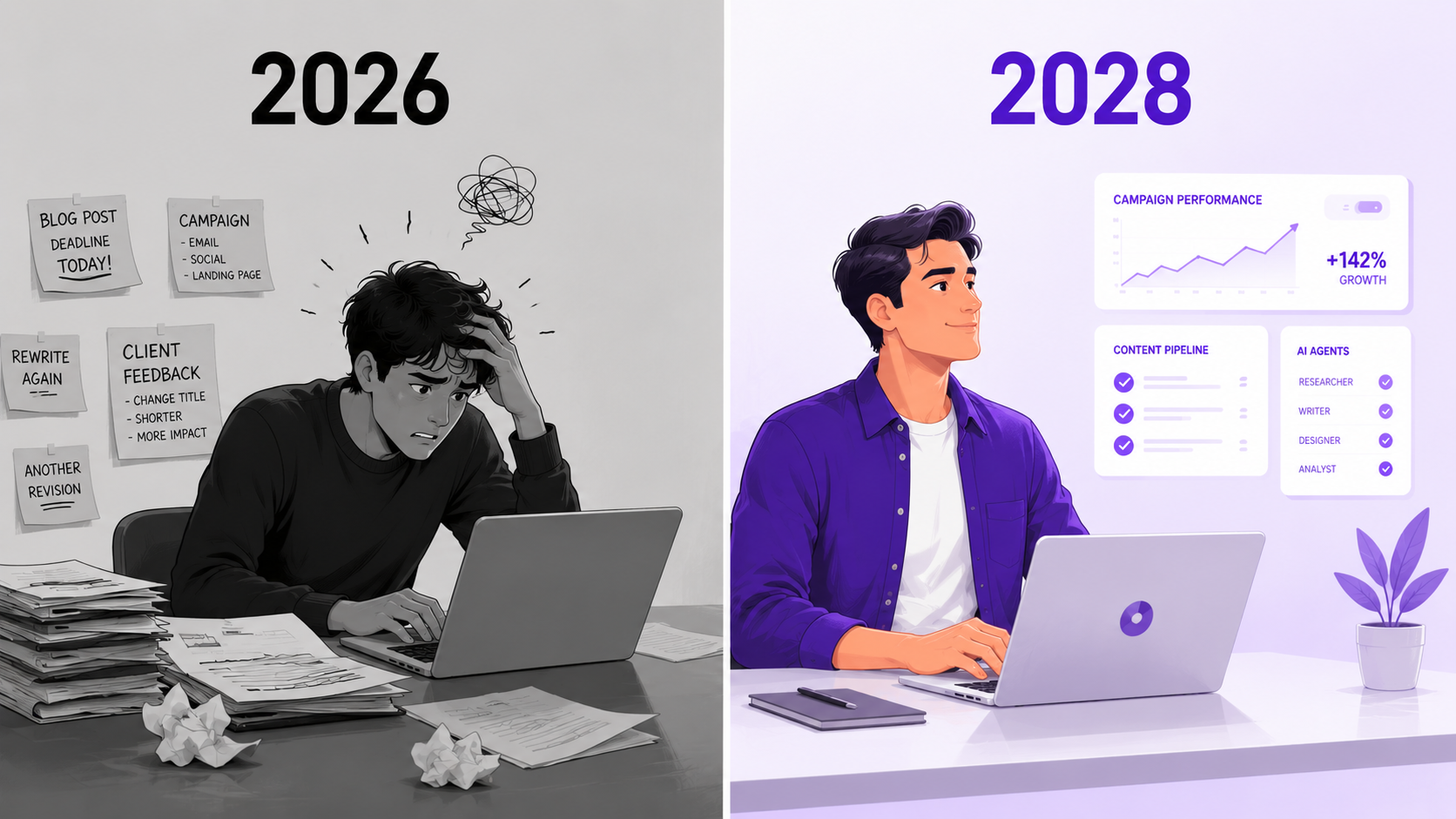
The marketer of 2026 would barely recognize the marketer of 2023. Same job title, same reporting line, maybe even the same LinkedIn headline. But the way the work actually gets done has been gutted and rebuilt from the studs up, and it's nowhere close to finished.
The skills that used to make a marketing career (channel expertise, campaign execution, the sheer ability to churn out content on deadline) are either automated already or standing in line for it.
A recent Anthropic report ranking 800 occupations by AI exposure put marketing specialists fifth, trailing only programmers, customer service reps, data entry workers, and medical transcriptionists. The same report puts a number on it: 65% of the tasks marketers do today are eventually replaceable with AI. Not "might be." Eventually will be.
Using AI well is the baseline skill of a marketer in 2026. It won't be the differentiator by 2028. Everyone will know how to use the tools by then.
The gap will open up somewhere else: in cultural judgment (does this actually land, or does it just look finished?), in accountability (who owns the call when the AI is wrong?), and in a kind of prompting that has nothing to do with "prompt engineering" and everything to do with knowing what result you actually want before you ask for it.
Less "write me a tweet," more "think like a marketer who's read this brand's last two years of customer complaints."
This blog walks you through what that shift demands: where marketing skill used to live, where it lives now, and where you need to plant your flag for the next three years.
What used to define a marketer, before AI ate the checklist
Pre-2023, marketing careers were built on production speed and channel fluency. You were valuable because you could write fast, execute a campaign across five channels without dropping a ball, and think on your feet when a launch went sideways at 4pm on a Friday. Being "good with words" was a career. Knowing the quirks of each ad platform was a moat. None of that required judgment about whether the work was good, it just required the work to exist, on time, at volume.
That world is closing. Volume and speed are now table stakes an AI clears without effort. HubSpot's 2026 data shows 80% of marketers already using AI for content creation and 75% for media production. The moat is gone.
Your upskilling path for the staying relevant as a marketer
This is where it gets actionable, not theoretical.
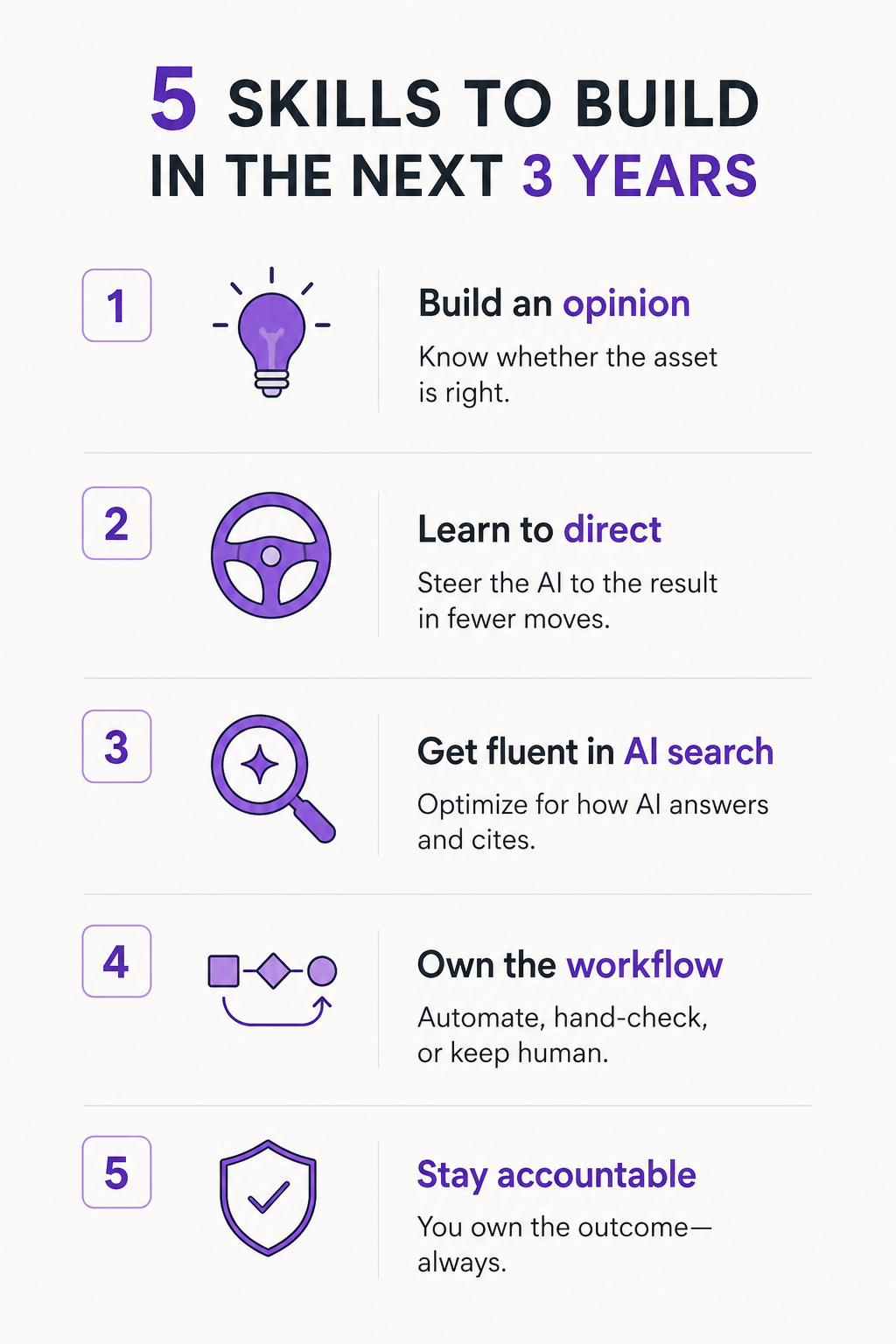
- Build an opinion, not just an output. If your only value-add is producing the asset, you're competing with a tool that produces it faster and cheaper. Your value is having a defensible point of view on whether the asset is right.
- Learn to direct, not just prompt. Anyone can type a request into a chat window. The skill is holding the end result in your head clearly enough to steer the AI toward it in two moves instead of twelve.
- Get fluent in AI search, not just Google search. AEO and GEO (optimizing for how AI engines answer questions and cite sources) are becoming as core as SEO once was. Gartner data shows marketing leaders expect AI-driven automation of marketing work to more than double, from 16% in 2026 to 36% by 2028, and that automation is increasingly happening inside AI search interfaces, not traditional SERPs.
- Own the workflow, not just the task. Knowing which parts of a campaign to automate, which to hand-check, and which to keep entirely human is now a strategic skill, not an ops footnote.
- Stay accountable for the miss. When AI gets tone wrong, brand voice wrong, or facts wrong, "the AI did it" isn't a defense anyone's buying. That accountability is exactly what makes you irreplaceable.
Working with AI without losing what makes you a marketer
This is where most marketers are underprepared. It's not about whether you can use AI, everyone can at this point. It's about whether you can spot when AI output is subtly wrong before it goes live.
Develop an editor's eye. Read AI-generated copy the way a skeptical creative director reads a junior's first draft: does the joke actually land for this audience, or does it just look like a joke? Does the slogan sound like something a real brand would say, or does it sound like fifty other slogans an LLM has already seen?
Learn to use AI to amplify, not replace, the thing that made your content distinct in the first place. That means feeding it your best instincts as inputs (your brand's actual voice samples, your actual customer objections, your actual wins and misses) instead of asking it to invent a voice from scratch.
Get serious about workflows. The marketers pulling ahead right now aren't the ones generating the most content. They're the ones who've mapped their entire campaign process, decided exactly which steps AI should own end to end, which need a human checkpoint, and which should never be automated at all. That's systems thinking, and it's rapidly becoming the actual job description.
Conclusion
Cultural judgment. Directive prompting. AEO/GEO fluency. Workflow ownership. Accountability for the output, not just authorship of the input. These aren't nice-to-haves for 2028, they're the actual job description forming in front of you right now.
AI tools will keep changing faster than any of us can keep up with solo. That's the whole reason Yarnit exists: not another AI tool you have to babysit, but a constantly evolving companion built for exactly this shift, one that gets your brand voice, handles the content grunt work, and leaves you free to do the part no model can, deciding what's actually worth saying.


