Beyond MQLs: Why B2B Lead Generation Needs a Reset
We will look at why the MQL broke, what buying groups and buying signals actually look like in your own data, what replaces the MQL as the unit you measure, and how to make the switch without blowing up the system your team runs on today.
Most B2B marketing teams are still graded on a number that stopped meaning much a long time ago: how many leads they handed to sales last month. The dashboards look healthy. Form fills are up, the nurture tracks are full, the MQL target gets hit. Then you sit in the pipeline review and hear the same thing you heard last quarter, that the leads were not ready, that sales could not get a meeting, that the deal was already decided by the time anyone picked up the phone.
That gap is a sign that the model itself is out of date. Forrester put a name to the shift at its B2B Summit, calling it the GTM singularity, and it listed marketing-qualified lead obsession alongside mass emailing, gated content and siloed teams as practices B2B firms need to drop. The reason is simple enough: buying moved, and lead generation did not move with it.
So this piece is about what to do instead. We will look at why the MQL broke, what buying groups and buying signals actually look like in your own data, what replaces the MQL as the unit you measure, and how to make the switch without blowing up the system your team runs on today.
Why the MQL Model Stopped Working
It helps to remember why the MQL was invented in the first place. It came out of a time when sellers controlled information. If you wanted the pricing, the architecture diagram or the case study, you filled in a form and a rep called you. A form fill genuinely told you something, because the only way to learn about a product was to raise your hand.
That has not been true for years. Buyers spend only about 17% of their total purchase time with any supplier, and when several vendors are in play, each one gets roughly 5% to 6%. Most of the decision happens in rooms you are not in.
The second problem is arithmetic. One person filling a form is one data point from a decision that involves many people. Gartner puts a complex purchase at six to ten decision makers, each arriving with four or five pieces of information they gathered themselves. Score that group one contact at a time and you get a stream of individually plausible leads that add up to no picture at all.
Third, volume targets quietly corrupt everything upstream. If the number you report is leads, you will buy list traffic, gate the content worth reading, and count a webinar registration from a student the same as a security review request from a head of engineering. Sales learns to ignore the queue. Marketing concludes sales cannot follow up. Both are right, and the model is what made them right.
Add AI to that and the capture points get weaker still. Buyers now run a large part of their research through assistants that summarise comparisons without ever visiting your pricing page.
Buying Groups and Real Signals Matter More
If the lead is the wrong unit, what is the right one? Two things, and they work together: the group that makes the decision, and the pattern of behaviour that group throws off while it decides.
Start with the group. Somewhere between 60% and 90% of purchases are made by three or more people acting together, and groups of five to seven are common. Those people are not interchangeable. A champion is building the business case, an economic buyer is deciding whether this beats the other three things on the budget list, a technical evaluator is hunting for reasons to say no, and procurement, legal or security sit at the end holding a veto nobody put on your persona slide.
One of them downloading a guide tells you very little. Four of them from the same account touching pricing, security documentation and a competitor comparison inside two weeks tells you a lot. That is the whole shift in one sentence: a single engaged contact is noise, coordinated activity across roles is signal.
The timing makes this urgent rather than academic. 6sense's annual buyer experience research found buyers are close to 70% of the way through their process before they engage a seller, they start the conversation more than 80% of the time, and 81% already have a preferred vendor when that first contact happens. By the time your form fires, the shortlist is usually written.
So you have to read the group before it identifies itself. The signals fall into two buckets. First-party ones live in systems you already own: several people from one domain on high-intent pages, a cluster of content engagement across job titles, three registrations for the same webinar, a sudden spike in documentation traffic, a dormant account that starts reading again. Third-party ones come from outside: intent data, technology changes, hiring for roles that imply your category, funding, a competitor renewal coming up.
None of these is proof on its own. Read as a pattern over weeks rather than as isolated events, they are a far better predictor than any score you can put on one contact. And buyers have not disappeared entirely into AI research either. 69% still want a sales rep to validate what AI has told them, which is the opening you are trying to spot early.
What replaces the MQL
Four things change when you make the switch.
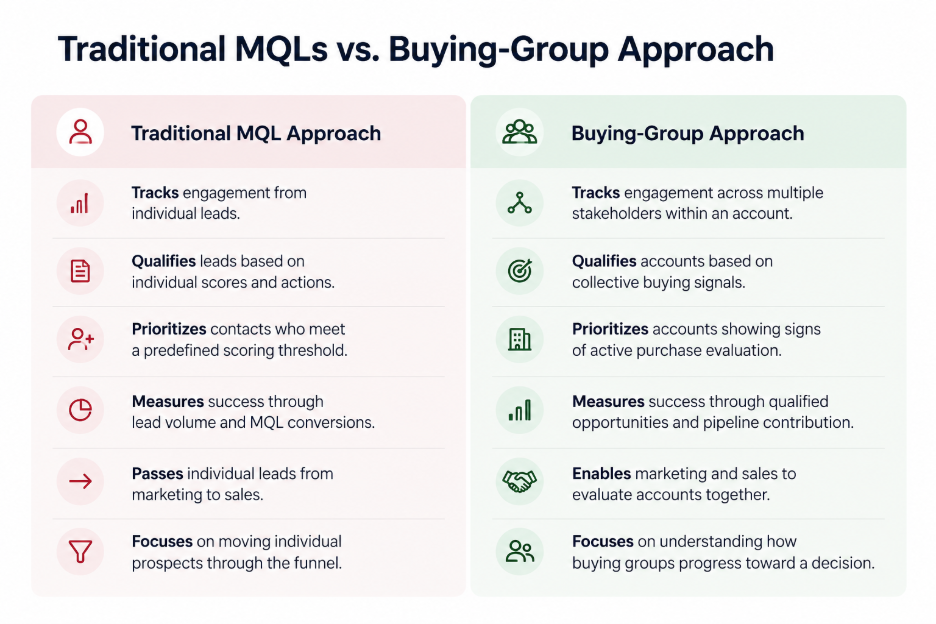
The unit of qualification. You qualify an account with a coalescing group, not a contact with a score above 80. One person is a member of something, not a thing in itself.
The trigger for sales. Engagement fires on group-level patterns, multiple roles active in a window, rather than on any individual crossing a threshold.
The shared metric. Marketing, sales and customer success report on qualified opportunities, buying group coverage, conversion and velocity, not on lead counts that only one team believes in.
The job of marketing. Less demand capture at the end, more preference building early, because preference is usually formed before anyone is willing to be captured.
Side by side, the difference looks like this.
How to make the switch without breaking what works
Audit what your volume bias is costing you. Pull the last four quarters. For every closed-won deal, count how many people from that account engaged before the opportunity was created, and check how many of them your system ever scored. Then do the same for MQLs that went nowhere. Most teams find two uncomfortable things: the deals that closed had three or more people active early, and a large share of scored leads came from accounts that never bought anything. That one analysis does more to win the internal argument than any framework slide.
Map the buying group for your ICP. For your top segment, write down the roles that show up, who typically starts the process, who can kill it, what each one needs to see, and the objection each one raises. Five roles is usually enough to start. If sales cannot agree on this list, that disagreement is itself the finding.
Fix the data layer before buying anything new. Group-level reading needs three things to work: contacts reliably tied to accounts, website and content engagement resolved to companies rather than cookies, and some view of activity happening off your properties. Plenty of teams already have two of the three sitting unused inside their CRM and automation platform. Check that before signing an intent data contract, because intent data poured into messy account records just produces confident noise.
Redesign routing around the pattern, not the person. Define what a group signal means in your business. Something like: three or more contacts from one target account, across at least two functions, engaging high-intent content inside fourteen days. When that fires, sales gets the whole picture, who engaged, what they read, in what order, rather than one name and a score.
Change the scorecard at the same time. This is where most transitions quietly die. If marketing is still carried on MQL volume in the quarterly review, the old behaviour comes back inside a month. Replace it with qualified opportunities created, buying group coverage on target accounts, opportunity conversion and deal velocity, and get sales to agree to the definitions in writing before you launch.
Pilot it on one segment. Take your highest-value segment or fifty named accounts, run the new motion for a quarter alongside business as usual, and compare conversion and cycle length. A pilot gives you evidence instead of an opinion, and it gives sceptical reps a version they can poke holes in before it becomes the standard.
Where to start this week
Optimising MQL volume in 2026 is optimising a model that no longer matches how anything gets bought. Buyers show up late, in groups, with a shortlist already written, and the form fill arrives at the end of a process you mostly did not see. You can run that machine harder, or you can change what it measures.
Start small and start with evidence. Pull your last four quarters of closed-won deals and count how many people from each account engaged before the opportunity existed. Then check how many of those people your lead scoring ever noticed. If the answer is one or two out of five, you have both your problem and your business case in the same spreadsheet.
From there, pick one segment, map its buying group, agree a group-level trigger with sales, and run it for a quarter. That is a small enough bet to make without permission and a big enough one to learn from.
If you are working through this inside your own team, reply and tell me where it is getting stuck. The next pieces in this series go into the two problems that come up most: how AI is changing product discovery before anyone talks to you, and how marketing, sales and customer success share one view of the account without three systems of record.
See exactly why your Product Detail Page isn't converting
Thank you! Your submission has been received!
Oops! Something went wrong while submitting the form.




.avif)
%20(1).png)