Explore how AI influences B2B buying decisions, why third-party reviews and earned media matter, and what marketing and sales teams can do to improve visibility and influence purchase decisions.
For most of B2B history, finding a vendor was a social act. You called someone from your last company and asked what they used. You flew to Dreamforce or SaaStr, walked the expo floor with a lanyard and a tote bag, and came home with a stack of business cards and a rough sense of who deserved a meeting. An analyst quadrant settled the internal arguments. The rep you'd shared a few conference dinners with got the first call, and usually the deal.
Relationships did the filtering. If you didn't know someone who knew someone, you probably weren't on the list.
That system still exists, but it has a lot of company now. Buyers get their read on the market from a dozen newsletters that land before 9 a.m. They follow a handful of LinkedIn operators whose teardown posts shape opinion faster than any keynote. They lurk in Slack communities and Reddit threads where practitioners say things about vendors nobody would say on a reference call.
And then they open ChatGPT.
The personal network that used to decide B2B deals now shares the job with a sprawl of channels vendors can barely see. AI sits at the center of it.
The first search now happens in a chat window
Half of B2B software buyers now start their research in an AI chatbot more often than in Google, according to G2's Answer Economy report, based on a March 2026 survey of 1,076 buyers. A year earlier, that figure was 29%. Seventy-one percent use AI chatbots somewhere in their research.
Forrester's State of Business Buying, 2026 arrives at the same place from a different direction. When Forrester first added generative AI as a research option in 2024, it immediately ranked among the most used tools. By the 2025 survey, it was the single most cited meaningful interaction type for researching purchases, per Digital Commerce 360's coverage.
The exact share of buyers using AI depends on who's counting. Gartner puts it at 45%. TrustRadius says 63%. 6sense reports LLM use at 94%. Most of that gap comes down to definitions, since asking a chatbot to summarize one vendor page and running an entire shortlist through it both count as using AI. The direction is identical in every dataset, and the slope is steep.
What buyers actually ask
The most common use is comparison. In G2's data, 41% of buyers named comparing vendor strengths and weaknesses as their top use for AI chatbots, ahead of basic product research and vendor identification (Demand Gen Report). The same share use Deep Research tools to run structured software evaluations.
A typical research session moves through four kinds of prompts:
Framing the category. "What should I look for in a contract management tool for a 50-person legal team?"
Building a shortlist. "Which platforms fit that, and which do companies our size use most?"
Comparing. "How does X compare to Y on implementation time and pricing?"
Pressure-testing claims. "Is X's 90-day ROI claim credible? What do users complain about?"
The fourth deserves the most attention. Buyers ask AI the awkward questions they would never put to a sales rep, as Digital Astronauts points out: what the downsides are, whether a product is genuinely different, what breaks after six months. Those questions already surface in your sales calls and support tickets, which makes customer conversations a better content brief than any positioning doc.
Google hasn't vanished from the process. In the Omniscient and Wynter study of 100 B2B decision-makers, only 11 used an LLM as their very first step. A more common pattern was Google to get oriented, then an LLM to organize and compare. AI has become the place where a messy search turns into a structured decision.
AI builds the shortlist. Humans defend it.
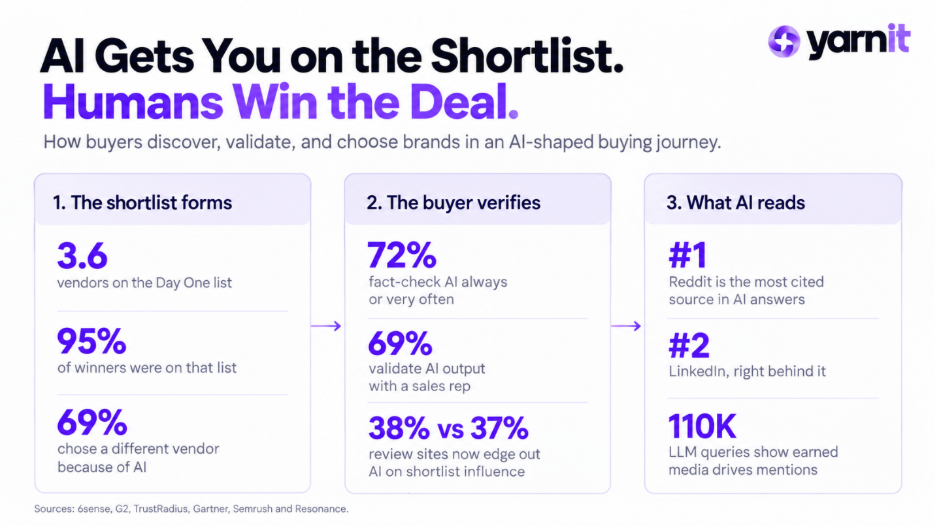
The shortlist now forms before sales knows a deal exists. Across roughly 4,000 buyers in 6sense's research, the Day One shortlist averaged 3.6 vendors, and the winner came from it 95% of the time (Omnibound). AI is reshuffling those lists as they form: 69% of buyers in G2's survey said a chatbot steered them to a vendor they hadn't expected.
Then the checking starts. Sixty-four percent of buyers run into AI hallucinations often or very often (Foundation), and the share who fact-check AI answers always or very often rose from 58% to 72% in a year (TrustRadius). Gartner found 69% prefer to validate AI output with a sales rep. By July, review sites (38%) had edged past AI chatbots (37%) as the top shortlist influence in G2's own follow-up.
Both the shortlist and the checking draw on sources vendors don't control. Semrush data ranks Reddit as the most cited source in AI answers, with LinkedIn second, and Resonance's study of 110,000 LLM queries found earned media decides which brands get recommended. Detailed peer reviews pull double duty, since specific, verifiable reviews are exactly what models cite. The principle holds across all of it: what AI trusts matters more than where your buyers hang out.
What B2B teams should do about it
Audit your shortlist presence. Run the prompts your buyers actually type, including "X vs. Y" and "downsides of X," across ChatGPT, Gemini, and Perplexity. Note who appears beside you and which sources get cited. Here's how to track AI visibility across engines.
Invest where AI reads. Reviews, earned media, and practitioners on LinkedIn and Reddit shape the answer more than your homepage. Paid media can help AI learn about your brand when it produces citable coverage. Keep your own site for verification: pricing logic, integrations, security, implementation timelines.
Turn sales into validators. Drop the "tell me about your challenges" opener. Ask what the buyer has already researched and what they still doubt, then arm the champion for the internal debate.
Measure what you can't see. Add AI assistants to "how did you hear about us," segment AI referral traffic, and watch direct and branded traffic. AI visitors are few but convert well: 0.5% of Ahrefs' visits drove 12.1% of its signups (Ahrefs).
Most of these figures come from companies that sell into this trend, so hold the exact percentages loosely. Forrester and Gartner point the same direction. Buyers now meet your brand through a summary someone else wrote, then come to you to test it. Make sure your story survives the test.
See exactly why your Product Detail Page isn't converting
Thank you! Your submission has been received!
Oops! Something went wrong while submitting the form.


%20(1).png)

.avif)