A homeowner calls a roofer and says: "There's a brown ring on my ceiling and it's getting bigger, and I don't know if that's the roof or a pipe."
Open a keyword tool and you get "roof leak repair Mumbai." Both describe the same person. Only one of them tells you what to write.
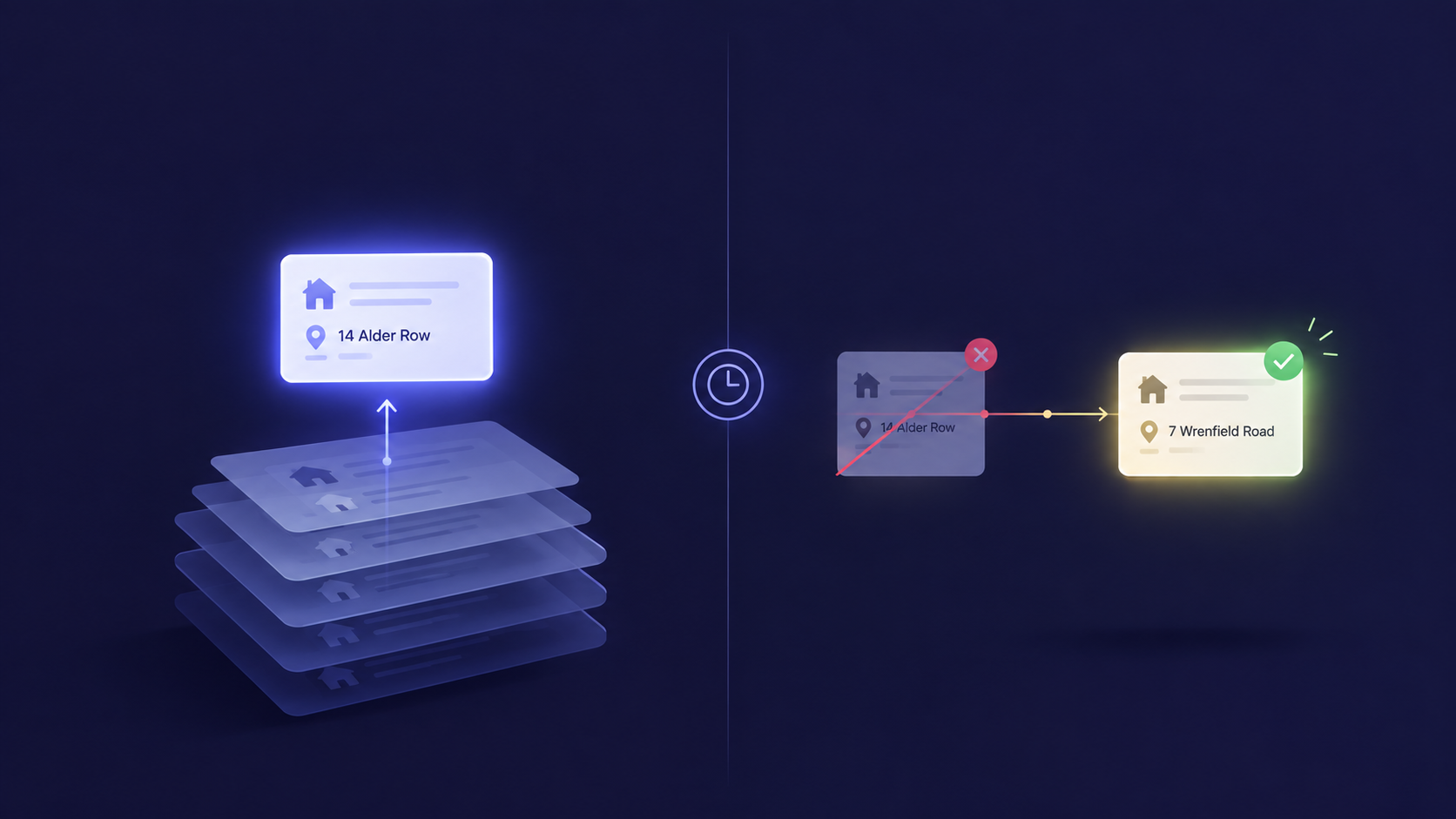
Search volume is an estimate built from Google's ad data and clickstream panels. That's why the same keyword often shows different numbers in Ahrefs, Semrush, and Moz and why those estimates become less reliable for long-tail queries. Ironically, those specific, high-intent queries are often the ones that matter most.Keyword tools give you a clean, standardized vocabulary, but they miss the context and intent behind why people ask a question.
And that's where customer conversations and queries change the game. People no longer search in four-word queries. The average ChatGPT prompt is around 23 words, compared to roughly four words on Google. AI assistants then break those prompts into multiple sub-queries behind the scenes.
The good news is you already have thousands of those conversations. They're sitting in your sales calls, demo, reviews and AEO queries. It is time turning them into a repeatable content strategy.
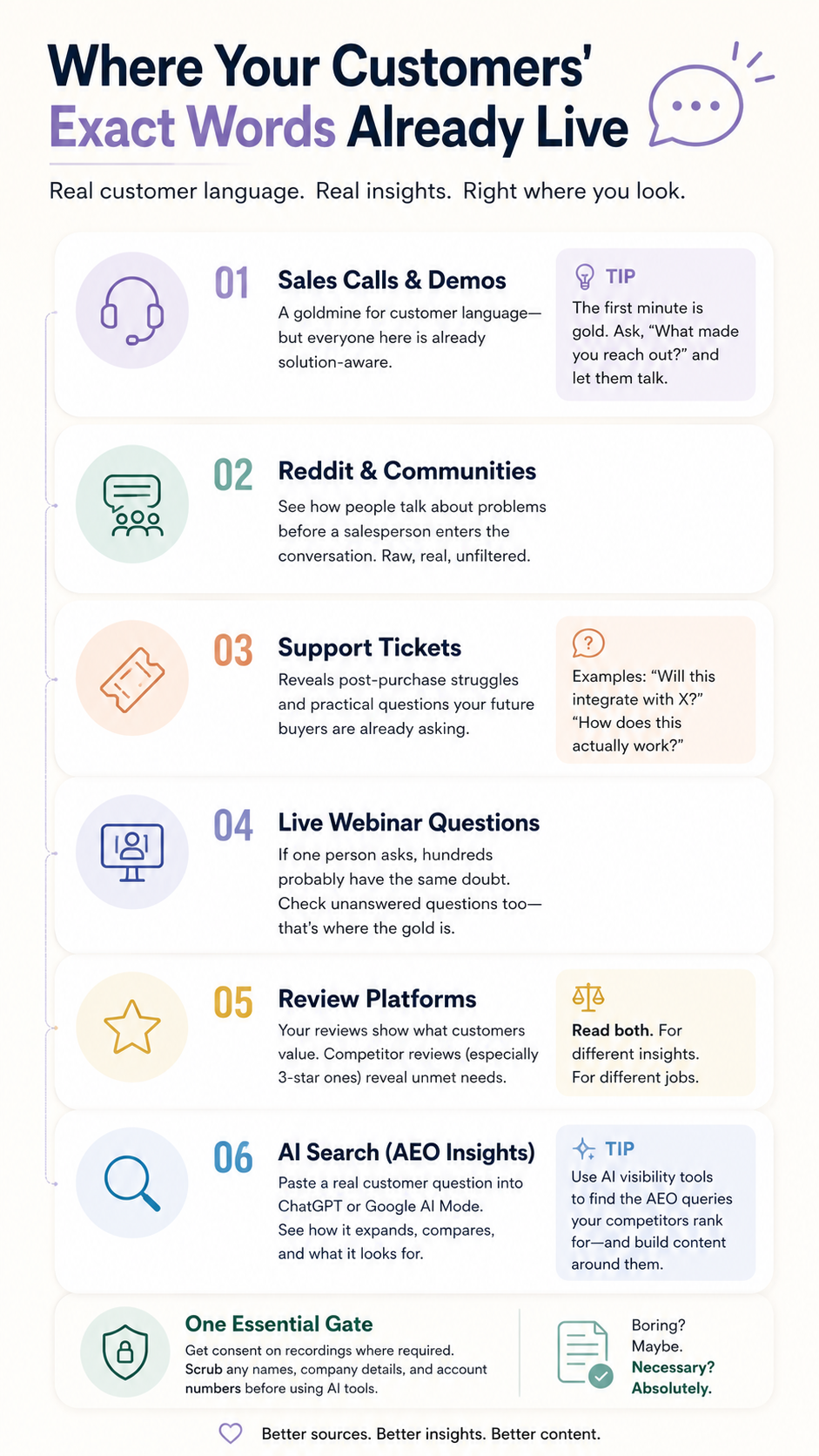
Where your customers' exact words already live
Every source is useful. Every source is also lying to you a little. Knowing how is the difference between a content library and a pile of blog posts.
Sales calls and demos are a goldmine for customer language. But everyone on those calls has already found you, they're solution-aware. If this is your only source, you'll create excellent bottom-of-funnel content while missing the questions people ask before they even know your product exists.
Tip: The most valuable part of any sales call is the first minute. Ask, "What made you reach out?" and let them talk. That's when they're describing the problem in their own words. Once the conversation moves on, they're often repeating your sales team's language instead of their own.
Reddit and online communities show you how people talk about problems before a salesperson enters the conversation. The discussions can be raw, opinionated, and technical, but they're incredibly useful for understanding genuine customer language.
Support tickets reveal what customers struggle with after they buy. While they're less useful for attracting new users, they're perfect for answering practical questions like, "Will this integrate with X?" or "How does this actually work?" questions future buyers are already asking.
Live webinar questions are one of the most overlooked sources. If someone is willing to ask a question in front of hundreds of people, chances are many others have the same doubt. The best insights are often the ones the host never had time to address.
Review platforms tell two different stories. Your reviews reveal the benefits customers genuinely value, which aren't always the ones your marketing emphasizes. Competitor reviews are even more interesting. They're written by people who wanted the product to work but found something missing. That's where unmet needs become obvious.
AI search itself is another source most teams ignore. Take an actual customer question and paste it into ChatGPT or Google AI Mode. Watch what follow-up questions it generates, what comparisons it makes, and what evidence it looks for. You'll get a real-time view of how a single question expands into an entire research journey.
Tip: Use AI visibility tools that tell you the AEO queries for which your competitors are ranking for and then you can build your content around this!
How to pull keywords out of a sales conversation
In the mid-90s Bob Moesta and Clayton Christensen built Jobs-to-be-Done on a single idea: nobody buys a product, they hire one to make progress. You find out what for by asking about a switch someone actually made. Moesta has since run it across 3,500-odd products, and found ten good interviews reveal three to five patterns covering 90% of a market.
Two things from it are worth stealing.
The first is what to ignore. Roughly 80% of what someone says is noise. The useful 20% is wherever they describe effort, a struggle, a workaround, the thing they did twice because it didn't take. No friction in the sentence, skip it. You're not reading transcripts. You're scanning for effort.
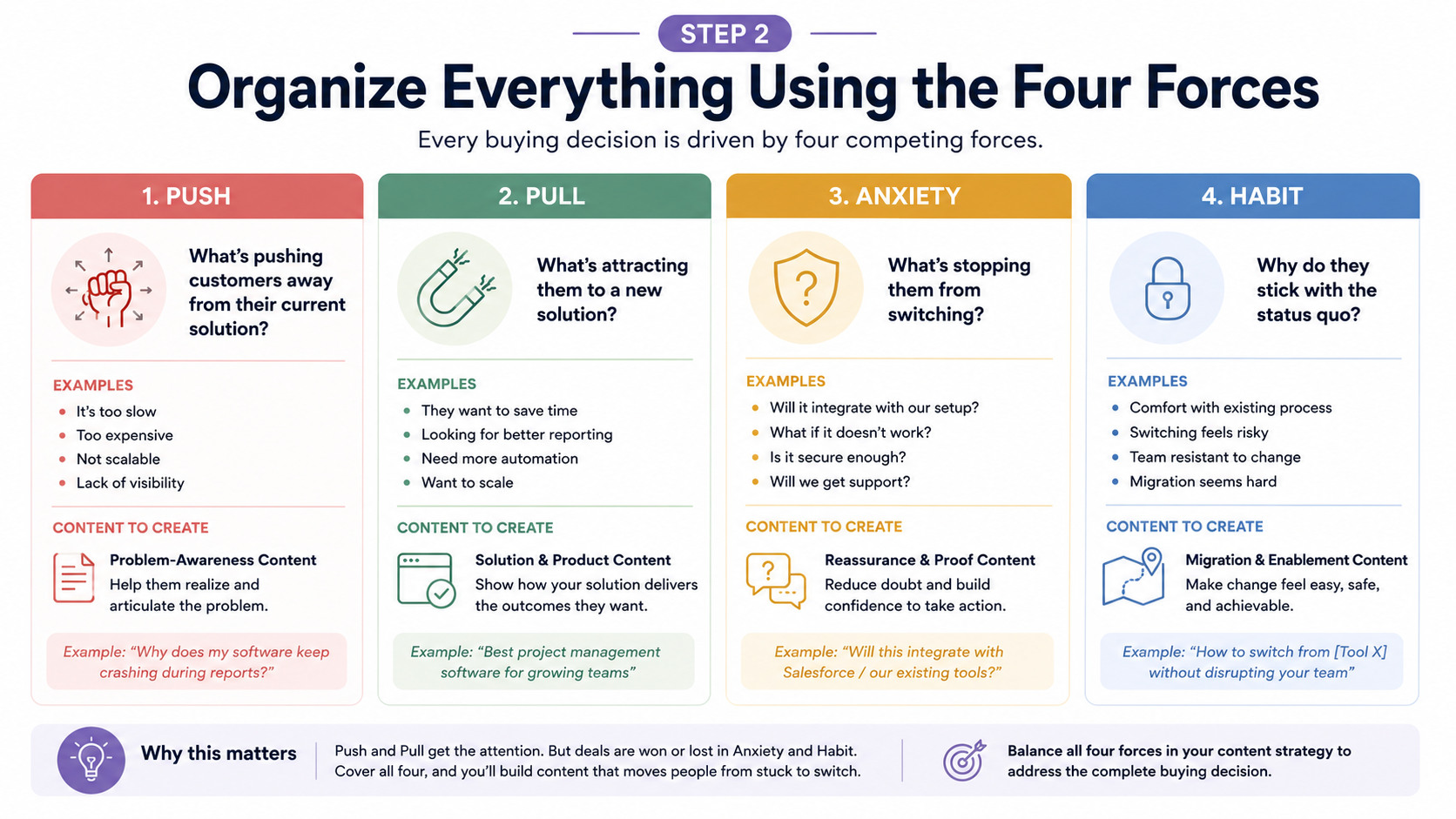
The second is the four forces. Every switch is a tug-of-war between push, pull, anxiety and habit: the problem shoving them out, the appeal of the new thing, the fear it won't work, and the gravity of what they already do. Push and pull have to beat anxiety and habit or nobody moves.
Now look at your content calendar. It's all pull. "Best project management software." "Top 10 CRMs." "Why choose us?" There's a reason for that. Pull is the only force with search volume. Nobody searches for their anxieties. Nobody types "I'm worried this'll make me look stupid if it fails" but that's why your last five deals stalled.
So sort what you hear into all four. Push is problem-aware content: why does my microwave bang when it starts. Pull is the money pages you already have. Anxiety is the comparisons and the will-this-work-with-our-setup posts, the force everyone underestimates, because you can't feature your way past it. Habit is the migration guides nobody writes.
Then three filters, or the transcripts will drown you.
Twenty to thirty calls before you conclude anything. Any fewer and one memorable customer quietly becomes your content strategy.
Keep the specifics. "It keeps breaking" is nothing. "It breaks every time we run the Monday export" is a page. The detail nobody would think to invent is what makes a reader recognise themselves, and the only thing a retrieval system has to grab hold of.
Write down what winning looks like, not just what's broken. Everyone records the pain and forgets to record the picture. When eight people independently say they want to "get their Fridays back," they've just handed you your positioning line.
How to use customer insights in your marketing assets
The obvious assets first. Phrases go into headlines, service descriptions and meta titles. "My microwave is making a banging noise" is a brilliant H2 and a dreadful service page title. Recurring questions and objections each become a post, clustered as FAQ schema. In your ads, the phrase goes in the copy and again on the landing page behind it. For local SEO, people say "best roofer in Mumbai," not "roofing contractor Mumbai," so that's what goes on your Google Business Profile posts and local pages.
But there's a newer payoff almost nobody has joined up yet.
Princeton researchers ran the first proper academic test of what makes AI answers cite a page. Adding quotations lifted visibility by 30–40%. Statistics and cited sources did roughly the same. Keyword stuffing did nothing at all.
So the highest-leverage thing you can put on a page is quotable, first-hand material. Everyone who read that study went hunting for experts to quote. You have something better sitting in a folder: your customer, describing your customer's problem, in their own words. "One property manager told us her team had rebuilt the same spreadsheet four times in a year" is a sentence your competitor cannot write, because they weren't on the call. It's original data, and original data is what AI platforms lean on hardest.
The shape of the page matters too, though not the way most people assume. Ahrefs checked 174,048 pages and found almost no relationship between word count and getting cited. Length isn't the signal. AI pulls passages, not whole pages, so what wins is a self-contained answer sitting under a heading that matches the question. Which is exactly what you end up with when your H2s are questions customers actually asked.
Finally, decide how you'll know it worked. You can't rank-track a phrase with no volume, so use Search Console impressions at 30 to 60 days instead: it either surfaces or it doesn't. Add "what made you get in touch?" to your forms. And listen for the best signal of the lot, a prospect quoting your own page back to your rep.
Conclusion
For years, keyword research has been about estimating demand. AI search changes the question entirely. Instead of asking, "What are people searching for?" the better question is, "How do people describe the problem before they know the solution?"
Those answers rarely come from keyword tools. They come from sales calls, support tickets, webinar chats, reviews, Reddit threads, and conversations your business is already having every day.
The companies that win in AI search will publish the content that sounds most like their customers. So before opening Ahrefs or Semrush for your next content brief, spend an hour listening to a few customer conversations. Look for the struggle, the objections, the workarounds, and the outcomes people actually want.
Because the best keyword research in 2026 is already sitting in your conversations.
See exactly why your Product Detail Page isn't converting
Thank you! Your submission has been received!
Oops! Something went wrong while submitting the form.
Frequently Asked Questions
1. Why are customer conversations more valuable than keyword research?
Customer conversations reveal the language, context, and intent behind a search. They help you create content that answers real questions instead of just targeting keywords.
2. What are the best sources of customer insights for content?
Sales calls, support tickets, product reviews, webinar Q&As, Reddit discussions, and AI search queries all reveal valuable customer questions and pain points.
3. How can I turn customer conversations into content ideas?
Look for recurring problems, objections, desired outcomes, and comparisons. Each pattern can become a blog, FAQ, landing page, or case study.
4. How do customer insights improve AI search visibility?
Content built around authentic customer questions is easier for AI search engines to understand, retrieve, and cite in generated responses.




.avif)

%20(1).png)