




Every marketing team has a slide called "Where Are Our Buyers." It has personas, channels, a funnel with an unnecessary number of arrows. It has answers.
Ask the same team where AI trusts your brand, and you get silence, followed by a Slack message that says "let me get back to you on that."
That silence is not a knowledge gap you can Google your way out of. AI visibility is genuinely young as a discipline, maybe eighteen months old in any serious, structured form, while SEO has had two decades to calcify into checklists, playbooks, and an entire cottage industry of people arguing about backlinks. There is no equivalent muscle memory yet for how AI assistants decide who to recommend.
Here is what we do know, building on the last two pieces in this series on press releases and review sites. AI systems favor high domain authority sources, and they triangulate answers across multiple independent references rather than trusting any single one. What nobody has fully cracked is how to make all of that add up to something that actually reflects your brand's narrative, instead of a scattered pile of mentions that happen to include your name.
That is the shift worth making. Stop treating content as a list of assets, and start treating it as a trust-based content system, one where every piece is evaluated by how much trust it deposits into the AI's model of your brand, not by clicks or shares.
What We Mean by "Trust-Based"
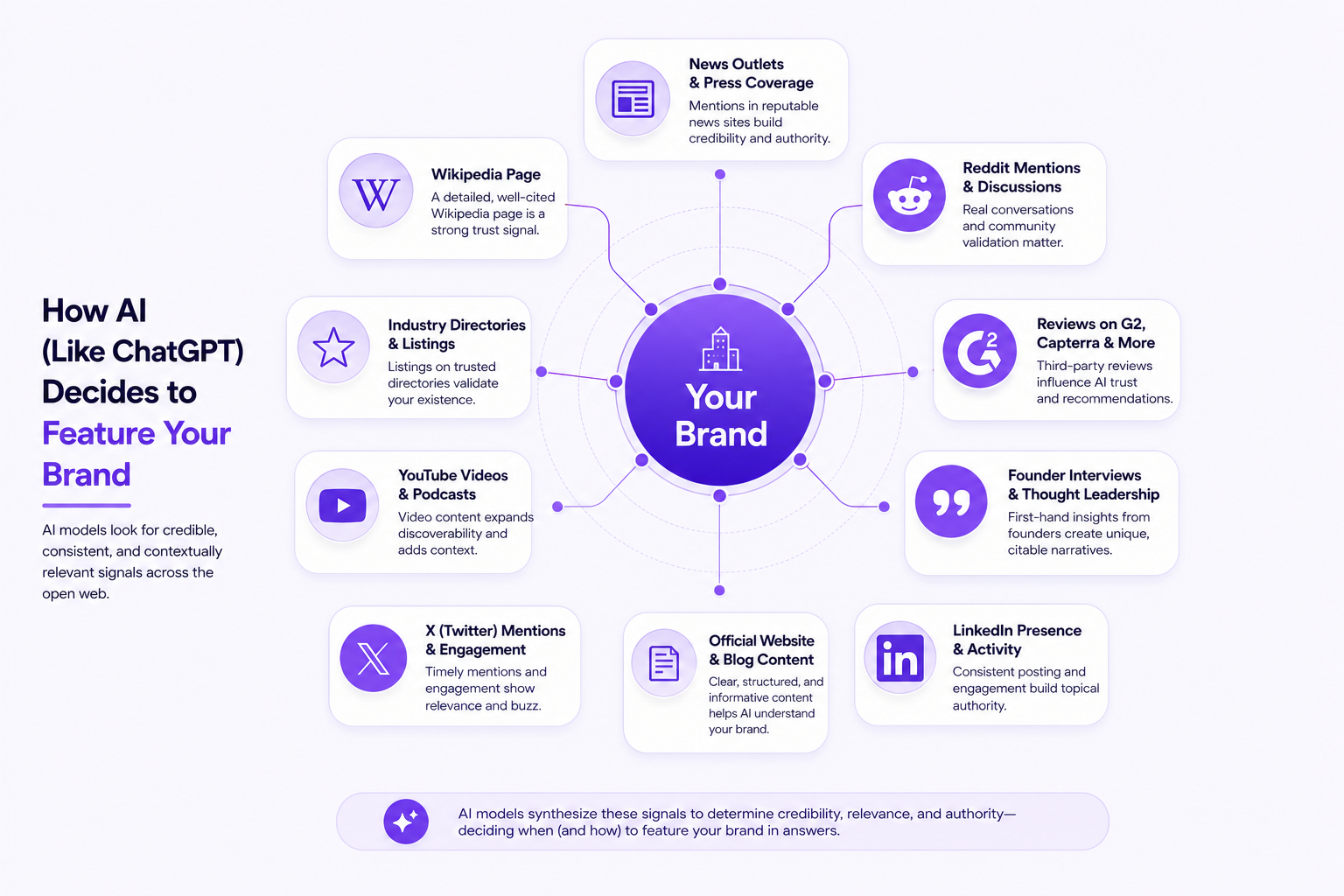
We have covered before how AI assistants actually decide to surface a brand. Short version for anyone joining mid-series: picture your brand as a node in a web, not a listing in a directory. The more credible nodes it connects to, the more an AI model trusts it, and the more likely it gets recommended when a matching query comes up. Call it a graph of trust, built one credible mention at a time.
Building that graph means showing up, consistently and independently, on the specific sources AI models keep pulling from when constructing answers, and that list has been moving. Reddit had its moment as the internet's favorite AI training snack. The gravity is now shifting toward Wikipedia and review platforms like G2 and Capterra, largely because these sources are dense with user-generated content that describes your brand in language nobody paid for.
Here is the part worth sitting with: none of these are places you write your way onto. You earn presence there, over time, across many independent voices. Once you are present across enough of them saying roughly the same true things, you have built a web of corroboration. That is what "trust-based" actually means in practice: architecting toward corroboration, not just visibility.
Making Your Language AI-Legible
Showing up across these sources is only half the job. The other half is phrasing things the way retrieval systems actually want them phrased. Recent research on generative engine optimization backs this with real numbers: content built around concrete statistics sees a meaningful lift in pickup, and content carrying quotable, well-attributed claims performs even better. AI systems also favor short, self-contained paragraphs and content that states its answer early, since they are frequently breaking one big question into several smaller ones and searching for each separately.
Here is how that plays out across five mediums that make up most brand PR:
- News stories: Lead with the fact, not the framing. "Company X raised $12M to build Y" outperforms three paragraphs of scene-setting before the number shows up, because models extract heavily from the opening lines and rarely reward a slow build.
- Founder features: Write quotes as complete, standalone claims. A founder saying "we built this because enterprise tools weren't solving X" is far more extractable than a rambling anecdote a model has to summarize before it can use it.
- Reviews on high-DA platforms: Specificity beats sentiment. "Cut onboarding time from six weeks to nine days" gets cited over "great tool, highly recommend," because models are pulling facts, not vibes.
- Creator placements: Direct comparisons and explicit pros-and-cons framing translate cleanly into AI answers. Vague enthusiasm, however genuine, tends to get dropped entirely.
- Comparison and roundup content: Structure does the heaviest lifting here. Tables, numbered lists, and head-to-head framing get lifted almost intact into synthesized answers, because the model does not have to do any interpretive work to use them.
The common thread across all five: write like you already know a model is going to lift one sentence out of context and reuse it. Because that is exactly what happens.
Recap, and What to Actually Do
A trust-based content system comes down to three shifts. First, stop scoring content by reach and start scoring it by which node it strengthens: press, reviews, Wikipedia presence, creator mentions. Second, deliberately build toward the sources AI models are visibly favoring right now, not the ones that mattered five years ago. Third, write every asset, from a press release to a reply on a G2 review, as though a model will extract one sentence with zero surrounding context. Because that is precisely what is about to happen.
The brands winning AI visibility right now are the most corroborated, not the loudest. Start building the web before a competitor's brand fills in the nodes next to yours.


