



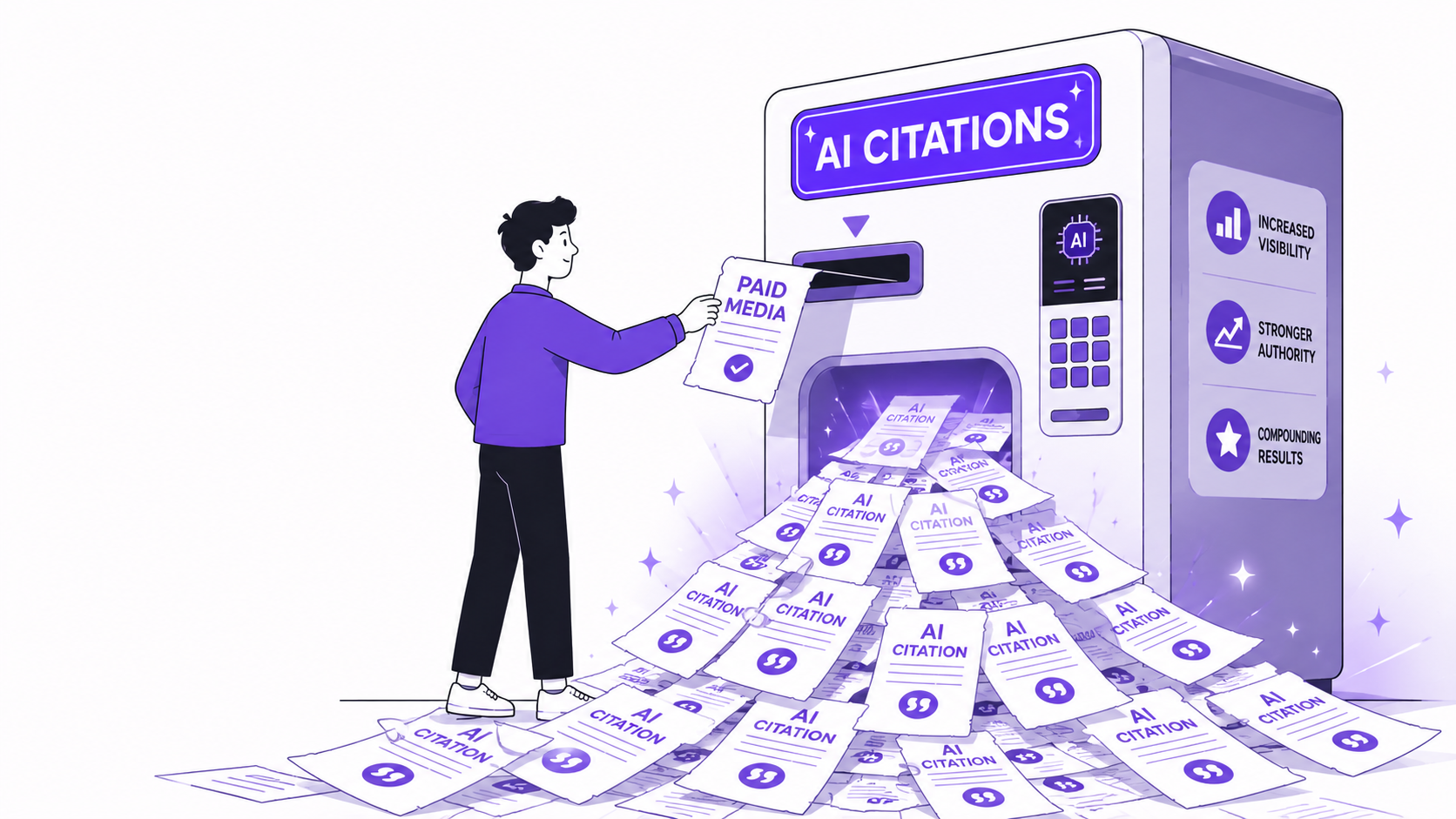
Every marketer has had this daydream: an ad channel that keeps working after the campaign ends. No fresh budget every month. No bidding war that resets to zero the day the flight closes. Something like organic search. That compounding, keeps-paying-you-back kind of visibility, minus the part where you spend eighteen months building a content library, minus the SEO audits, minus the part where you wait, and wait, and wait for Google to notice you exist.
That channel exists. It has existed the whole time. It's called paid media, and in 2026, it has a second job.
To be clear, paid media is not a silver bullet. It won't fix a bad product, and it won't replace a real SEO or content strategy. But a well-placed press mention, a product review on a platform buyers actually trust, or a founder interview that gets picked up and syndicated does something a performance ad simply cannot: it keeps working long after you've stopped paying for it. It builds SEO authority. It compounds web visibility. And it directly feeds AI visibility, which is quickly becoming the difference between being recommended and being invisible.
Here's why that last point matters more than it did even a year ago. AI assistants don't have opinions. They have citations. When someone asks an LLM to recommend a tool, a vendor, or a service, the model is stitching together a web of sources it trusts, including sources like review sites, news coverage, forums, and third-party mentions, to construct an answer.
If your brand isn't part of that web, you don't get a bad answer. You get no answer. You simply don't exist in the conversation. Earned and paid-for-media is how you get woven into that web in the first place.
The Media You Can Actually Buy (And What It Buys You in AI Visibility)
Let's break it down.
"Paid media" in this context isn't a Google Ads budget. It's money spent to earn the kind of third-party validation that AI models and buyers both treat as trustworthy. Here's the current menu.
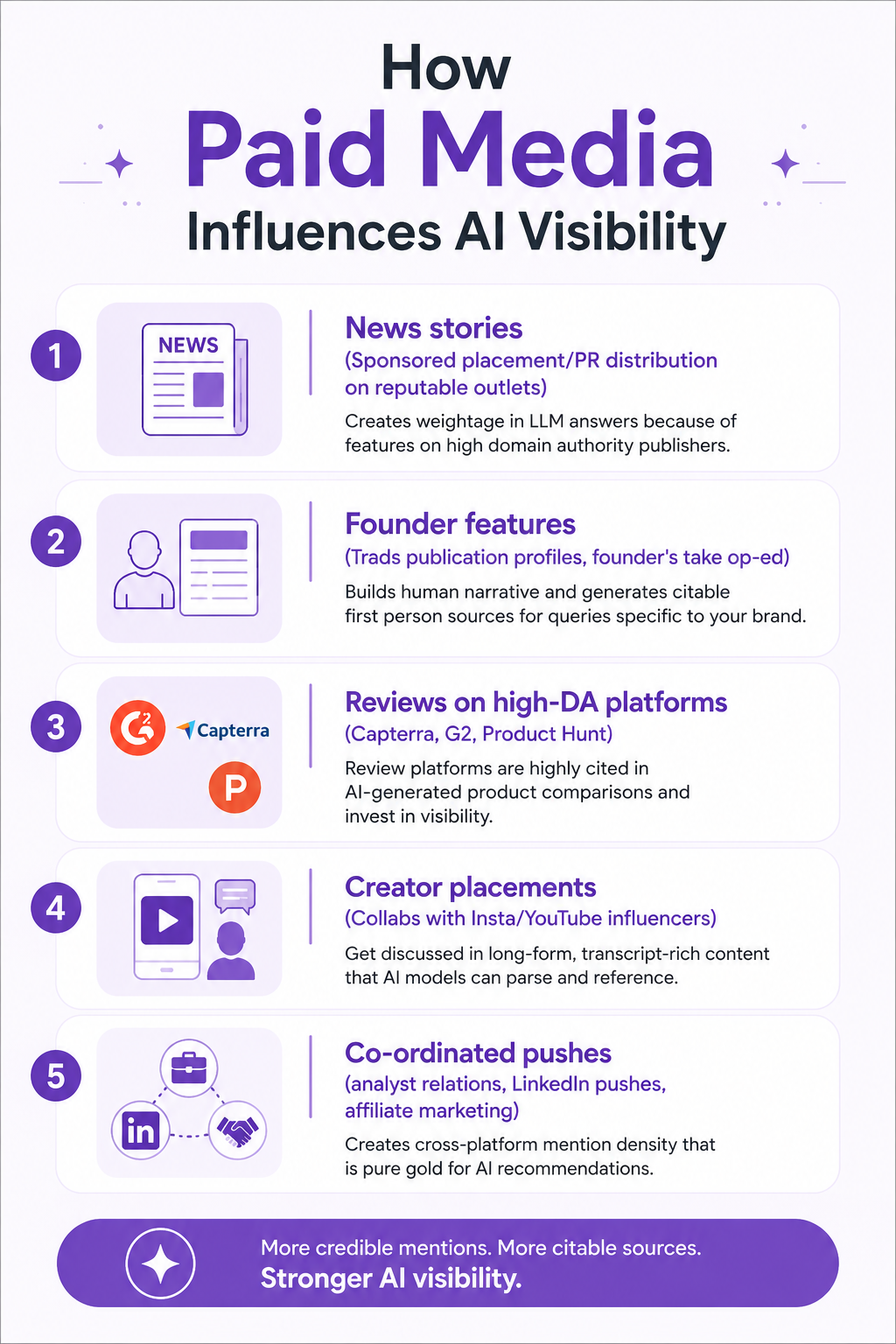
1. The news story. A sponsored placement or paid press release distribution on a reputable outlet. This is the fastest way to get your brand name sitting next to real journalism, indexed on a domain Google and every LLM crawler already trusts. For AI visibility, this is foundational: models weigh high-authority publishers heavily when constructing answers about "who's doing what" in a category.
2. The founder feature or interview. A trade publication profile, a podcast guest slot, a "founder's take" op-ed. This does double duty, it builds a human narrative around your brand (which AI models increasingly use to answer "who's behind this" and "is this legitimate" questions) and it generates a fresh, citable, first-person source that's harder to fake and easier to trust than a landing page.
3. Paid reviews on G2, Capterra, and Product Hunt. Yes, you can and should pay to be featured, badged, or boosted on these platforms: not to fake reviews, but to invest in visibility on the review infrastructure that both buyers and AI models treat as ground truth. Review platforms are some of the most heavily cited sources in AI-generated product comparisons. Being absent here is the fastest way to lose a recommendation you never even knew you were up for.
4. Influencer and creator placements. Buying a dedicated segment or full video with a credible YouTube creator in your category. This translates into getting discussed in long-form, transcript-rich content that AI models can actually parse and reference, unlike a 15-second Reel.
5. Coordinated affiliate, analyst, and LinkedIn pushes. A synchronized push, including affiliate write-ups, analyst commentary, and a wave of LinkedIn posts around a launch or milestone creates the kind of cross-platform mention density that signals relevance to both search engines and AI models. One mention is a data point. Ten mentions across different domains in the same week is a pattern, and patterns are what get cited.
The common thread: AI assistants don't trust brands. They trust networks of other trusted sources talking about brands. Every one of these plays is, functionally, a deposit into that network.
Building a Paid Media Strategy That Actually Compounds
Knowing the menu isn't the hard part. Sequencing it is. A few operating principles:
Treat analyst relations as a relationship, not a campaign. Don't call analysts when you have news. Brief them quarterly, whether or not you're launching anything. Send them your roadmap before your customers see it. The payoff isn't one report \\\ it's being the vendor they mention by default when a client asks "who should I look at."
Match the media type to the moment. A funding round or major product launch deserves a news story \\\ it has the news hook to earn real placement. A new feature or a strategic pivot is a better fit for a founder interview \\\ it needs narrative, not a headline. Steady-state, no-news months are exactly when review platform investment and analyst touchpoints should be running, because they don't need a hook.
Prioritize the evergreen plays every single quarter. Reviews and analyst relations aren't campaign tactics \\\ they're infrastructure. They should be budgeted like rent, not like a one-off sponsorship. Everything else (news stories, influencer buys, founder features) can flex around real events, but the review and analyst layer should never go dark.
Make your organic team the second wave, not an afterthought. Every piece of paid-for media should get repurposed within a week: the press mention becomes a LinkedIn post, the founder quote becomes a founder post, the review badge becomes social proof on your homepage and in your next outbound email sequence. The paid placement is the seed; organic repurposing is what makes it compound instead of decay. Most teams spend the budget and move on. The ones winning at AI visibility spend the budget and then spend two more weeks squeezing it dry.
This is the first in a four-part series. The next three will double-click into each piece of this: how to actually run analyst relations without an analyst relations budget, how to make paid reviews worth the spend instead of a checkbox, and how to build a repurposing engine that turns one placement into a month of content.


