



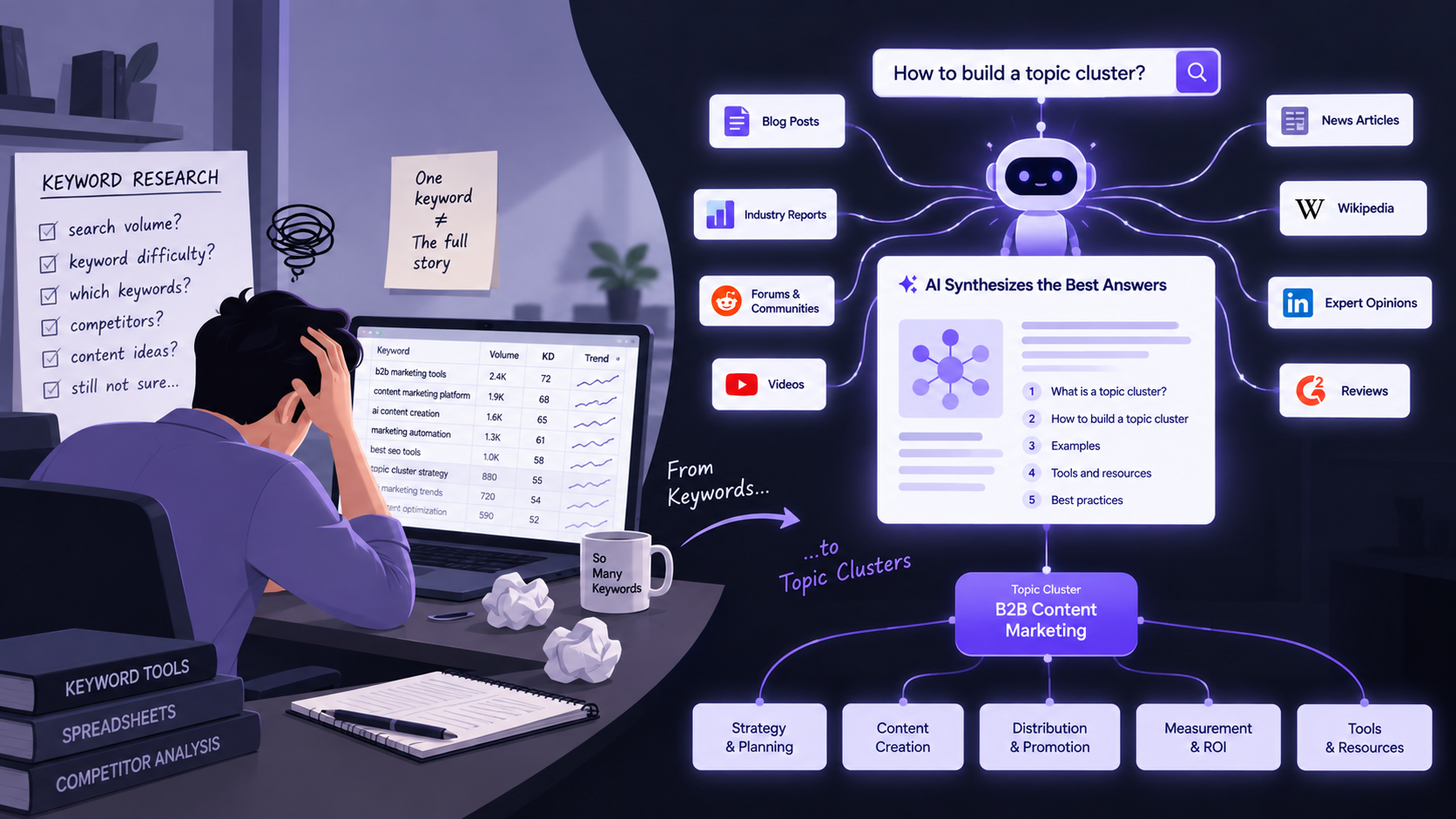
For years, building topic clusters meant crawling through thousands of keywords, grouping them by intent, and mapping out what to publish.
Then ChatGPT started doing something similar in seconds. AI can surface related questions, subtopics, comparisons and nuances from a single conversation. It has, in many ways, been doing the clustering for us.
So it’s time to rethink how we build topic clusters.
Because AI search doesn’t see your content as a collection of keywords. It looks for connected information that helps it understand a subject, answer a question and decide what is worth citing.
That means the question is no longer just “Which keywords should we target?”
It’s “What body of content makes our expertise easy for AI to understand, connect and cite?”
And that changes how you research, structure and build topic clusters in the AI-search era.
What changes when you build topic clusters for AI search?
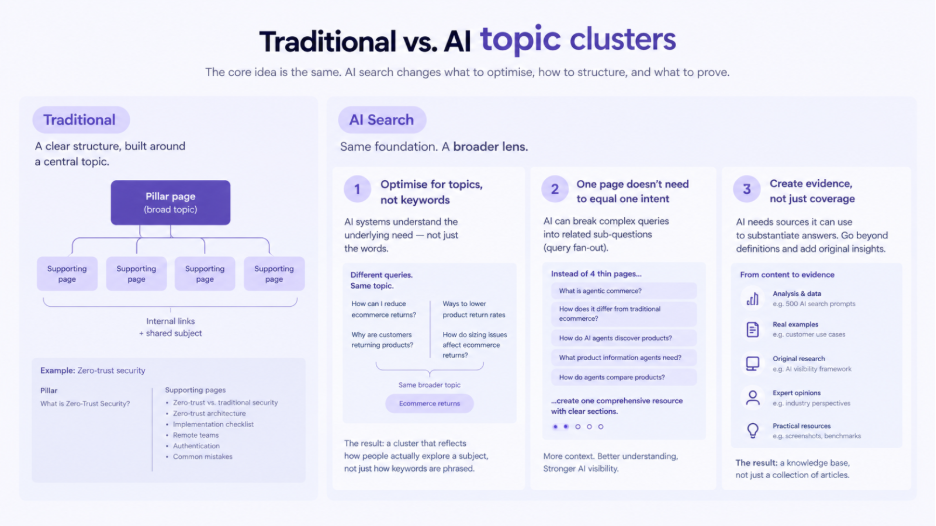
The traditional topic-cluster model is straightforward.
You have:
- One broad pillar page
- Several supporting pages covering narrower topics
- Internal links connecting them
- A shared subject tying everything together
For example, a cybersecurity company might build a cluster around zero-trust security:
Pillar:
What is Zero-Trust Security?
Supporting pages:
- Zero-trust vs. traditional security
- Zero-trust architecture
- Zero-trust implementation checklist
- Zero-trust for remote teams
- Zero-trust authentication
- Common zero-trust mistakes
This structure is still useful.
But AI search introduces another layer.
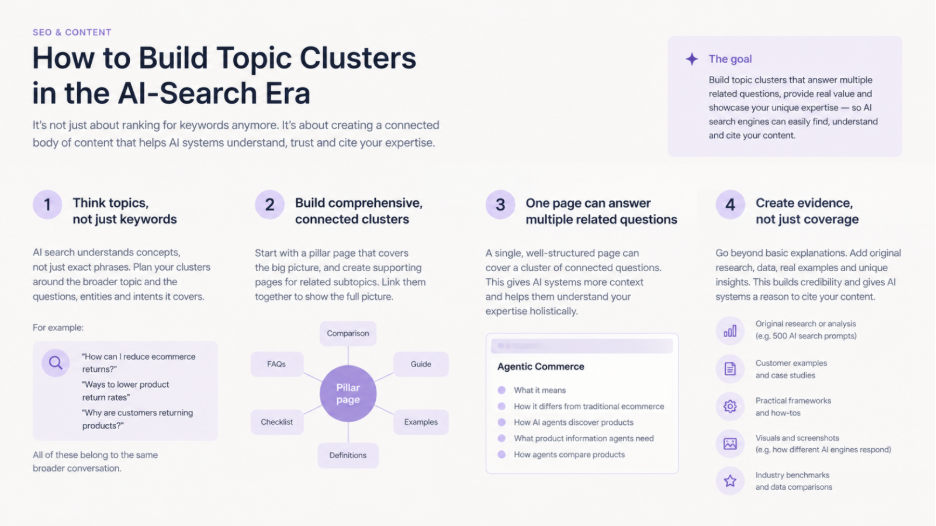
1. The unit of optimisation is moving from the keyword to the topic
Traditional keyword clustering often asks: Which keywords can one page rank for?
AI-era topic planning asks a slightly different question: Which questions, concepts and entities does an AI system associate with this topic?
This distinction matters because two queries can use completely different words while expressing almost the same underlying need.
For example:
- “How can I reduce ecommerce returns?”
- “Ways to lower product return rates”
- “Why are customers returning products?”
- “How do sizing issues affect ecommerce returns?”
A keyword tool may treat these as separate opportunities. A topic-first strategy recognises that they belong to the same broader conversation around ecommerce returns.
The result is a cluster that reflects how people actually explore a subject, rather than simply how keywords happen to be phrased.
2. One page does not necessarily need to equal one intent
Traditional SEO often encouraged very narrow pages:
“What is UCP?”
Then another page:
“How does UCP work?”
Then another:
“UCP vs. ACP.”
That approach can still make sense when the subjects have genuinely different search intents. But AI search creates a reason to reconsider excessive fragmentation.
If several questions are tightly connected and can be answered naturally on one page, separating them into four thin articles may make less sense than creating one genuinely useful resource. This is partly because AI systems can break complex queries into related sub-questions before retrieving content. Google describes this process as query fan-out.
So instead of creating a page for every variation of:
“What is agentic commerce?”
you might create a comprehensive resource covering:
- What agentic commerce means
- How it differs from traditional ecommerce
- How AI agents discover products
- What product information agents need
- How agents compare products
The individual sections can still target specific questions. The difference is that they live within a resource that gives the AI system much more context.
3. Your cluster needs to create evidence, not just coverage
This is one of the biggest differences between an old-school content cluster and a useful AI-search cluster.
Suppose ten websites have articles explaining:
“What is AI search?”
They may all cover the same definitions.
Now imagine one company publishes:
- An analysis of 500 AI search prompts
- Original examples from its own customers
- A framework for measuring AI visibility
- Screenshots of how different AI engines answer the same query
- A benchmark showing citation differences across industries
That company has created evidence around the topic, not just content about it.
This matters because AI systems need sources they can use to substantiate answers. Google's own guidance continues to emphasise original, useful content rather than content created simply to capture search traffic.
So a strong topic cluster should increasingly contain a mix of:
Explanations + examples + data + opinions from experts + original research + practical resources.
The cluster becomes a knowledge base rather than a collection of SEO articles.
How to Actually Build Topic Clusters for AI Search
1. Anchor your entity before you touch a keyword tool
Before mapping a single topic, make sure the thing your cluster about (your brand, product, or founder) exists as a clean, disambiguated entity. That means an About page with accurate Organization JSON-LD, a Wikidata entry (no notability bar to clear here, unlike Wikipedia), and sameAs schema pointing to your LinkedIn, Crunchbase, and G2 profiles. For example, Ledgerly's cluster on "cash flow management" will get cited far more reliably once "Ledgerly" itself is a recognized entity, not just a domain name with pages on it.
2. Mine topics with trend signals and semantic grouping
Traditional clustering grouped keywords that shared the same ranking pages. That's a weak signal for AI search, where the retrieval logic runs on meaning, not keyword overlap. Instead, pull emerging angles from trend-tracking tools before they're obvious, then group them using semantic similarity rather than shared SERPs. For Ledgerly, "late payment fees," "invoice factoring," and "cash flow forecasting" might never rank for the same keyword, but they're semantically part of the same buyer journey, and an AI engine will likely retrieve them together when answering a broader cash flow question.
3. Map the fan-out and the follow-up chain, together
For each cluster node, don't just list the sub-questions a search engine would fan a query into (tier 1, 2, and 3 as the existing playbooks describe). Also sketch the conversational chain: what would someone ask next, and next after that. Ledgerly's "invoice factoring" page should anticipate "is it worth it for a small business," "how much does it cost," and "how does it compare to a business line of credit," because that's the realistic path an AI Mode conversation would take a user down.
4. Write every page as a self-contained, extractable unit
Since retrieval happens at the chunk level, every H2 and H3 in your cluster needs to work if it's the only thing an AI system ever sees. Practically:
- Lead each section with the answer, then the reasoning, not the other way around.
- Name the subject explicitly in each chunk ("Ledgerly's factoring fees typically run 1-3%") instead of leaning on pronouns that only make sense in context.
- Use FAQPage and HowTo schema so the structure is machine-legible, not just visually obvious to a human reader.
- Where possible, build something genuinely original in the chunk (a formula, a benchmark, a mini-calculator) so there's a reason to cite you specifically rather than paraphrase generic advice.
5. Build two link meshes, not one
Internal linking still matters (bidirectional links between spokes, descriptive anchor text, the pillar tying it together). But given how much citation weight sits on Reddit, YouTube, and Quora depending on the engine, treat off-domain presence as part of the cluster's architecture, not a separate PR workstream. That could mean genuinely useful answers on relevant subreddits, a YouTube walkthrough of the tool referenced from your cluster pages, or getting mentioned (accurately) in comparison threads where your category gets discussed. The goal isn't promotion, it's making sure the conversation happening about your topic outside your site says the same thing your cluster says.
6. Audit the cluster quarterly, and diagnose before you refresh
Not every underperforming page needs a rewrite. Use the four decay patterns to triage: ranking decay needs genuinely new substance, zero-click capture needs the page turned into something irreplaceable, intent drift needs a format change (maybe that spoke needs a comparison table now, not more prose), and demand decay just needs consolidation or a redirect. Treating all four the same way, usually by adding more words, is probably the single most common reason clusters go stale despite regular "updates."
The Bottom Line
Topic clusters aren't obsolete in the AI search era, they're arguably more load-bearing than they've ever been, because comprehensive topical coverage is the actual raw material AI engines assemble their answers from. What's changed is the engineering underneath: clustering by meaning instead of shared rankings, treating every spoke as its own citable unit instead of leaning on one pillar, planning for conversations instead of single queries, anchoring the whole structure to a real, verifiable entity, and extending the cluster's reach onto platforms you don't own. Build it that way, and you're not just optimizing for today's algorithm, you're building the kind of structured, genuinely useful content that any future retrieval system, AI or otherwise, will keep finding a reason to pull from.


