



If you're a marketer in 2026, you're already using AI, drafting with it, editing with it, repurposing with it. That's not in question anymore. What's changing isn't whether marketers use AI, but how deep that usage goes, and what it unlocks once you stop treating AI as a faster pen and start treating it as a system you can design.
That deeper layer has a name now: content engineering. It's not a different job for a different kind of person, it's the same marketer, the same instincts, the same understanding of brand and audience, pointed at a new question. Instead of "how do I write this piece well," you start asking "how do I build something that keeps producing good work, channel after channel, without me touching every output by hand."
This blog walks through what that shift looks like in practice, grounded in a real job listing rather than abstraction, what separates the two layers of the job, what it takes to move from one to the other, and why marketers who start now get to shape what the role becomes.
What does a Content Engineer do?
The term is new enough that there's no single official job description for it, but across the marketing and AI industry, the definitions have converged on the same core idea. A content engineer designs, builds, and governs the system that produces content, rather than producing individual pieces by hand. A content engineer builds the pipeline that researches the topic, drafts it, optimizes it for search and AI answer engines, publishes it across channels, tracks how it performs, and feeds those results back into the next cycle. Jasper's CMO has compared the shift to what DevOps did for software engineering: a discipline whose whole job is making scale, governance, and speed possible for everyone building on top of it, rather than shipping any one feature itself.
In plain terms, a content engineer builds and runs the system that turns one piece of content into many, without someone manually redoing the work for each channel. Instead of writing a single asset and moving to the next one, they design the workflow, often using agentic AI tools, that pulls research, drafts first passes, reformats for different platforms, and checks output against brand standards on its own. The person still owns direction, accuracy, and final judgment; the system just handles the repetitive execution underneath that.
The clearest way to understand this role is to look at what a company is actually asking for when it hires one. Baseten, an AI infrastructure company that powers inference for Cursor, Notion, and Clay, has an open Content Engineer listing that spells the job out in concrete terms, and it's worth walking through line by line because it's far more specific than most descriptions floating around online.
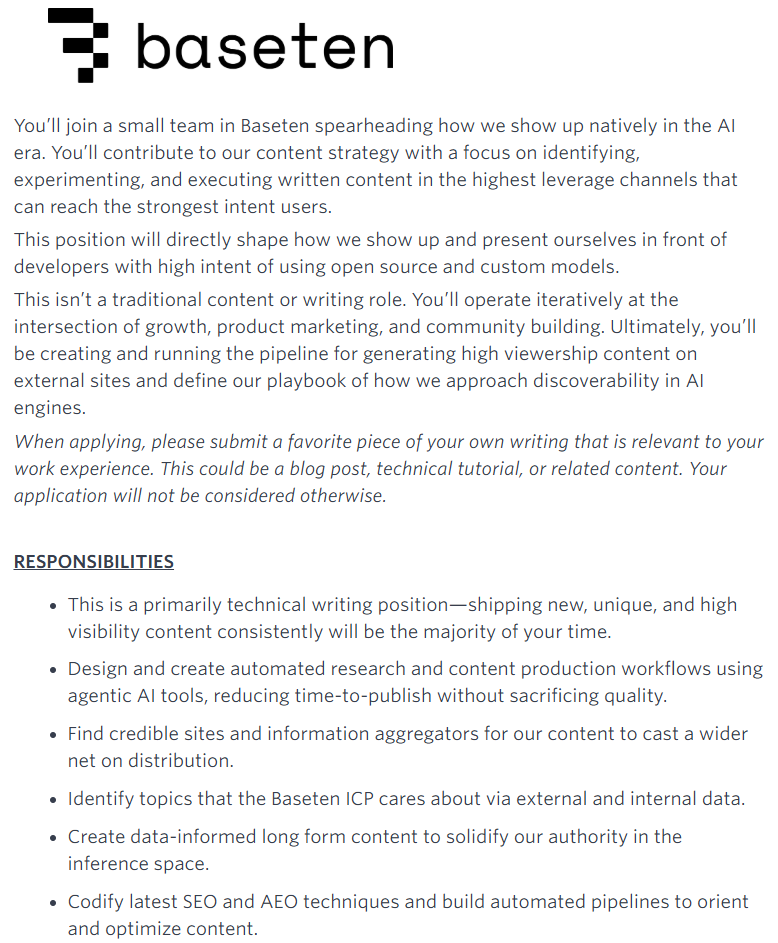
The listing asks the person to design and build automated research and content production workflows using agentic AI tools, specifically to cut down the time between an idea and a published piece, without sacrificing quality. That means setting up systems where AI tools do the repetitive groundwork, pulling research, drafting first passes, formatting for different platforms, while the person stays responsible for direction, accuracy, and final judgment. The listing also asks for help finding credible external sites and content aggregators to widen distribution, so the content doesn't just sit on the company's own blog waiting to be found.
What makes it a content engineer's job rather than a content writer's job comes down to a few specific asks in the listing:
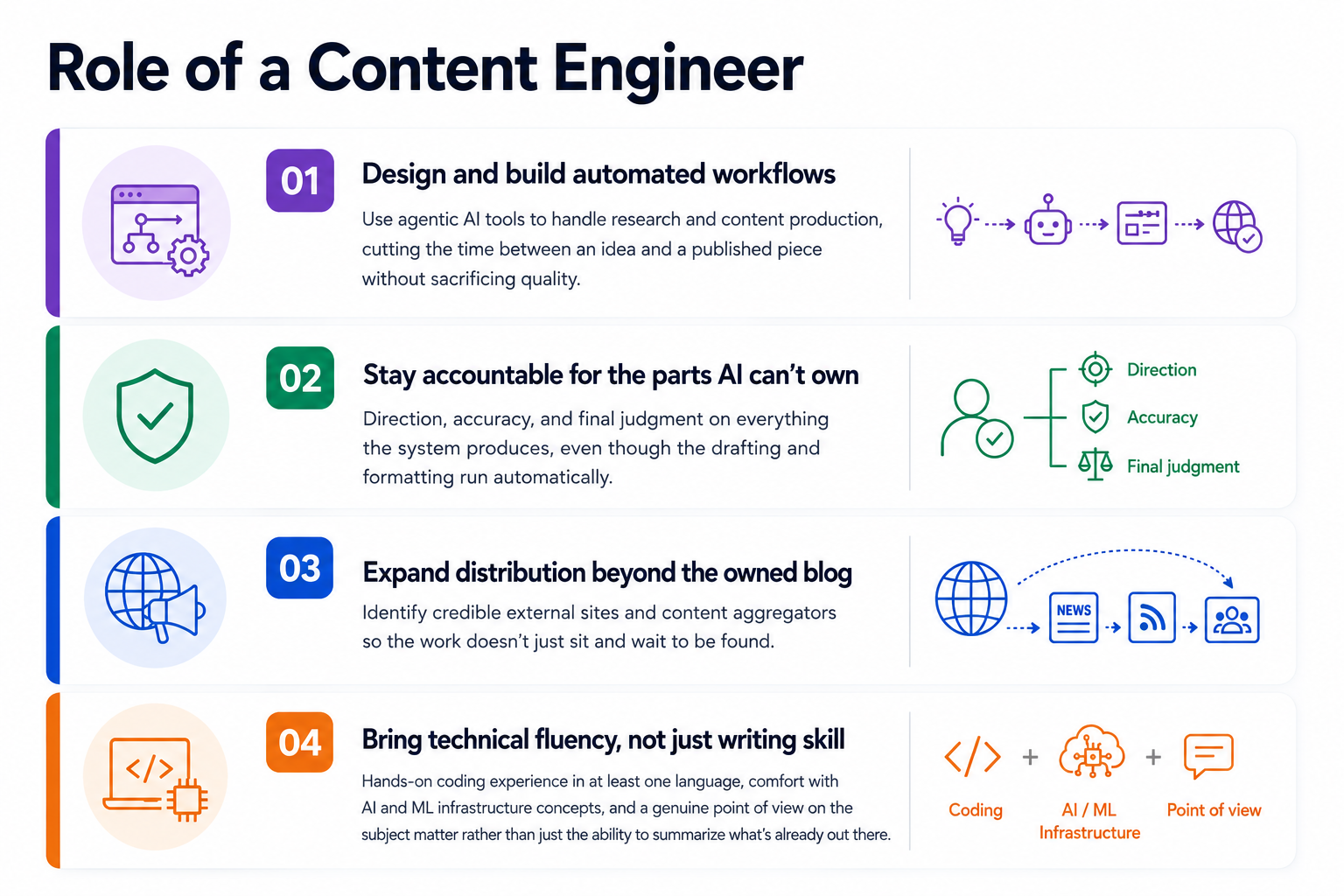
• Design and build automated workflows, using agentic AI tools to handle research and content production, cutting the time between an idea and a published piece without sacrificing quality.
• Stay accountable for the parts AI can't own: direction, accuracy, and final judgment on everything the system produces, even though the drafting and formatting run automatically.
• Expand distribution beyond the owned blog, by identifying credible external sites and content aggregators so the work doesn't just sit and wait to be found.
• Bring technical fluency, not just writing skill: hands-on coding experience in at least one language, comfort with AI and ML infrastructure concepts, and a genuine point of view on the subject matter rather than just the ability to summarize what's already out there.
What Separates a Producer From an Engineer
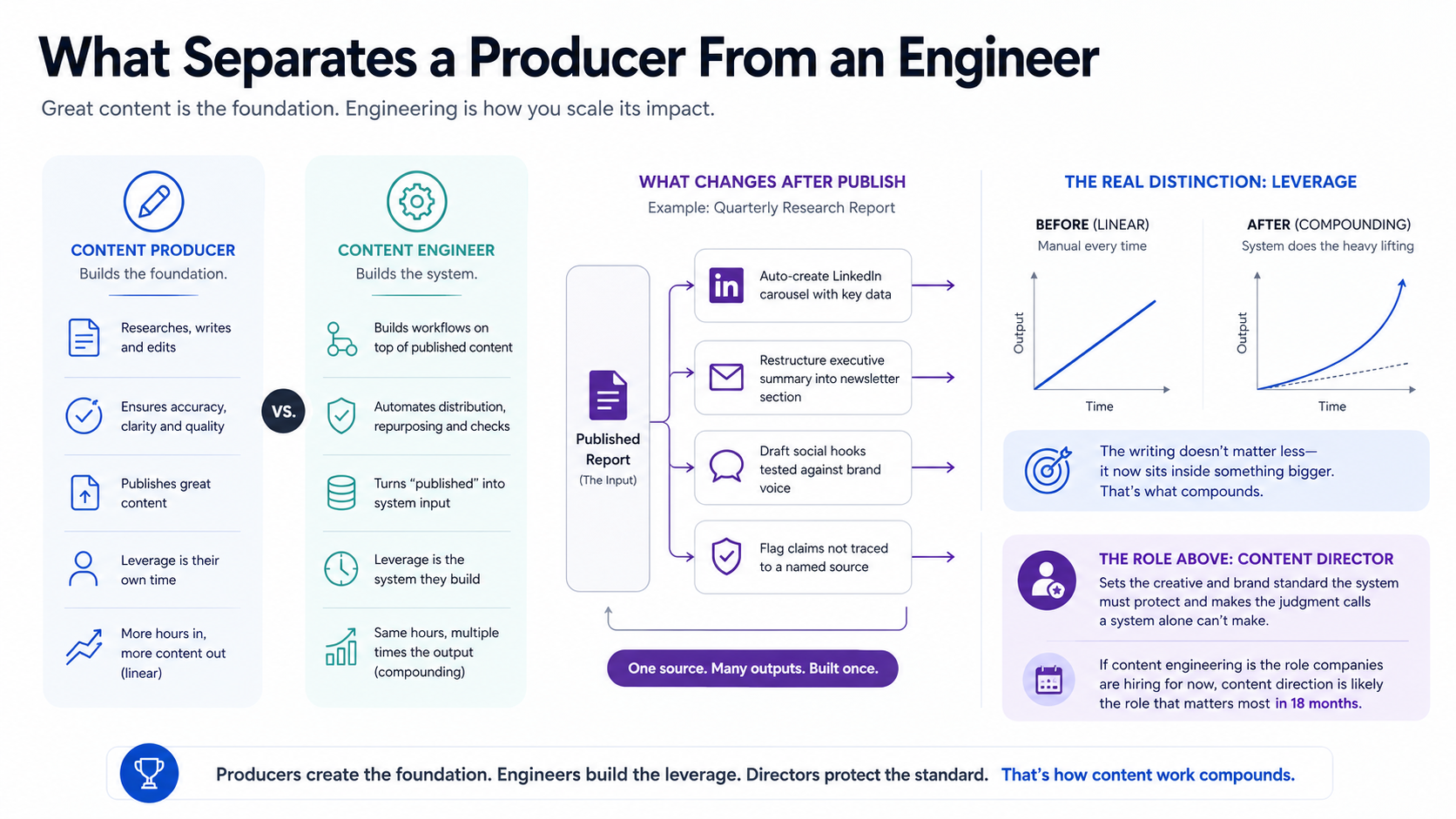
It's tempting to think content engineering replaces content production. It doesn't because producing great content is still the foundation. Engineering is what you build once that foundation is solid enough to scale past what one person typing into a doc can manage alone.
Writing a great blog post is still hard, still requires real skill, and AI hasn't made that disappear. What's changed is what happens after it's published. A content engineer doesn't see "published" as the finish line, they see it as the input to a system. Take a quarterly research report: the writing and editing work to produce it is exactly as valuable as it's always been. What's new is the layer built on top, a workflow that automatically pulls key data into a LinkedIn carousel, restructures the executive summary into a newsletter section, drafts social hooks tested against the brand's established voice, and flags any claim that doesn't trace back to a named source, without someone manually redoing that work for every channel.
That's the real distinction, and it's about leverage. A marketer's leverage used to be mostly their own time, more hours in, more content out, roughly linear. Once the system is built around the writing, the same hours can produce several times the output, because the repetitive parts run on their own instead of being redone by hand each time. The writing doesn't matter less, it now sits inside something bigger, and the marketers who build that "something bigger" are the ones whose work compounds instead of just accumulating.
There's a role worth naming here too, since almost nobody in the current conversation is talking about it clearly: the content director, who sits above the content engineer, sets the creative and brand standard the system has to protect, and makes the judgment calls a system alone can't make. If content engineering is the role companies are hiring for now, content direction is likely the role that matters most in eighteen months.
What It Actually Takes to Make the Transition
The good news: this transition is closer to what good marketers already do than it might first appear. The skills are an extension of judgment most experienced marketers already have, applied to a new layer of the job. Three gaps worth naming honestly:
Systems thinking over storytelling instinct. Content engineering requires fluency in AI-powered content systems, SEO, analytics dashboards, and editorial standards plus systems thinking that asks "how does this scale without me in the loop" rather than "is this piece good." This doesn't mean abandoning creative instinct, it means designing creative processes that don't collapse once you step away from them.
AI literacy past basic prompting. Real AI literacy means understanding prompt engineering well enough to consistently generate brand-accurate output, and understanding retrieval-augmented generation (RAG) well enough to limit hallucinations and model drift. It also means knowing the tooling beyond ChatGPT and Claude. Platforms like AirOps, or automation built on Zapier, Make, or n8n, have a steeper learning curve but unlock the repeatable workflows that define the role.
Governance and brand integrity at scale. This is the gap senior marketers are best positioned to close, and it's the one that matters most. AI doesn't always grasp the nuances of human context, the content engineer's job is to make sure output isn't just technically correct, but contextually right for the brand and the moment. This is exactly where taste, judgment, and years of brand instinct become more valuable, not less, because they're the one input AI genuinely cannot replicate.
Start Building Before the Job Posting Does
If the last two years were about marketers learning to use AI tools individually, this next stretch is about learning to connect those tools into systems that work together. The real question is whether you're designing how that change happens on your team, or waiting to be told.
The broader shift in marketing careers points the same direction. Roles that rewarded deep specialization in one narrow skill are increasingly rewarding range, using AI to handle the repetitive parts of execution while spending more time on the strategic judgment AI still can't replace. Content engineering is a concrete, hireable version of that shift, not an abstract prediction. It already has job listings, real salary bands, and companies testing it out, like Baseten is doing right now.
So here's the practical starting point: you don't need to wait for your company to write a new job description. Pick the one content process you repeat most often, a newsletter, a repurposing flow, a research-report rollout, and instead of doing it the same way again, build the version that doesn't need you to manually repeat the work. That one workflow is where the shift from producer to engineer actually begins.


