AI Insights
Agent Memory Has Outgrown Retrieval
Most AI memory systems can find relevant past information but can't tell if it's still true, so agents act on stale data that was technically "retrieved correctly."
September 17, 2026

For most of the last fifteen years, local SEO had one job: win a position in a ranked list. That model is now being dismantled by a change in what "search" even means.

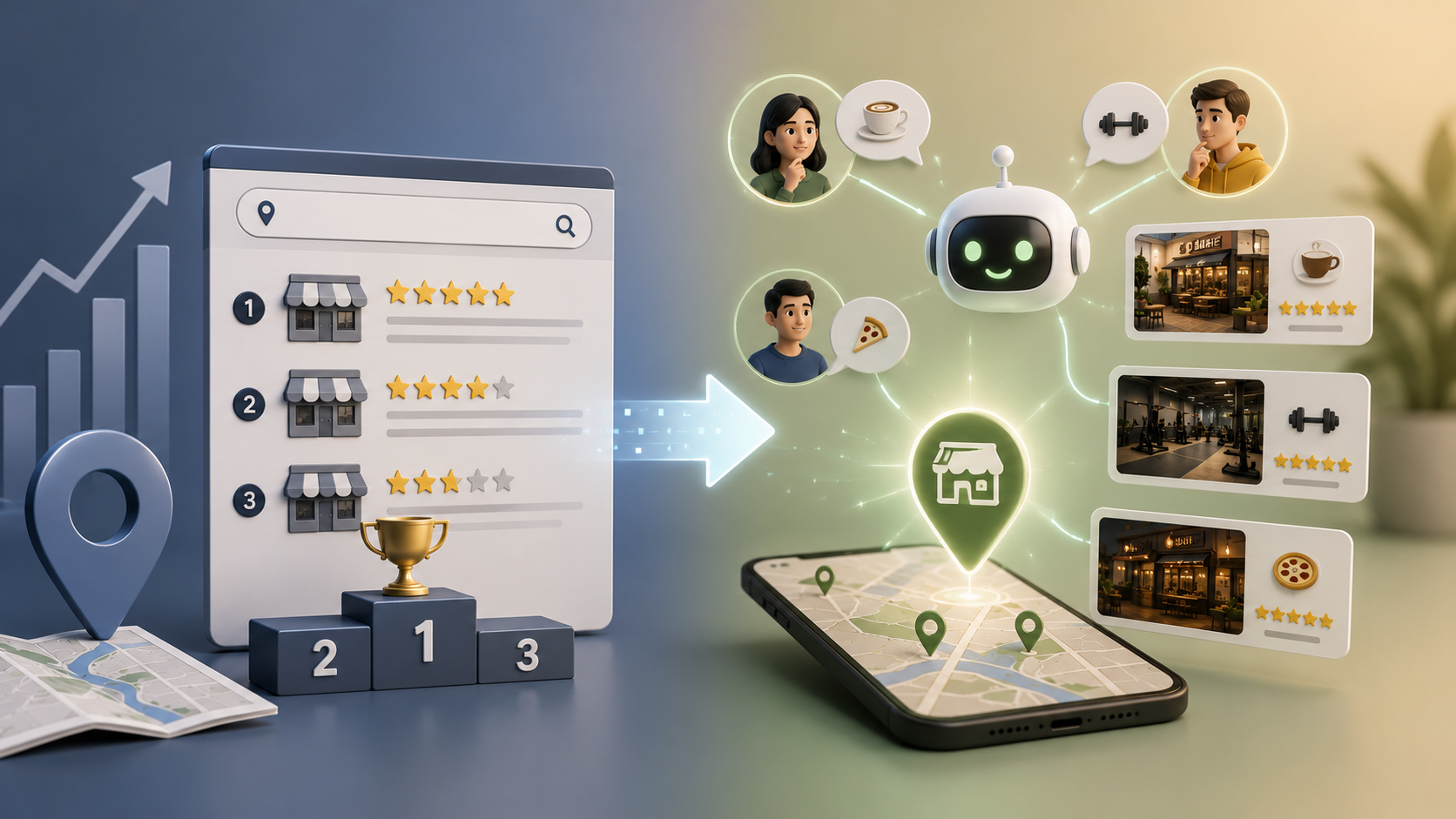

For most of the last fifteen years, local SEO had one job: win a position in a ranked list. Show up in the map pack of three, or high enough in the ten blue links below it, and the customer would do the rest: scroll, compare, click, decide. That model is now being dismantled by a change in what "search" even means. This is the story of how we got from optimizing for rank to optimizing for recommendation, and what actually changes for a local business along the way.
Google's own guidance for over a decade rested on three official local ranking factors: relevance, distance, and prominence. Local SEO practice built itself entirely around gaming those three levers well.
Underneath all three was a shared assumption: a human being was at the other end of the query, scanning a list, and would make the final judgment call themselves. SEO's job was to get you onto that list, ideally near the top of it. What happened after that, whether the customer actually picked you, was marketing's problem, not search's.
Three things happened roughly at once, and together they didn't just tweak this system, they replaced its premise.
Search stopped ending in a list. Zero-click search, where a user gets their answer without clicking through to any website, has been climbing for years: roughly 50% of Google searches in 2019, around 60% by 2024, and an estimated 64.8% in 2026. On mobile, where most local queries happen, that figure is now above 77%. When AI Overviews appear on a results page, click-through on the number-one organic result falls from roughly 31.7% to 19.8%, a drop of more than a third. The list didn't disappear, but fewer and fewer people are scrolling through it.
The list itself got shorter. Google's Ask Maps feature, which expanded through 2026, doesn't hand a user ten or twenty ranked pins to compare. It surfaces three to five businesses per query, already filtered and already judged. Competing for position eleven used to mean invisibility on page two. Competing for position six now means invisibility, full stop, because there is no page two in a conversational answer.
The unit being evaluated changed. Complete business profiles stitched together from your website, your Google Business Profile, your reviews, and every third-party mention of you, cross-checked against each other rather than read one page at a time. A page can rank. An entity has to be verified.
Put together, these three shifts describe a compressed journey: instead of "search, scan, click," the new pattern is "ask, get an answer, take action". The decision that used to happen in the customer's head while scrolling a list now happens inside the AI system before the customer sees anything at all.
The underlying inputs, your reputation, your information, your content, haven't become irrelevant. What changed is which version of each one counts, and how it gets evaluated.
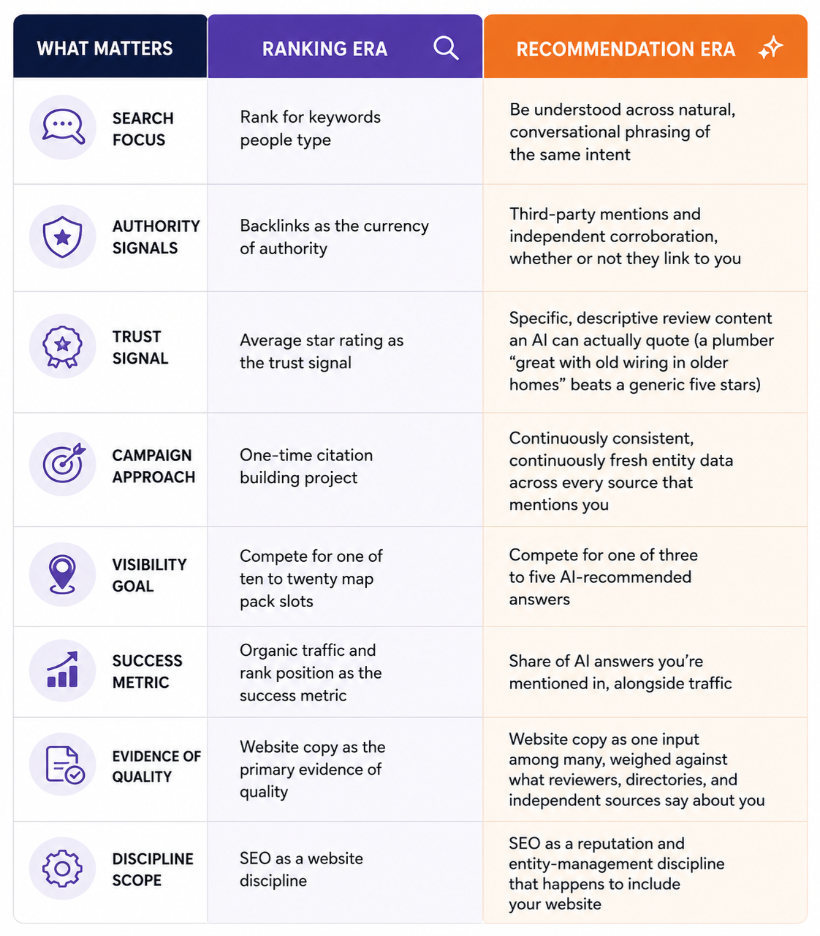
This is the shift a related piece of coverage on the same theme frames as authority now needing to be "earned, not optimised": the old game rewarded clever configuration of a page. The new one rewards a genuinely well-regarded, well-documented business, because that's what survives being cross-checked against independent sources.
Technical fundamentals, page speed, mobile usability, schema markup, well-structured service pages, still matter, because they're still part of what an AI system reads when it forms an opinion about you. What's new is that they're no longer sufficient on their own. A perfectly optimized page attached to a business with three-year-old reviews, an incomplete profile, and no independent mentions anywhere else on the internet now loses to a rougher page attached to a business that shows up consistently, gets talked about elsewhere, and keeps its information current.
In practice, that means the work shifts in emphasis:
Local SEO used to be about ranking highest in a list. Now it's about being one of the few businesses an AI recommends directly. The basics still matter: good service, real reviews, accurate information. What's different is the ongoing effort needed, keeping that information consistent and current everywhere it appears, not just setting it up once and moving on.
.avif)

From collection to clarity — we’ll help you make sense of it all.

Giving shape to intelligence