




Half of B2B software buyers now open ChatGPT before they open Google. G2 put it at 51% this year, up from 29% twelve months earlier. In the same research, 69% of buyers ended up picking a different vendor than the one they'd walked in planning to buy, and a third bought from a company they hadn't heard of until the chatbot said its name out loud.
For B2B brands, this means that a vast majority of buyers changed their mind inside a conversation you will never see, can't measure, and can't respond to. If you're a B2B marketer, this is a bigger problem than it is for anyone selling shoes. Your buyer has a committee, a procurement process, and a nine month cycle. All of that pushes them to research heavily and alone, which is exactly the behaviour AI assistants are best at serving.
Search Everywhere Optimization (SEvO) is the response. Show up, correctly, wherever your buyer goes looking for an answer: Google, ChatGPT, Gemini, Perplexity, G2, LinkedIn, YouTube, a Reddit thread from two years ago.
SEO assumed one search box. There are now a dozen, and each one works differently.
How AI Search Actually Finds Things
AI search doesn't work on keyword crawlers or domain authority like SEO. Instead, it uses a method called query fan-out.
When your buyer types a question into ChatGPT or Google's AI Mode, that question doesn't get searched as written. The system pulls it apart, generates a batch of related searches, runs them in parallel, and assembles one answer out of whatever comes back.
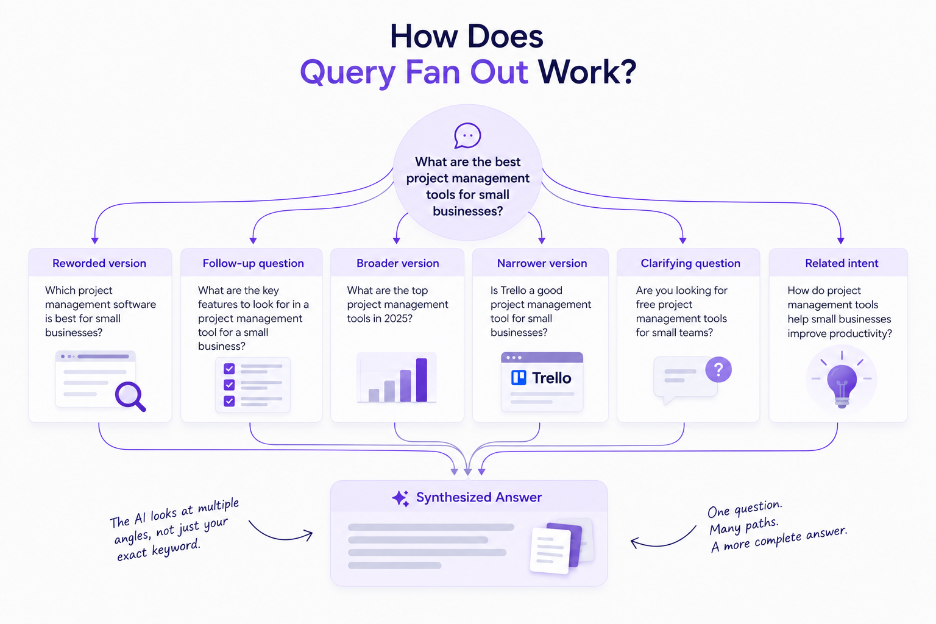
Google's patents call it query variant generation. OpenAI's docs call it query rewriting. The industry settled on query fan-out.
Take a realistic buyer question: "What's the best marketing automation platform for a 200-person B2B company?"
Behind the scenes, that becomes something closer to:
- best marketing automation software mid-market B2B (equivalent)
- marketing automation for 200 person company with Salesforce (specification)
- best marketing automation platforms (generalization)
- marketing automation pricing mid-market (follow-up)
- does [vendor] integrate with Salesforce (entailment)
- email automation or full lifecycle (clarification)
Eight or ten searches, none of which your buyer typed. A model then reads everything that returns, looks for agreement across sources, and names three to five vendors.
This is the whole ballgame for content strategy. A page that answers only the headline question turns up in one of those ten searches. A competitor who covered pricing, integrations, and company-size fit turns up in six, gets seen repeatedly, reads as consensus, and gets named.
So the unit of content stops being the keyword and becomes the cluster of questions around a decision. One page that handles pricing, integrations, security, objections and comparisons will outperform six thin pages that each handle one.
Two other mechanics matter, in this order.
Most citations point away from you. A study of 167,000 AI citations across 128 brands found roughly 86% went to sites the brand doesn't own. Review platforms, trade press, forums, comparison posts. Your website is a minority shareholder in your own reputation.
Models need a clean entity. If your name, category and one-line description read differently on your site, your LinkedIn, and your G2 profile, the model has low confidence about what you are and hedges by naming someone else. Fixing this is dull work with an unreasonable payoff.
The SEvO Playbook For B2B Enterprises
You already have useful instincts. The research discipline, the technical hygiene, the structural writing. What changes is the number of surfaces. Do it in this order.
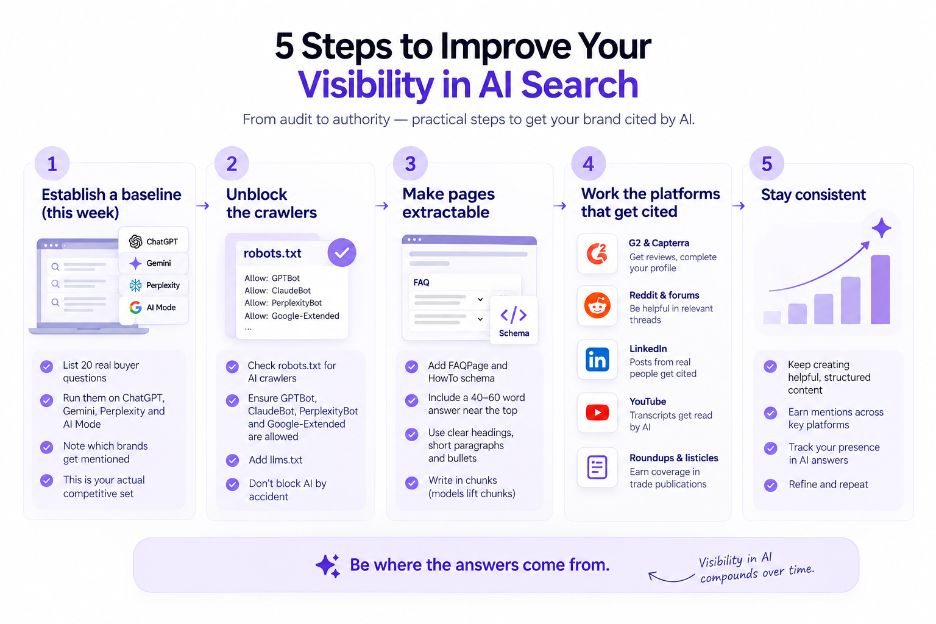
1. Establish a baseline, this week. Write down the 20 questions your buyers genuinely ask: category, comparison, "best X for Y", pricing, integration. Run all 20 through ChatGPT, Gemini, Perplexity and AI Mode. Record who gets named. That list is your actual competitive set, and it rarely matches the one in your SEO tool.
2. Unblock the crawlers. Check robots.txt for GPTBot, ClaudeBot, PerplexityBot and Google-Extended. A lot of B2B sites are invisible to AI by accident, blocked by a line someone added in 2023. Add llms.txt while you're in there.
3. Make pages extractable. FAQPage and HowTo schema on key pages. A direct 40 to 60 word answer near the top of every piece. Short paragraphs, real headings, bullets. Models lift chunks, so write in chunks.
4. Work the platforms that get cited.
- G2 and Capterra carry more weight in B2B than anything you publish. Chase reviews, keep the category accurate, fill in every comparison field.
- Reddit and niche forums are structured as question and answer pairs, which is the format models retrieve best. Be useful in threads about your category. Shilling gets caught and costs more than it returns.
- LinkedIn posts from named people at your company get cited more than most marketing teams realise. Attribution to a real expert is a trust signal.
- YouTube transcripts get read. A demo video with a clean transcript answers questions your blog never got around to.
- Roundups and comparison listicles in trade publications are digital PR work, not SEO work. Budget for them separately.
5. Rebuild content around question clusters. For each core topic, list the fan-out follow-ups and answer them in one place. Add real numbers, name your sources, put a human byline and bio on anything substantial.
6. Track monthly. Re-run the 20 questions, log who appears and in what tone. You're measuring presence and sentiment now, not position. When a model has your category wrong, a rebuttal post won't fix it. Get a credible third party to state the correct version and give retrieval 30 days to catch up.
Work through those six steps and you'll have a functioning SEvO setup inside a month. Two parts of it will feel wrong the whole time, because they genuinely don't map onto anything in traditional SEO.
The first is measurement. There's no position to report. A model either names you or it doesn't, and the same prompt can return a different answer on Tuesday than it did on Monday. Share of voice, citation counts and sentiment replace rankings, and you'll need a way to sample consistently enough that the noise averages out. We've written separately on how to build an AI visibility dashboard that actually tells you something, including which metrics are worth the tracking effort and which are vanity.
The second is topic research. Keyword volume is close to useless when the queries you care about are conversational, long, and mostly unmeasured by any tool. What replaces it is question mining and cluster building, which is a different research motion with different inputs. That's covered in our piece on SEvO trend research and topic clusters.
Get the foundation right first. The six steps above are the part that pays off immediately, and everything else is easier once your site is legible to the models and you know where you currently stand.


