AI Insights
Agent Memory Has Outgrown Retrieval
Most AI memory systems can find relevant past information but can't tell if it's still true, so agents act on stale data that was technically "retrieved correctly."
September 17, 2026

AI engines like ChatGPT and Gemini are shifting buyer journeys away from traditional search and toward conversational recommendations. As a result, bottom-of-funnel content packed with proof, comparisons, and decision-making context is becoming the most valuable content asset for brands.

.png)

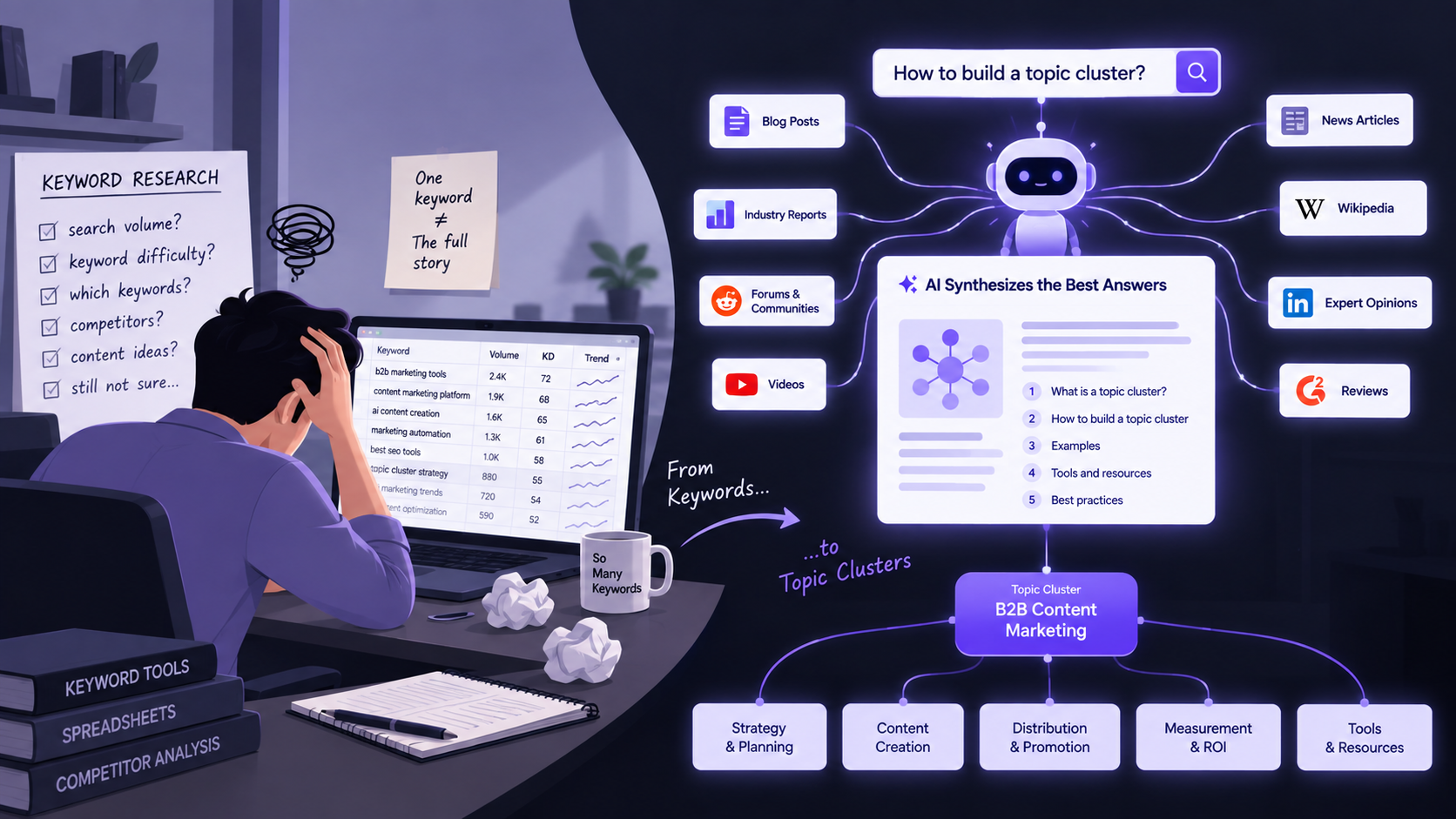
A few years ago, buying software online felt like doing research for a thesis. Buyers would open fifteen tabs, skim through “What is…” blogs, compare pricing pages, read Reddit threads, watch YouTube demos, and maybe even ask LinkedIn for recommendations before shortlisting a vendor.
Marketing funnels were built around this exact behavior. First, you attracted visitors through educational content. Then you nurtured them with product explainers and finally pushed them toward conversion with demos, case studies, and pricing pages.
But AI search is breaking that journey.
Today, a buyer simply opens ChatGPT, Gemini, Claude, or Perplexity and asks:
“What’s the best warehouse management system for a fast-growing ecommerce brand with multiple fulfillment centers?”
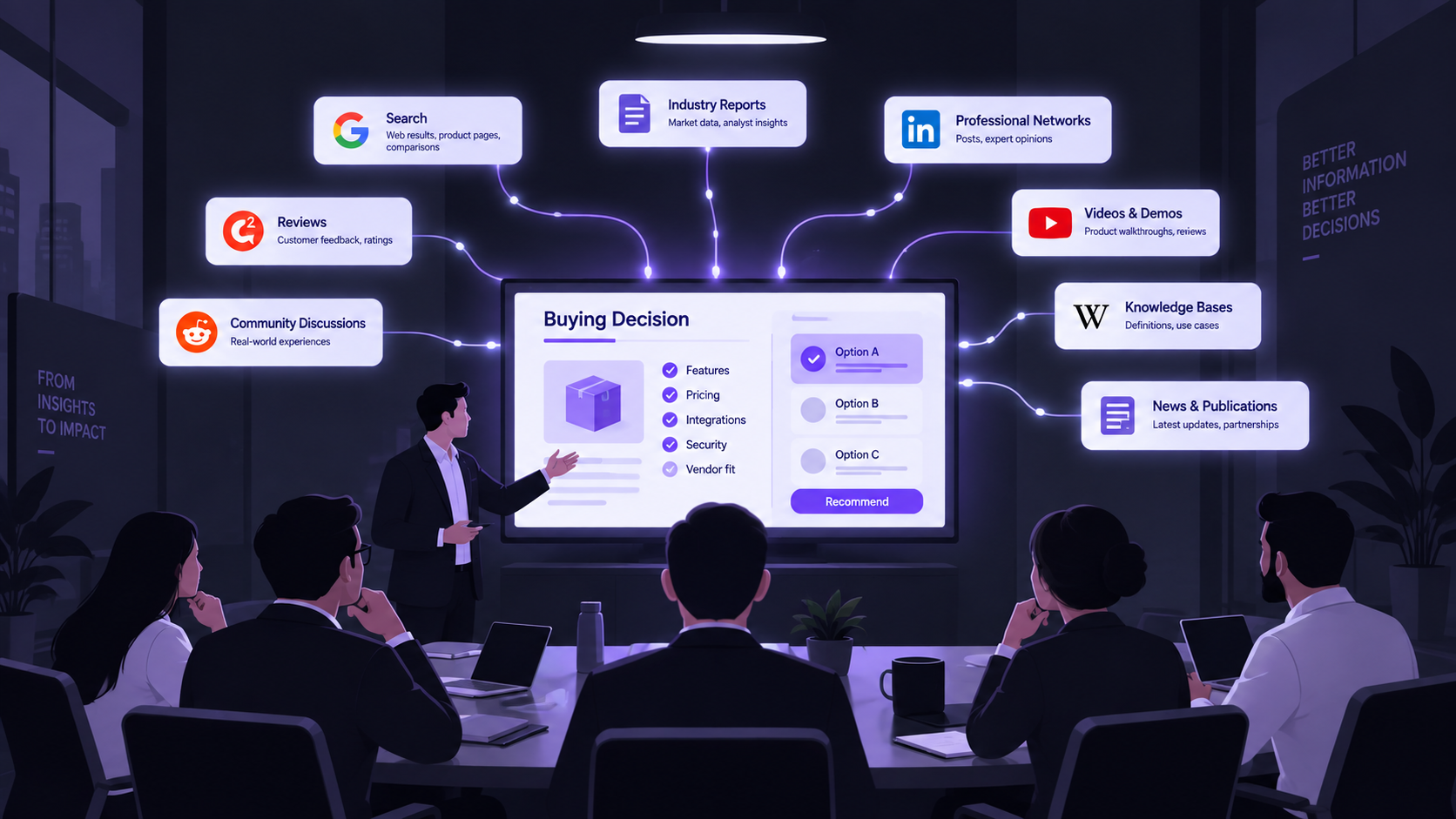
Within seconds, the AI responds with vendor comparisons, strengths and weaknesses, pricing context, use cases, implementation considerations, and even recommendations. Before the buyer has visited a single website, the shortlist has already started forming.
That changes the role of content entirely. The content AI engines rely on most heavily is not fluffy top-of-funnel content. It’s bottom-of-funnel content, the kind packed with specifics, proof, comparisons, workflows, implementation details, and measurable outcomes.
This is why bottom-of-funnel content is becoming one of the most valuable assets a brand can own in the AI-search era. This doesn’t mean content marketing is dead. It means the definition of valuable content is changing. The brands that succeed in AI search won’t necessarily be the ones publishing the highest volume of blogs. They’ll be the ones publishing the most useful buying intelligence.
And that starts with bottom-of-funnel content.
If your content strategy was built on informational queries, "what is content marketing," "how does CRM software work," "what is a sales funnel", you've likely already felt the pain. Informational queries have seen 30–40% organic traffic declines as AI Overviews handle these query types best. And the coverage is expanding fast: AI Overviews now appear in over 13% of all Google queries, up from under 5% during the 2025 limited rollout, with analysts projecting 20–25% coverage by the end of 2026.
And therefore, rankings are no longer a reliable proxy for visibility. The overlap between top-10 Google rankings and AI Overview citations collapsed from 75% in mid-2025 to between 17% and 38% by early 2026. You could be ranking #3 and still be invisible in the answer a buyer sees.
And TOFU content specifically is the most exposed: when someone asks an AI "What is content marketing?", there's simply no reason for the AI to recommend your brand. The information is commoditized, there's little to no differentiation between one definition and the next, so there's no reason to send users to a page when they all say the same thing. The AI answers the question itself and moves on.
Think of it like this: if you ran a restaurant and someone asked Google "what is pasta?", you'd never expect that to drive reservations. TOFU content has always had the same structural problem, it attracts attention without intent. AI has simply removed even the traffic benefit.
When someone asks ChatGPT "What's the best project management tool for a remote team of 20?", they want a shortlist. They want a recommendation. And the AI gives them one, complete with reasons why each option might or might not fit their specific situation. Users asking AI for product comparisons, pricing breakdowns, tool recommendations, and alternatives are already in decision mode. These AI responses often act as shortlists or final recommendations, if your brand appears here, you're part of the decision.
The conversion numbers back this up powerfully. Bottom-of-funnel keywords already convert 10x to 25x better than top-of-funnel ones in traditional SEO. Layer on top of that the fact that AI-referred traffic converts 4.4x better than standard organic search because visitors arrive already informed and further along in their buying decision, and you're looking at a fundamentally different quality of audience than anything TOFU ever delivered.
There's also a behavioral shift happening that most marketers haven't fully internalized yet. With AI search, people give it their full context. It's a conversation, not a search. A buyer might start with "best SaaS content marketing agency," then refine by saying "we're a Series B fintech company targeting SMBs, we've tried SEO already, we need someone who focuses on pipeline not traffic." That means the first sales touchpoint has moved to AI chat. AI is now the one selling your solution. Your job is to give it the right content to do that job well.
Understanding that BOFU content wins is only half the battle. Understanding why certain BOFU content gets cited and other content gets ignored is where the strategy comes together.
The first thing to understand is that generic doesn't get recommended. The companies that get recommended most clearly articulate who they're best for, what they're best at, and why they're better than the competition. If your marketing site has similar copy, benefits, and use cases as every other competitor in your space, expect to stay lost in the shuffle.
Think about what this means practically. An AI scanning your website to decide whether to recommend you to a fintech startup is essentially asking: "Does this brand clearly own a specific problem for a specific type of customer?" If the answer is "sort of, maybe, they seem pretty good," the recommendation goes to someone else.
The second thing: structure helps AI read your content. AI engines break pages into individual passages and evaluate each one for relevance, clarity, and factual density. Every section needs to stand on its own. Start each section with a clear, direct answer, then expand with context. Use a clean heading hierarchy. Add FAQ sections wherever it makes sense, AI engines rely heavily on clear question-and-answer pairs when building responses.
Third: what people say about you matters as much as what you say about yourself. Earned mentions like customer reviews on G2, Capterra, or Trustpilot; journalists mentioning your company in industry articles; community discussions on Reddit or Quora where users recommend your solution, give AI systems clear signals about your credibility. When multiple independent sources discuss your brand in relevant contexts, AI systems have more data to interpret your authority.
There's also a technical dimension that's easy to overlook. Many sites block AI crawlers without realizing it. Cloudflare recently changed its default configuration to block AI bots, so if you use Cloudflare, your AI bot traffic may have been shut off automatically. Check your robots.txt. Ensure your important content is server-side rendered. Consider adding an llms.txt file to guide AI systems on how to interpret your site.
Not all BOFU content is equally citation-worthy. Based on what's working right now, here are the five formats that consistently surface in AI recommendations, and how to build each one well.
This is the workhorse of BOFU content in an AI world. "[Your Product] vs. [Competitor]" and "Best [Category] Tools for [Specific Use Case]" pieces directly answer the questions buyers are asking in the most decision-proximate moments of their journey.
The most effective versions are comprehensive guides targeting high-intent queries with a reusable review methodology, honest pros and cons including about your own product, and content written for someone in the middle of a purchase decision, not someone casually browsing. Credibility is the currency here. An obviously biased comparison gets ignored by both readers and AI engines.
Roundup-style content that covers an entire product category — "Top 10 CRM Platforms for Startups," "Best Email Marketing Tools for E-commerce" — functions as what one GEO expert aptly calls a "marketplace of answers." These posts give LLMs exactly what they need to generate recommendation-style responses for buyers at the decision stage.
The key to making these work: segment your roundup by buyer type, not just features. "Best for enterprise teams," "best for bootstrapped startups," "best for non-technical users" signals to both human readers and AI engines that you understand the nuance of the decision.
Bottom-of-funnel keywords convert because customers search around problems they're trying to solve, "what's the best way to measure conversions?", "alternatives to [tool they're currently using]?", "what should I look for in [category] software?" These aren't keyword opportunities; they're buyer moments.
The approach here is to write content that explicitly names the outcome the buyer wants, the friction they're currently experiencing, and why your solution is the best path between those two points.
Structured FAQ content is disproportionately powerful for AI citation purposes. Structure your content with direct answers in the first 40–60 words, maintain fact density with statistics every 150–200 words, cite authoritative sources throughout, and implement proper FAQ schema markup.
FAQ schema essentially pre-formats your content in the way AI engines already want to consume it. Think of it as writing in AI's native language.
💡 Tip: For each BOFU piece you publish, include a dedicated FAQ section at the bottom that directly answers 5–8 questions buyers actually ask your sales team. Mine those questions from Gong calls, support tickets, and sales rep interviews. This is the specificity that gets you cited.
When a buyer asks an AI "Has this solution worked for companies like mine?", the AI needs something to pull from. A vague case study that says "we helped Company X improve efficiency" gives it nothing useful. A specific case study that says "we helped a Series B fintech company reduce customer onboarding time by 40% in 90 days" gives the AI a precise, matchable answer.
Structure your case studies with named industries, quantified outcomes, clear before-and-after framing, and a section that explicitly names what type of company this result applies to. The more specific, the more citable.
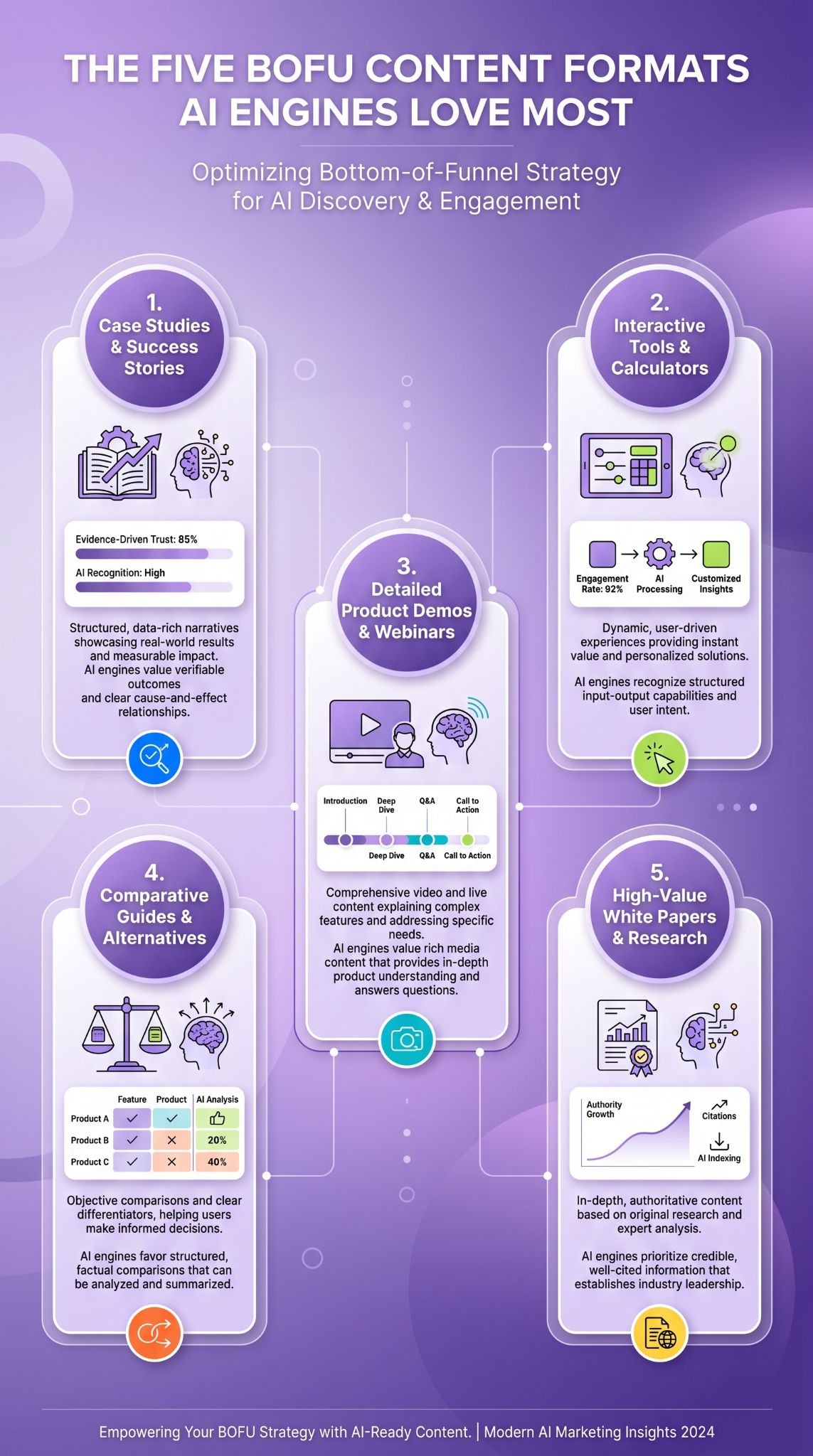
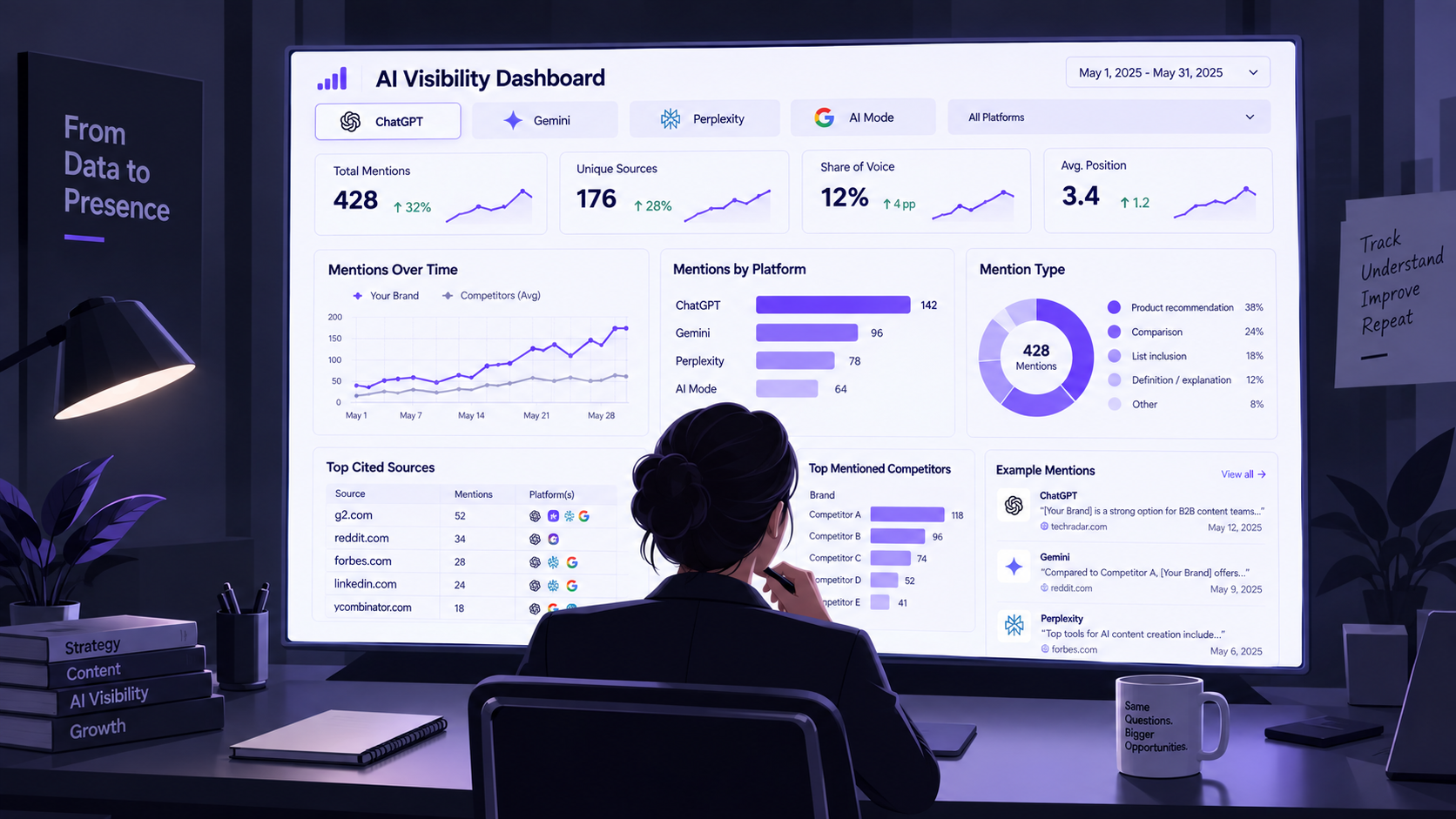
Most marketing teams are still measuring success in a way that was designed for the old internet. Traffic as vanity. Rankings as performance. Clicks as proof of work. None of those metrics tell you whether you're actually showing up when a buyer asks an AI to recommend solutions in your category.
The shift to BOFU-first content is a recognition that the buyer journey now begins in AI, and the brands that have clear, specific, credible content at the decision stage are the ones getting recommended. Not the brands with the highest domain authority. Not the ones who published the most blog posts last quarter. The ones who made it easy for AI to say, confidently and specifically, "this brand is the right fit for your problem."
The brands investing in BOFU content and GEO now are capturing citation share while competition is still relatively low. A year from now, that window will be significantly narrower.
Start with one piece. Pick the query your ideal buyer searches when they're 30 days from a purchase decision. Build the most credible, specific, honestly useful piece of content that exists for that query. Structure it clearly, mark it up properly, and make sure your site doesn't accidentally block the AI crawlers trying to read it.
Then do it again.
The AI engines are looking for brands worth recommending. Give them a reason, and give it to them at the bottom of the funnel, where it actually matters.
.avif)

Bottom-of-funnel content is content designed for buyers who are close to making a purchase decision. It includes comparison pages, case studies, pricing guides, demos, FAQs, and alternatives content that help users evaluate solutions confidently.
AI platforms like ChatGPT, Gemini, and Perplexity are compressing the traditional buyer journey by directly answering research and comparison queries. Instead of browsing multiple websites, users now receive curated recommendations instantly, reducing reliance on top-of-funnel search behavior.
AI engines prioritize content that contains specific, structured, and decision-oriented information. BOFU content provides clear use cases, comparisons, proof points, and outcomes that help AI systems generate trustworthy recommendations for buyers.
AI systems frequently surface comparison guides, alternatives pages, case studies, FAQ content, product demos, and detailed category roundups because they contain actionable and context-rich information useful for purchase decisions.
Informational queries like “What is CRM software?” are increasingly answered directly within AI Overviews and AI chat interfaces. Since this information is highly commoditized, users often no longer need to click through to websites for basic educational content.

From collection to clarity — we’ll help you make sense of it all.

Giving shape to intelligence