AI Insights
Agent Memory Has Outgrown Retrieval
Most AI memory systems can find relevant past information but can't tell if it's still true, so agents act on stale data that was technically "retrieved correctly."
September 17, 2026

This blog explores why traditional narrative-heavy case studies fail in AI-driven discovery and explains how to restructure them for maximum visibility, citability, and trust.



Three years ago, your case studies sat quietly on the website, ready to convince a warm lead scrolling late at night that yes, you really deliver results. Today, those same case studies have a bigger job. Before any human even reaches your site, AI platforms are deciding whether to recommend you or your competitor. If your success stories aren’t formatted for easy extraction, they simply don’t exist in the buyer’s world.
The rules have changed. Case studies must now convince humans and earn citations from machines. Get this right, and you turn one project win into ongoing visibility, authority, and leads. Miss it, and you’re invisible in the new answer economy.
This guide walks you through exactly how to optimize (or create) case studies that stand out for both audiences. Follow it as your step-by-step playbook.
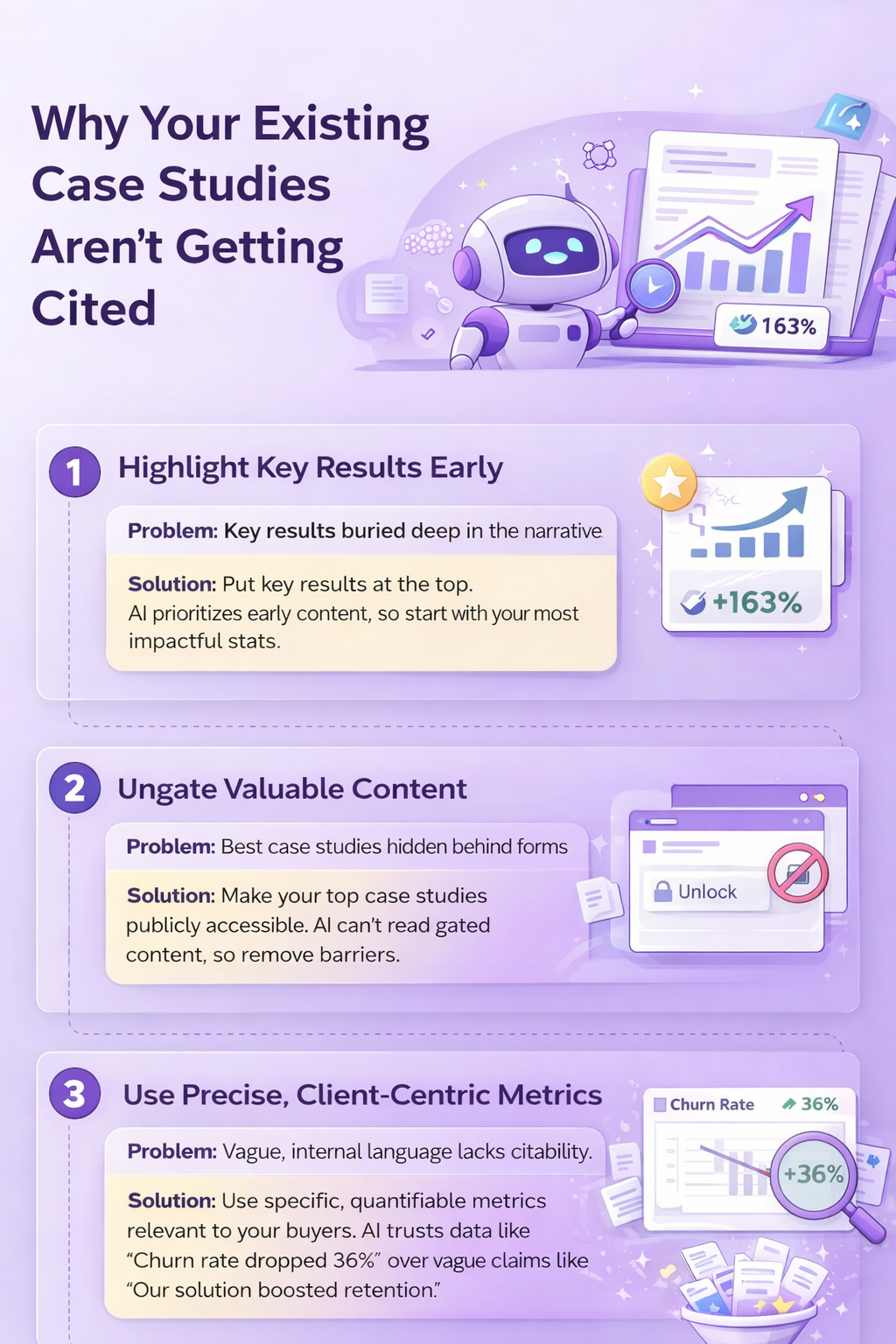
A typical B2B case study follows a well-worn narrative arc: here's the client, here's the challenge they faced, here's what we did, and here are the results. It's a logical structure for a human reader who enjoys a setup-and-payoff story. But AI engines don't read like humans, they scan for extractable facts, and they prioritize what appears early in the document.
So the first problem is narrative-first structure, saving the best for last in a world where AI is only reading the first paragraph. Research on how large language models process long documents has revealed something called the "lost in the middle" problem.
LLMs exhibit a U-shaped performance curve when reading long content: they recall information placed at the beginning and end of a document with high accuracy, but performance degrades by more than 30% for content sitting in the middle, even when the model technically has a large enough context window to process the whole thing.
What this means for your case study is brutally simple: if your key results are sitting in the third or fourth section of a narrative-first structure, an AI retrieving content to generate a recommendation may never effectively "see" them. You could have the most impressive outcome in your industry buried two scrolls down, and it functionally doesn't exist to the model pulling citations.
The cure is to stop saving the best for last.
The second problem is gated content. If your best case studies are locked behind a lead-capture form, they can be invisible to AI crawlers and search engines. They cannot be indexed, cited, or used as evidence of your expertise.
Third is how vague language kills citability. AI engines are skeptical by nature. They want hard evidence, not marketing fluff. A claim like “our client saw significant growth” is almost useless to them because it’s vague and hard to verify. Here’s an example of a specific metric - “GreenLeaf Retail saw their online conversion rate jump from 2.8% to 7.4% after implementing our checkout optimization system.” The more exact you are with metrics, timeframes, and comparisons, the more AI trusts the information enough to cite it. During client interviews, gently dig for real numbers. If they say “sales improved,” ask follow-up questions like “By roughly how much?” or “Compared to the previous period?” Those details become your biggest advantage.
And finally, there's the language mismatch problem. Most case studies are written in internal product-team vocabulary. But your buyers are searching in a completely different language. If your case study describes "implementing a lifecycle engagement framework" but your ideal customer is searching "how to reduce SaaS churn at onboarding," AI cannot bridge that gap for you. The semantic mismatch means you're invisible for the exact query you should be winning.
Quick audit: Pull your top three case studies and answer these questions. Is the key result visible in the first paragraph? Is the page publicly accessible without a form? Does the language match what your buyers would type into ChatGPT? If the answer to any of these is no, you have an immediate fix to make.
Think of formatting for AI the same way you'd think about formatting a document for a very busy executive who has ten seconds to decide if it's worth reading further. Lead with the conclusion. Make the data impossible to miss. Structure everything so the important parts jump out immediately.
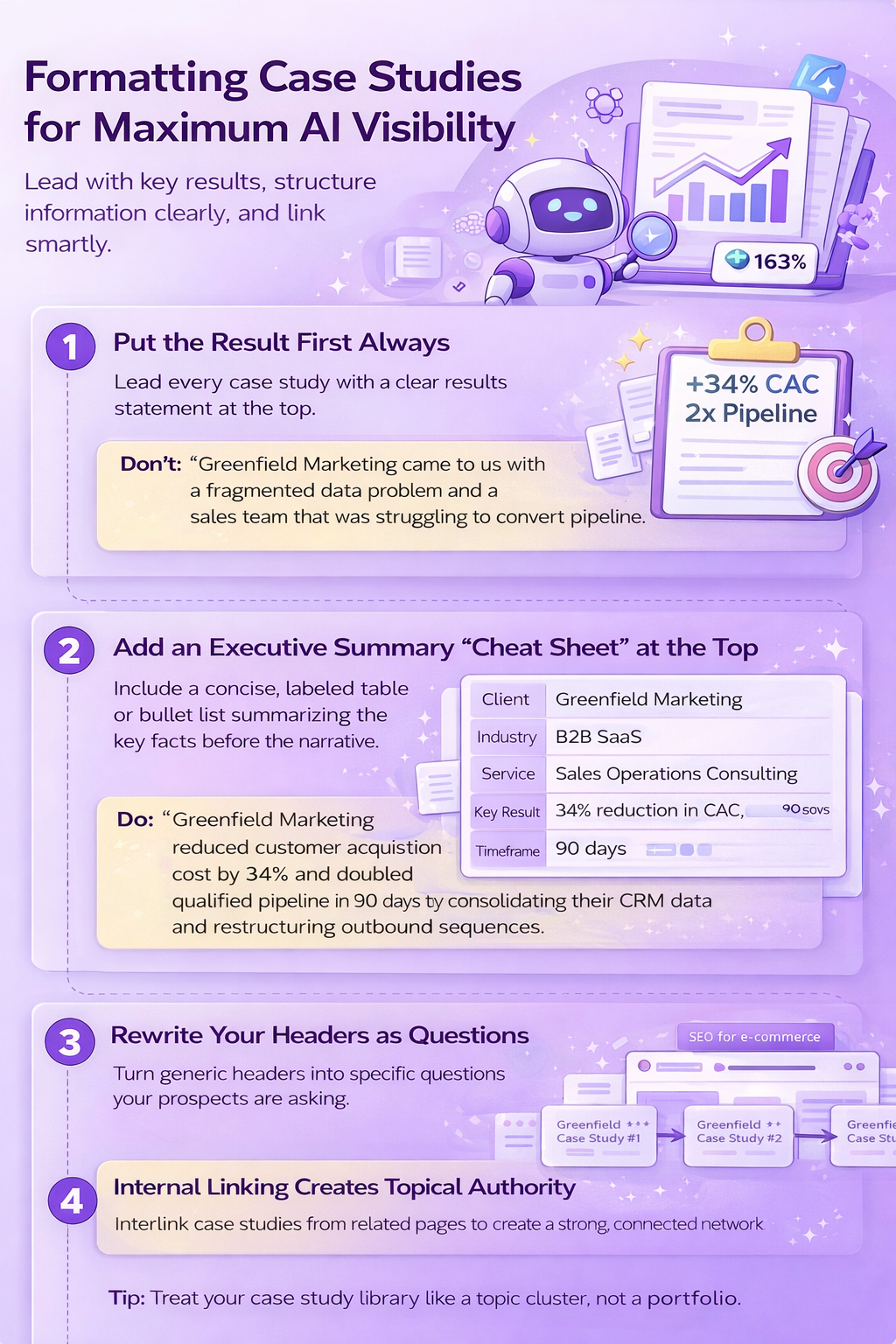
Place a clear results summary right at the top of every case study so both humans and AI immediately see the value.
The first sentence of your case study needs to be a standalone, citable claim:
The biggest shift you can make is adopting a “Bottom Line Up Front” (BLUF) approach. Before the narrative begins, place a small structured table or bulleted list at the very top of the page. Label your data explicitly:
Client: Greenfield Marketing
Industry: B2B SaaS
Service: Sales Operations Consulting
Key Result: 34% reduction in CAC, 2x qualified pipeline
Timeframe: 90 days
This serves two audiences at once: the human scanner who wants to know "is this relevant to me?" in three seconds, and the AI retrieval system that needs structured, labeled data to extract and cite.
Generic section headers like "The Challenge" or "Our Approach" are invisible to an AI looking for answers to specific questions. Reframe them as the questions your prospects are actually typing:
Each header becomes a semantic question-answer pair, exactly the format AI engines use to generate cited responses.
Pro Tip: Always front-load your key sentences. Start with who achieved what, by how much, in what timeframe, and in what context.
An isolated case study page is harder for AI to contextualize. Link your case studies from related service pages, blog posts, and pillar content. When your "SEO for e-commerce" service page links to three relevant case studies, and those case studies link back to relevant methodology posts, you're building a content cluster that signals genuine depth of expertise to AI engines.
Tip: Treat your case study library like a topic cluster, not a portfolio. Every page should be part of a connected web of evidence.
The standard approach is one dedicated page per case study. That's a good start, but it's not enough on its own. The better strategy is a combination:
Dedicated case study pages: full narrative, full data, targets long-tail queries like "B2B SaaS marketing agency case study" or "HubSpot implementation results for e-commerce." These become linkable, citable assets.
Embedded excerpts on service pages: pull a striking metric and a client quote and embed them directly in your service pages, with a link to the full case study. This adds real-world proof exactly where Google expects it and makes your service pages richer, more authoritative content.
This is the most overlooked part of the entire strategy. 82% of links cited by AI engines came from earned media. Your own website is harder for AI to cite with confidence than a third-party publication that covers your industry.
The practical fix: after publishing on your own site (keeping the canonical URL there), republish a reformatted version in trade publications, industry blogs, or media that already serves your ICP. Think of it less as a guest post and more as placing your evidence in a library that AI already trusts.
Repurpose case studies and share in industry-specific Reddit communities, LinkedIn newsletters, and relevant Slack groups, framed as lessons or analysis, not promotion. These surfaces are increasingly indexed by AI engines, and a case study result shared authentically in a trusted community carries real citation weight.
That audience has expanded. It now includes AI engines that are synthesising recommendations for millions of buyers every day, and those engines are actively looking for the kind of evidence that only a well-documented case study can provide.
The good news is that the changes required aren't monumental. You don't need to rebuild your entire content strategy. You need to put the result first, structure the data so it can be extracted, add schema markup, make the content publicly accessible, and place it where trusted sources can amplify it.
Start with your three best existing case studies. Run them through the quick audit in section two. Pick the one with the strongest results and reformat it this week, BLUF table at the top, restructured headers, results table, FAQPage schema, ungated. Then get it placed somewhere beyond your own website. Most businesses still don't have a single AI-optimised case study. The ones that move first will be the ones AI defaults to recommending, and in a world where 60% of searches end without a click, being the cited source is the conversion.
.avif)

Most traditional case studies are written as long narratives with key results buried deep in the content. AI engines prioritize structured, easily extractable information placed early in the document, making vague or poorly formatted case studies difficult to cite.
No. Gated case studies are often inaccessible to AI crawlers and search engines, limiting their visibility and citation potential. Publicly accessible case studies are far more discoverable in AI-powered search experiences.
Start by adding a results-first summary, rewriting headers around real customer questions, including measurable outcomes, improving internal linking, and distributing the case study through trusted industry publications and communities.
Beyond your own website, republishing case studies on industry publications, LinkedIn newsletters, Reddit communities, and niche media platforms can improve authority and increase the likelihood of being cited by AI engines.

From collection to clarity — we’ll help you make sense of it all.

Giving shape to intelligence