



A few years ago, you could build a solid career layering execution on top of execution: endless decks, briefs that no one fully read, reports that proved you were watching the numbers, and social posts scheduled like clockwork. Busyness felt like progress. Judgment was there, but it often hid behind the volume. You could coast if you stayed productive enough.
AI ripped that comfort away. Tools now generate copy, build campaigns, optimize budgets, and analyze performance in minutes instead of weeks. What’s left standing is the part that was always hardest and most valuable: deciding what actually matters, reading the room correctly, and owning the results when things inevitably drift. The marketers who thrive in 2026 are the clearest thinkers and the strongest judges.
In this blog, we’ll discuss how the role is evolving. I’ll show you what forward-leaning teams are actually doing with AI today. Then we’ll dive into the emerging role that’s becoming one of the clearest career paths forward: the Content Engineer. We’ll break down what it really means, the responsibilities involved, and the concrete skills you need to develop if you want to stay relevant.
What Marketers Are Actually Doing With AI Right Now
Planning: from gut instinct to data-grounded hypotheses
Planning used to mean a marketer staring at last quarter's dashboard and a competitor's latest campaign, then making an educated guess. AI has replaced the guesswork that preceded it.
Nestlé partnered with Accenture and Salesforce Einstein to feed social sentiment, behavioral data, CRM information, and third-party signals into AI models that surface emerging trends and emotional tone across markets before a campaign brief is even written.
The result was campaign planning time cut by roughly 50% in some cases, with culturally adapted content showing 35% higher engagement in emerging markets because the AI caught the cultural nuance a generic global brief would have missed.
Automation: from manual reporting to systems that flag and act
This is the most mature use case, and also the most misunderstood. Automation in 2026 marketing doesn't mean "if X then Y" email sequences anymore. It means systems that watch performance continuously and surface decisions before a human would have noticed the problem.
Function Growth used Improvado's AI-powered reporting layer to flag performance shifts and suggest budget reallocation in real time, instead of waiting for a weekly manual pull, a shift that moved the team's actual job from reporting to optimization, and reportedly lifted team productivity by 30%. Yum Brands (Taco Bell, KFC, Pizza Hut) built reinforcement learning into email marketing to continuously adjust send timing and offer content based on individual customer behavior patterns, improving repeat purchase rates without a human manually A/B testing send times forever.
But none of this automation eliminated the marketing job. It eliminated the part of the job that was essentially clerical, checking a dashboard every Monday morning. What's left for the human is interpreting why the system flagged something and deciding whether to trust the recommendation, which is a judgment call no automation layer makes on its own.
Content and creative: from production bottleneck to volume without the studio
This is where the change is most visible, and where the stakes around quality control are highest. Nutella used AI to generate 7 million unique jar label designs and the entire run sold out. The New York Times built internal AI tools to help reporters brainstorm headlines, summaries, and FAQ ideas, but drew a hard line. AI doesn't write or edit full articles, and nothing publishes without a human in the loop. That line is the whole point.
The pattern across these examples is the same: AI didn't replace the brief, the brand standards, or the review gate. It replaced the manual labor of producing variations against those standards. Teams that skipped the standards-setting step and just generated content got generic, forgettable output. Teams that built the governance layer first got Nutella's 7 million sold-out jars.
The Emerging Role of Content Engineering
If you want one piece of hard evidence that this isn't a vibe shift but a structural one, look at job titles and compensation data. "Content Engineer" listings are growing 300%+ annually while traditional Content Marketing Manager listings have dropped 73% since 2023, according to market data compiled by Averi. So what is the job, actually?
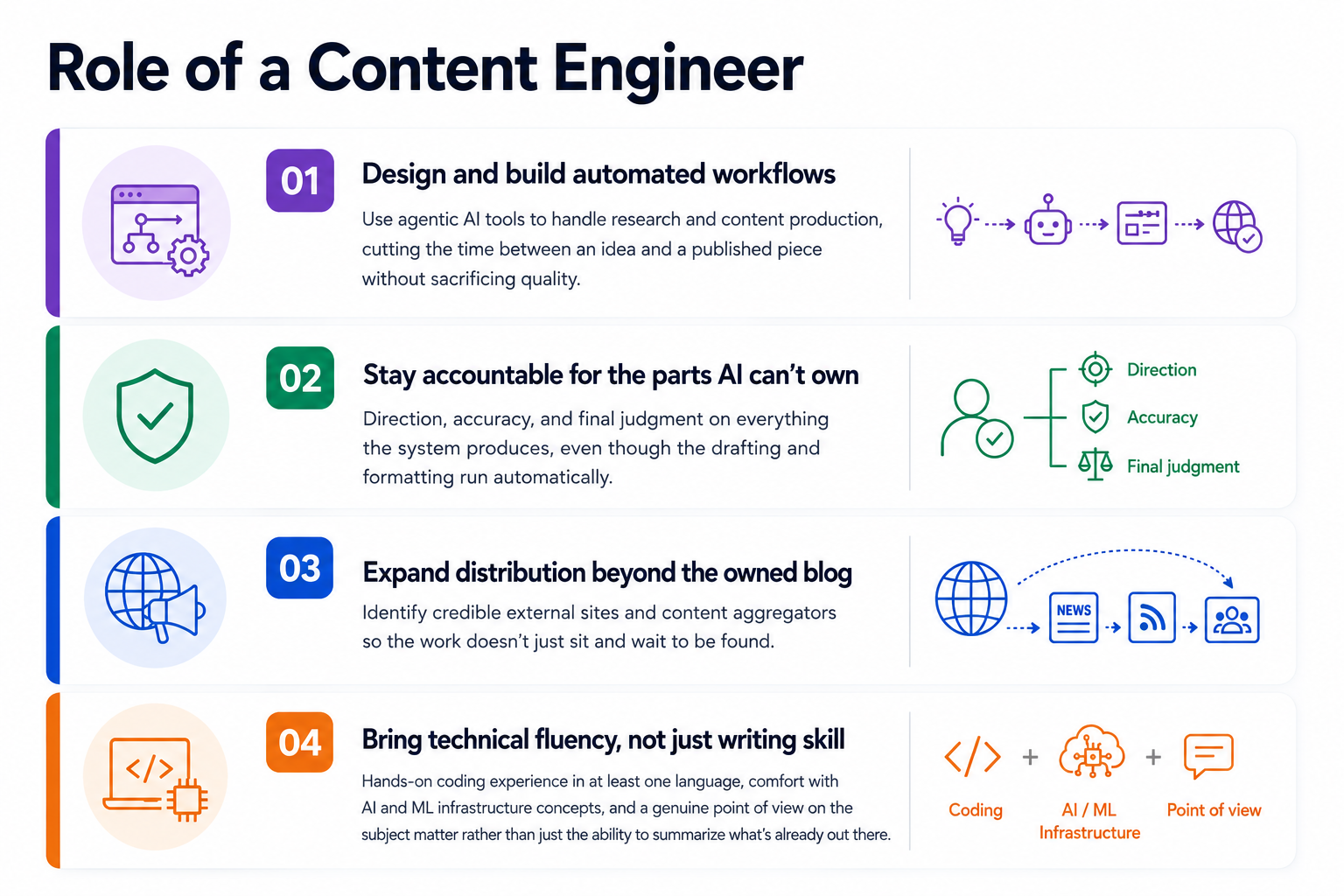
A Content Engineer designs, builds, and governs the system that produces content, the pipeline that researches a topic, drafts it, optimizes it for search and AI answer engines, publishes it to the CMS, tracks how it performs, and feeds those results back into the next cycle. The clearest way to picture the distinction: a content marketer is the driver. A content engineer is the person who designs the road the driver moves on
In practice, the role's responsibilities tend to cluster into four areas:
Workflow design. Building the prompts, templates, and quality gates that turn a one-line content request into a finished, on-brand piece without a human touching every step. This is the unglamorous, infrastructure-heavy part of the job, closer to systems thinking than to copywriting.
Brand and quality governance. Setting the guardrails that prevent AI output from drifting off-brand, factually wrong, or legally exposed. This is the part most teams underbuild and then pay for later, off-brand messaging, compliance gaps, and inconsistent quality are explicitly called out as the risk of adopting AI without dedicated governance.
Distribution and discoverability. Optimizing not just for traditional SEO but for how AI search engines like ChatGPT, Perplexity, and Google AI Overviews surface and cite content, which increasingly rewards original insight and specific data over generic, anyone-could-have-written-this copy.
Measurement and feedback loops. Connecting analytics back into the content system so that what performed well last cycle actually changes what gets produced next cycle, rather than living in a quarterly report nobody acts on.
To be clear, there's real debate about whether this needs to be a standalone hire or a skillset every senior content marketer should absorb. Ahrefs' Ryan Law has argued the role risks being overhyped and may prioritize automation over actual creative judgment. The more grounded read, and the one worth internalizing regardless of your title, is this: at startup and small-team scale, "content engineer" is less a job to hire for and more a capability to build into your existing marketers. At enterprise scale, multiple brands, multiple markets, high content velocity, it becomes a dedicated function because the coordination problem gets too large for any one generalist to hold in their head.
The Skillset Marketers Should Actually Be Building
AI fluency as baseline. Prompt engineering as a standalone skill barely shows up in job postings anymore, it appears in under 0.5% of listings, because it's assumed, the way "knows how to use email" is assumed. What's expected instead is working fluency across the actual tools, generative platforms, automation layers, analytics copilots, well enough to direct them, not just prompt them once and accept whatever comes back.
Systems thinking. This is the real differentiator behind the Content Engineer title, but it applies whether or not you ever take that title. It means thinking in pipelines and feedback loops instead of individual deliverables, recognizing that a single great blog post matters less than a system that reliably produces ten good ones a month without quality decay.
Cultural and brand judgment. This is the thing AI still can't do, and every case study above confirms it indirectly, the campaigns that worked (Nestlé's localized messaging, Salomon's structured creative brief, Dove's "Real Beauty Prompt Playbook" for keeping AI-generated beauty imagery on-brand and inclusive) all had a human define the standard before generation started. The marketers who skip that step get generic output; the ones who don't get sold-out Nutella jars.
Data interpretation over data production. Pulling a report is now table stakes. The valuable skill is reading the report and knowing which number is actually a signal and which is noise and being willing to act on a prediction before the full picture confirms it, since predictive systems are increasingly asking marketers to act before the retrospective data would have told them to.
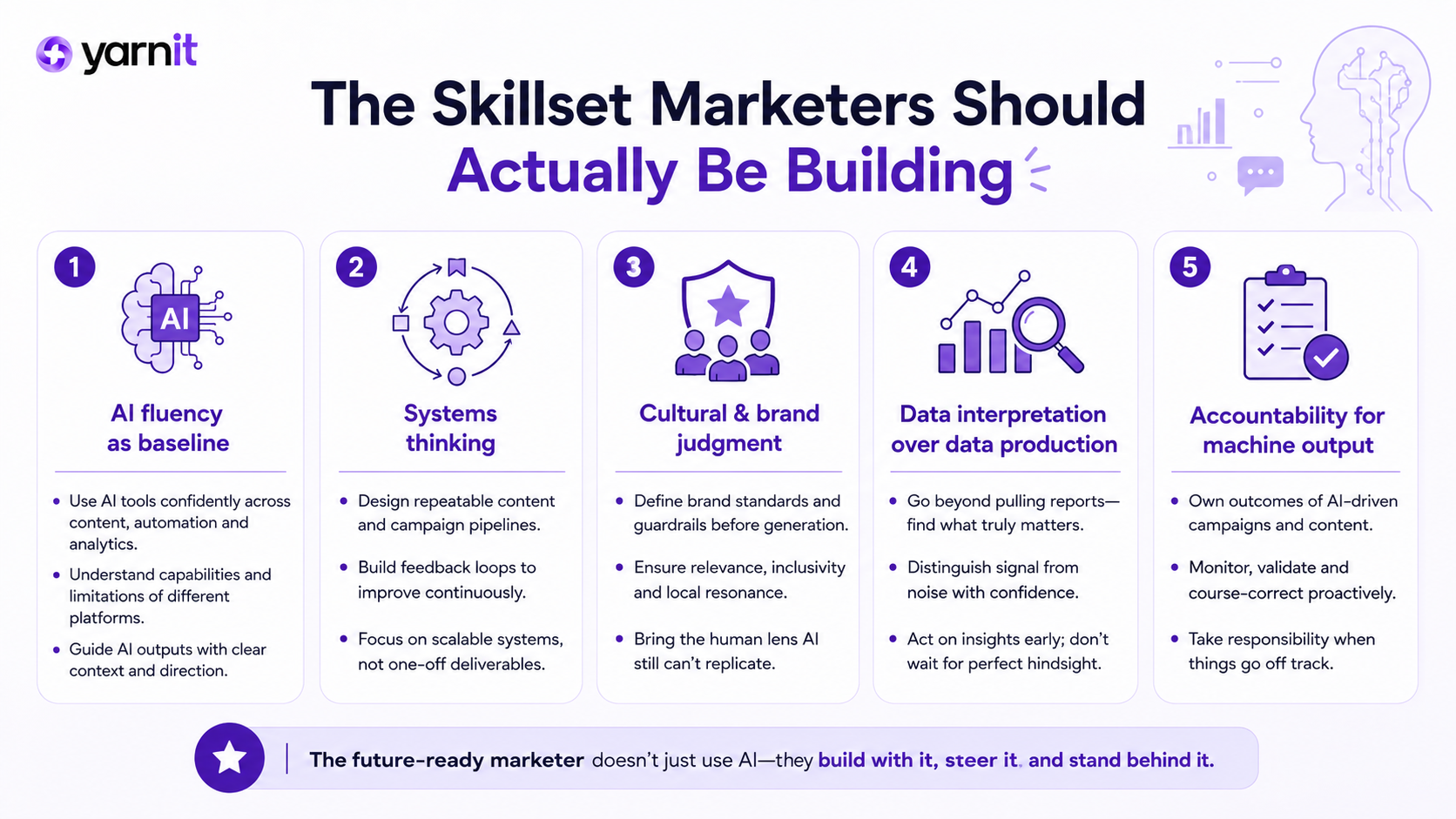
Accountability for machine output. When a model drafts a campaign and it underperforms, "the AI wrote it" is not a defensible answer anymore. Owning the outcome, including when the system you built drifts off-brand or makes a bad call, is becoming an explicit, named expectation rather than an implicit one.
What Comes Next
AI compressed execution. That exposed the truth: many careers were built on activity that can now be done faster and cheaper by machines. The best marketers were never hiding behind that execution, they were using it as a vehicle for judgment. Now judgment is naked and non-negotiable.
Teams that get this are hiring and training differently. They measure different things. They build systems so humans can focus on the work that matters: strategy, taste, accountability, and cultural relevance.
If you’re a marketer today, the path forward is clear but not easy. Audit where you still add value through pure execution. Start building small systems, even simple prompt libraries or review frameworks. Invest in your judgment muscle: read more widely, practice hard calls, and get comfortable steering AI instead of just consuming its output. The future belongs to marketers who engineer great work at scale while keeping their finger firmly on the human pulse.


