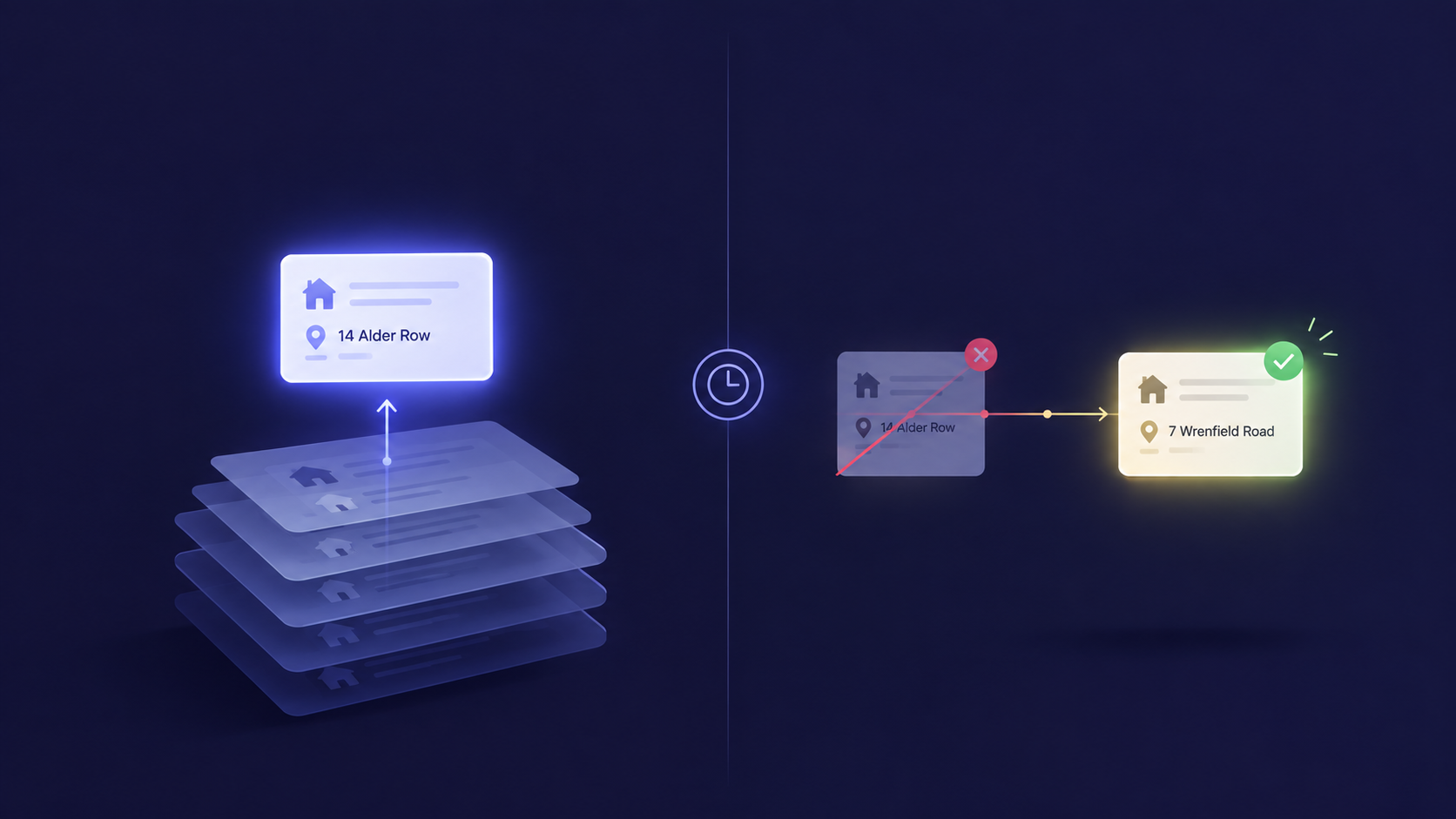
For most of marketing history, scale was a budget problem. More creative meant more production costs. More markets meant more shoots. More audiences meant more briefs. Small teams didn't lose because their ideas were worse, they lost because they couldn't produce enough to compete. AI changes that equation completely.
Digital platforms made this gap worse before AI made it better. Meta, Google, TikTok, and LinkedIn reward creative rotation, their algorithms thrive on variation and volume. The more variants you feed them, the faster they learn, and the better your results. Big brands with agency relationships and production budgets could keep up. Everyone else ran campaigns at a fraction of the scale needed to actually optimise.
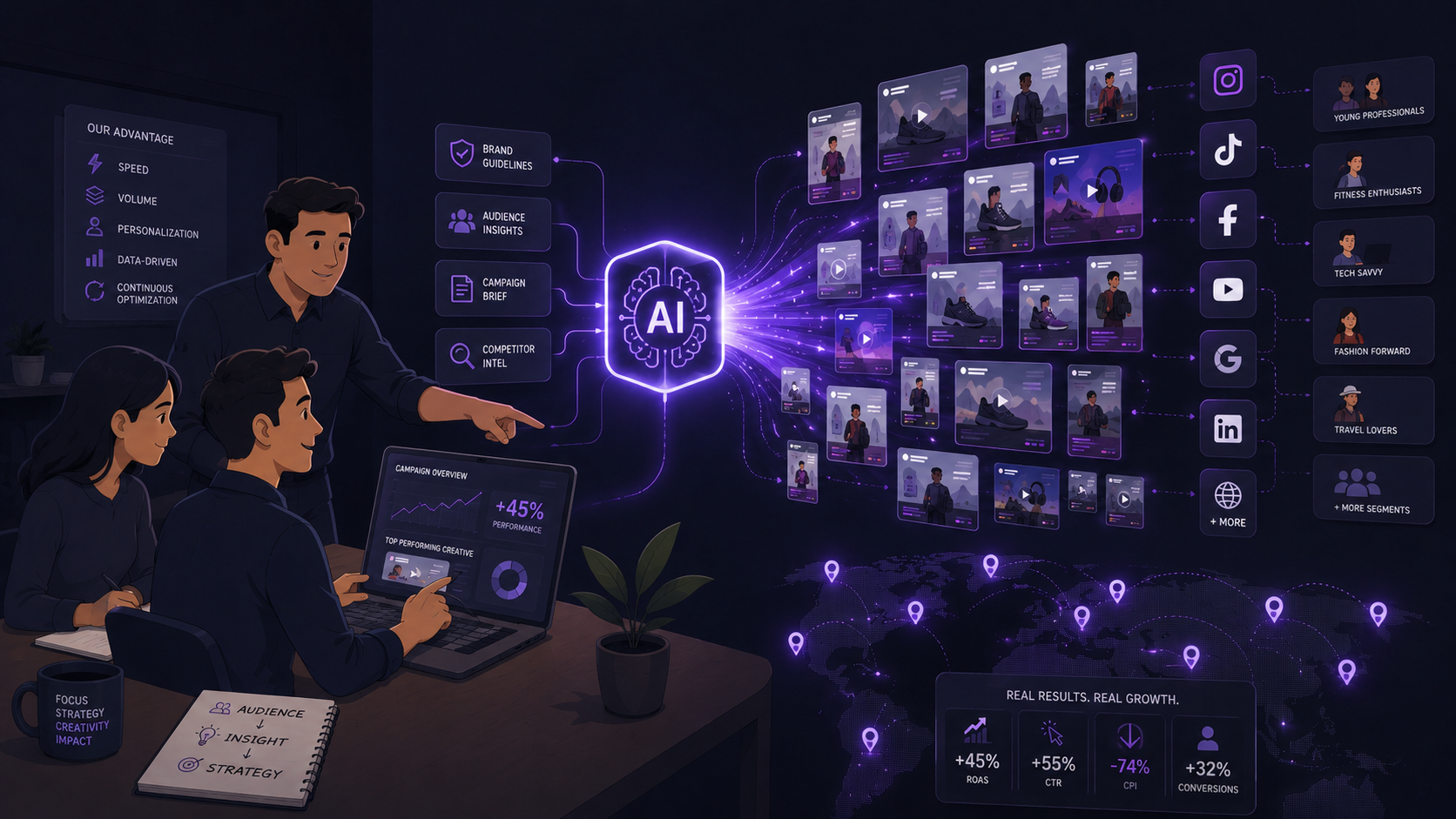
That constraint is gone. AI now lets a two-person marketing team operate like a creative studio, generating dozens of on-brand ad variants in the time it used to take to write a brief. The bottleneck has moved from production to strategy, which is exactly where it should have been all along.
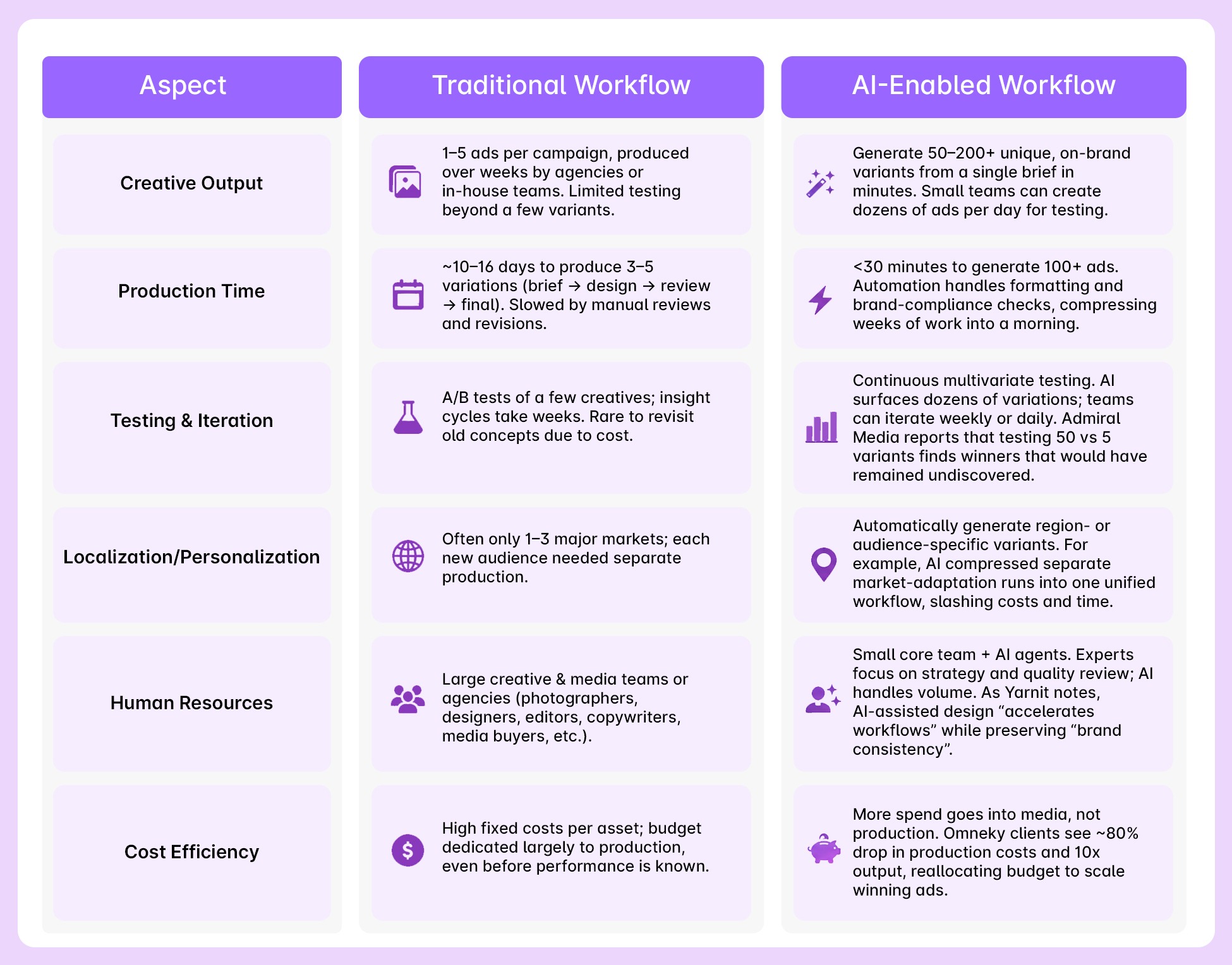
Traditional vs. AI-Enabled Production
Previously, producing a handful of ads could take 10–16 business days, often via external agencies, with each new market or message requiring a full re-run. In contrast, AI-driven workflows let a small team input a brief and instantly generate hundreds of on-brand ad variations. Brand guidelines can be embedded into the AI, so every variant (across formats or regions) adheres to the look-and-feel – something tedious to enforce manually. In practice, companies like Kimberly-Clark and Target have moved big chunks of creative in-house using AI, cutting content production from weeks to hours.
The net effect: capabilities that once required big budgets are now tools in any marketer’s belt. Suddenly, a two-person team can function like a mini-agency at scale.
Creative Volume as the New Competitive Edge
In performance marketing, creative is the growth engine, but only if you have enough of it. When AI does the heavy lifting of production, creative ceases to be scarce and becomes excess. This fundamentally changes strategy.
Rather than painstakingly crafting one “great” ad, the winning approach is to treat your campaigns like factories producing hundreds of iterations. Every concept spawns multiple hooks, images, headlines and formats. Yarnit, for example, embeds brand voice and visuals so that each output variation remains consistent, while enabling “endless creativity”.
The payoff is dramatic. Smart algorithms thrive on variation. Admiral Media’s work with game and app advertisers illustrates this: by testing 50 creatives instead of 5, they uncovered ads that traditional workflows would never have surfaced. Those extra winners drove big gains (e.g. +55% CTR, +45% ROAS in one case) simply because the testing surface was much larger.
Likewise, Omneky reports that brands using AI platforms achieved 30–60% higher CTRs and around 32% better ROAS within 90 days. Why? Because more creatives means faster learning. Each new ad variant is a data point; the best performers are quickly scaled, and the rest dropped. Over time, this compounds: speed multiplies advantage. When a competitor’s campaign lags by even one week, your AI-driven campaign has already gathered performance data and iterated. In a season-long campaign, those weeks add up to an unassailable lead.
Think of traditional campaigns as flipping a single coin a few times to predict weather. AI-powered marketing is like launching hundreds of balloons with sensors into the sky: you map the storm with precision. The first approach relies on intuition; the second builds intelligence through scale.
Practical Tip: Don’t treat AI creatives as “magical fixes.” The human role is still critical. Marketers must design systematic tests (different hooks, visuals, calls-to-action) and let AI produce the variants. The machines handle volume; people handle creativity and judgment. The result is a feedback loop where creative choices are driven by real data.
Guerrilla Growth: Small Teams, Big Ambitions
Personalization and Multi-Channel Scaling: AI doesn’t just crank out static ads. It can automate personalization and multi-channel workflows. For example, a retailer can use AI to tailor creatives to dozens of niche audiences (by interest, industry, or persona) rather than settle on one generic message. An automotive startup could produce separate video ads for commuters, families, and ride-share drivers without hiring separate directors. Tools like Yarnit allow brands to generate contextual content, ads, social posts, landing pages, all aligned to the same core brief and brand guide.
Localization Without Rebuilding: AI is particularly powerful for geo-specific marketing. The Admiral “PURE App” case study shows how AI-generated variants allowed one dating app to cut cost-per-install by 74% while scaling globally. Traditional production would have needed multiple shoots or designers for each country’s adaptation, but AI produced market-specific outputs automatically. For instance, a software company can have AI rewrite and reformat one core campaign for healthcare, finance, retail industries, etc., automatically embedding the jargon and imagery of each sector.
Autonomous Marketing Flows: Beyond creatives, AI agents can handle research and outreach. Tiny teams can deploy AI “personas” to scan competitive landscapes, discover trending keywords, or even craft personalized outbound sequences. (For example, an AI agent could analyze a target account’s news, website updates and social feed, then draft and schedule a tailored email series, a task that formerly required hours of analysis by a human.) This means even Account-Based Marketing and email nurture sequences can be built at scale with minimal manual work. In short, any marketing task that involves repetitive analysis or copy-pasting can be handed to AI. This frees humans for higher-level strategy: selecting target segments, brand messaging, and interpreting the AI’s findings and outputs.
Case in Point: As another example, consider European retailer Zalando. By integrating AI into its content pipeline, Zalando cut image production from weeks to a few days and cut costs by 90%. Crucially, they discovered it wasn’t just “better” content, it was new and fresh content that drove engagement. As Zalando’s VP of content explained, the advantage came from being “reactive” to short-lived trends. A shoe retailer in India can similarly ride a viral TikTok fad by generating a flash ad campaign in hours that appeals directly to that moment, something unheard-of a few years ago.
The Media Operating System: Integrating AI, Data, and Workflow
All these pieces start to add up to what industry analysts are calling a Media Operating System, a cohesive workflow that treats AI-powered content, data, and tools as interconnected infrastructure, not as siloed one-off hacks:
Campaign Brief & Data Inputs: Everything starts with strategy inputs, campaign goals, brand guidelines, audience personas, competitive intelligence. AI agents may gather data here (e.g. scan competitors’ latest ads, keyword trends, or CRM signals).
AI Creative Generation: Platforms like Yarnit take the brief and instantly spit out ads: images, videos, copy, and even landing page content. They incorporate brand rules (logos, colors, tone) so that no matter how many variants are generated, consistency is maintained.
Ad Variants Library: The generated creatives populate a library. These are pre-formatted for each channel (Instagram, TikTok, Google, etc.) and segmented by audience or context.
Multi-Channel Deployment: Ads are distributed across channels via integrated ad managers. Here, programmatic buys and social ads leverage the varied creative pool to automatically optimize delivery (for example, Meta’s algorithm learns to show each variation to sub-audiences likely to engage).
Performance Data & Feedback: As the ads run, metrics (CTR, conversions, engagement, etc.) flow back into dashboards and databases. This data includes not just final outcomes, but engagement signals (like video watch-time or scroll-depth) that hint which creative elements work.
AI Analysis & Optimization: Now AI agents come back into play to mine the data. They can answer questions like: “Which headline outperformed? Which image drove higher CTR among Gen Z? Did certain color palettes correlate with lower CPA?” Based on these insights, the system automatically tweaks the next creative batch: pulling high-performing elements forward and retiring weak ones. The loop then feeds into the next round of brief/refinement.
This closed-loop media OS means campaigns evolve in real-time. The result is akin to having an always-on R&D lab for marketing. Crucially, it’s feasible for small teams because the “operating costs” (data pipelines, agent workflows) are software-based. According to Smartly, brands that align creative and media into unified workflows see budgets stop leaking on misaligned assets. They are essentially running countless micro-experiments automatically. By contrast, the old silos (creative vs media vs analytics) are left in the dust.
Getting Started: A Roadmap to Adoption
This future may sound complex, but adoption can be phased. No team has to revolutionize overnight. A practical 6–8 step plan might look like this:
Educate & Plan: Convene the team for AI demos and strategy sessions. Sketch out which pain points to tackle first (e.g. “We have no video team; let’s try AI video scripts”). Set metrics (time saved? creative count? performance lift?).
Pilot Use-Cases: Start small. Perhaps use an AI tool to write email copy or generate banner images for a mini campaign. Evaluate quality and ROI. Learn from the pitfalls.
Implement Infrastructure: Onboard a platform like Yarnit or another creative AI tool. Upload brand assets and guidelines so that all outputs auto-conform to your voice. If possible, integrate it with existing project tools (e.g. Slack notifications for AI suggestions).
Run AI-Generated Campaign: Use AI to build a real multi-variant campaign. For instance, take an upcoming product launch and generate 20–50 ad variants. Launch on Meta/Google. Track all performance closely.
Build the Loop: Start automating the analysis. Use analytics dashboards (or AI analytics tools) that can identify winning variables. Set up regular check-ins where the team “teaches” the AI which ads to scale next.
Scale & Refine: Once comfortable, scale up. Increase budget on high-performing AI ads. Roll out to new channels (like TikTok or Pinterest) using the same briefs. Possibly add AI agents: one that scans competitor ads, another that drafts A/B test hypotheses, etc.
Continuous Learning: Review results regularly. Adopt AI-based content planning (like Yarnit’s contextual SEO suggestions) and personalization (dynamic ad content). Over time, many manual tasks will fade away, allowing the team to focus on high-level strategy.
The key is treating AI outputs as starting points, not finished products. Even though AI can output publishable ads, the best practice is to have marketers review and tweak. This human+AI partnership yields the quality that prevents “AI content fails”. Over 2–3 quarters, a systematic approach will transform your marketing engine. As metrics like those from Admiral and Omneky suggest, the ROI is not merely efficiency—it’s about unlocking hidden growth opportunities.
Conclusion
Every few years there's a moment where a new capability shifts who can compete at what level. Desktop publishing did it for small publications. Social media did it for small brands. This is one of those moments for marketing teams.
The shift isn't subtle. The things that used to require a big budget, production scale, creative volume, localization, personalization, always-on ABM, are now accessible to any team with the right tools and the discipline to use them. The budget is no longer the constraint. Creativity, strategy, and execution are.
Big brands are actually slower to adapt here than you might expect. Legacy agency relationships, approval processes, brand governance structures, all of it creates drag. A small team with fewer stakeholders and faster decision cycles can outmaneuver a larger competitor that's still waiting for the next quarterly creative review.
The question to ask yourself isn't "how much time will AI save us?" It's "what would we do if production were essentially free?" Answer that question, and you have your roadmap.
The era where budget defined capability is ending. What replaces it is creative velocity, the ability to generate, test, learn, and adapt faster than the competition. Any team can build that now. The ones that do will look, to everyone watching from the outside, like they have an unfair advantage.
They do. And so can you.
See exactly why your Product Detail Page isn't converting
Thank you! Your submission has been received!
Oops! Something went wrong while submitting the form.
Frequently Asked Questions
How is AI helping small marketing teams compete with larger brands?
AI automates content creation, localization, personalization, and campaign optimization, allowing small teams to execute at a scale that previously required large budgets and agencies.
Why is creative volume important in modern marketing?
Platforms like Meta, Google, and TikTok reward testing and variation. More creative assets generate more performance data, helping algorithms identify winning combinations faster.
What types of marketing content can AI generate?
AI can generate ad creatives, social media posts, videos, landing pages, email campaigns, blog content, localized assets, and audience-specific variations from a single brief.
What should marketing teams automate first with AI?
Most teams start with content creation, ad copy generation, creative variations, email campaigns, and performance analysis before expanding into more advanced workflows.



.avif)

%20(1).png)