AI Insights
Agent Memory Has Outgrown Retrieval
Most AI memory systems can find relevant past information but can't tell if it's still true, so agents act on stale data that was technically "retrieved correctly."
September 17, 2026

In this blog, we'll cover the strategic shift from TOFU to BOFU, decode what makes BOFU content unique, and give you a tactical blueprint for structuring content that search engines can't help but reference.

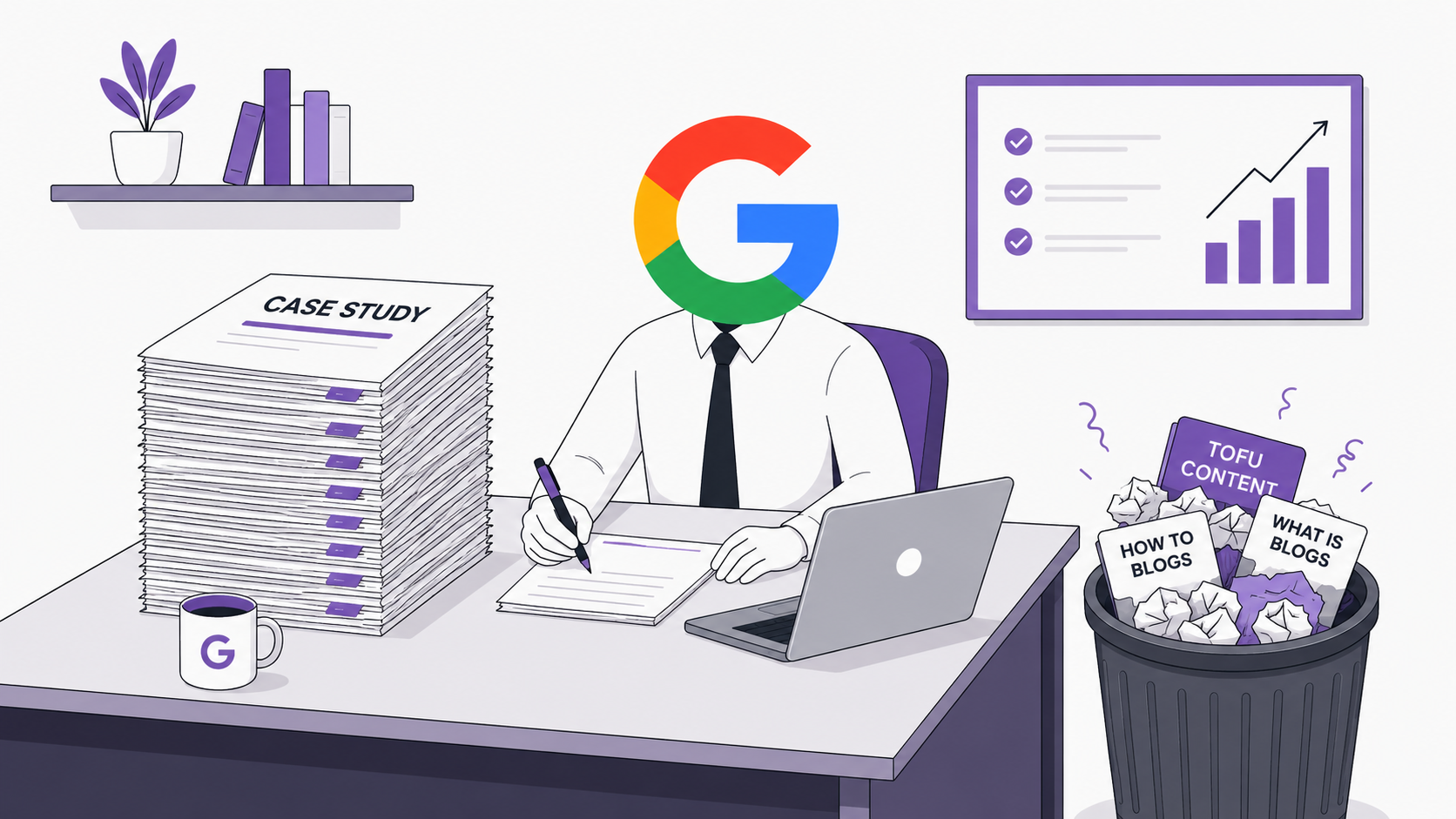

The Google citation that never came. That's what keeps B2B marketers up at night now.
You've published the thought leadership pieces, the industry trend reports, the "future of" predictions. Thousands of words. Decent traffic. But when someone searches "best project management software for remote teams" or "enterprise CRM implementation checklist," your content is nowhere to be found.
Here's what changed: Search engines stopped rewarding content that makes people think and started prioritizing content that helps people decide. The awareness-building blog posts that dominated SEO strategies for the past decade? They're being pushed aside by bottom-of-the-funnel content that answers the question every high-intent buyer is actually asking: "Which solution should I choose, and why?"
For B2B marketers, this creates a rare asymmetric opportunity. While your competitors are still chasing viral thought leadership and pumping out top-of-funnel content, you can dominate the searches that actually generate revenue. But only if you understand what makes BOFU content citation-worthy in the first place.
We'll cover the strategic shift from TOFU to BOFU, decode what makes BOFU content unique, and give you a tactical blueprint for structuring content that search engines can't help but reference.
Search has evolved because users have evolved. They don't want generic "what is" content anymore. They want specific comparisons, detailed case studies, ROI calculators, and proof that solutions actually work. That's BOFU territory, and search engines have adapted to prioritize this kind of content because it genuinely serves user intent better than surface-level information.
With features like Google AI Overview accounting for a higher percentage of traffic everyday, AI engines are evaluating content quality, relevance, and depth in ways that directly impact what gets surfaced and cited.
BOFU content sits at the sweet spot of this evolution. Approximately 70% of B2B buyers consume BOFU content during their decision-making process. Unlike broad, informational content at the top of the funnel, BOFU content addresses specific, high-intent queries from people who are actively evaluating solutions. Search engines prefer this kind of content because it actually answers specific questions instead of providing surface-level overviews.
The Content Marketing Institute reports that BOFU content generates 2-3 times higher conversion rates compared to top-of-funnel efforts. When you create content that directly addresses purchase-stage questions, you're not just attracting more visitors, you're attracting the right visitors.
For B2B marketers specifically, BOFU content offers three massive advantages:
Top-of-funnel content, all those "what is" and "why does" articles, has been largely commoditized by zero-click search experiences. You know what we're talking about. Users type a query, get an answer box or AI-generated response right there on the search results page, and never click through to your carefully crafted content.
Zero-click searches now account for nearly 50% of all Google searches. That's half your potential TOFU audience getting their answers without ever visiting your site.
This fundamentally shrinks your total addressable market at the top of the funnel. The easy wins that TOFU content used to provide are gone, or at least significantly harder to capture.
But BOFU content shines here. Because of its complexity, specificity, and depth, BOFU content can't be easily summarized in a snippet or quick answer box. Users need to engage with the full content to extract value. This creates a natural advantage for B2B marketers willing to invest in comprehensive, bottom-funnel resources.
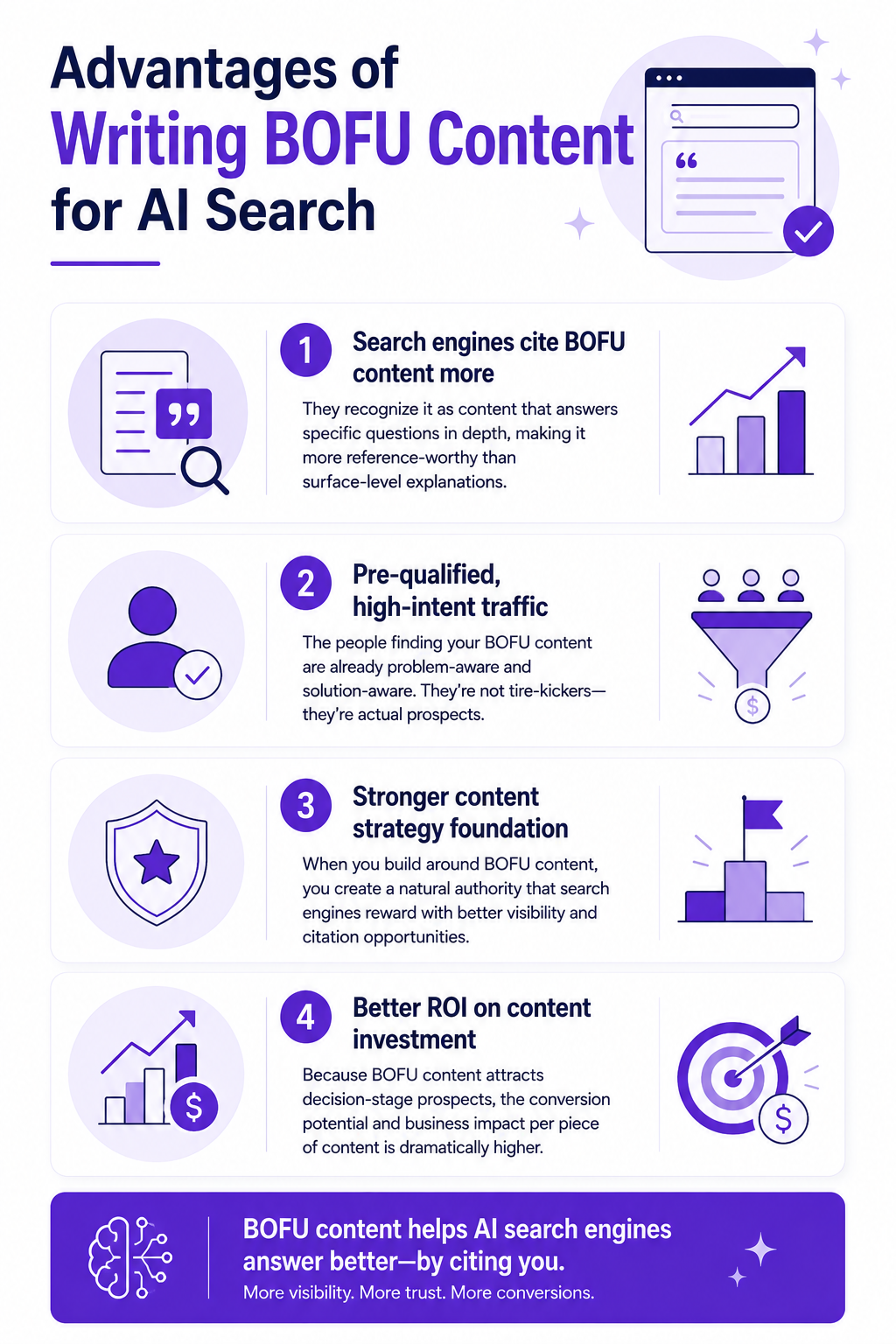
While TOFU content might generate more raw traffic, BOFU content generates more qualified leads and actual business outcomes. For resource-constrained B2B marketing teams, that trade-off makes perfect sense.
Does this mean abandoning TOFU content entirely? Not necessarily. But it does mean rebalancing your content portfolio to invest more heavily in the formats and topics that actually move your business forward in today's search environment.
The funnel stages break down like this:
That last one ("how we") is what separates effective BOFU content from everything else. BOFU content isn't about explaining industry concepts or providing generic how-to guides. It's about demonstrating your specific approach, methodology, and results. It's about showing prospects exactly how your company solves their problem better, faster, or more effectively than alternatives.
This positioning is what makes BOFU content stand out to both readers and search engines. When you create content focused on "how we," you're providing something genuinely unique that can't be replicated by competitors. You're sharing proprietary insights, proven methodologies, and real-world results that establish authority in ways generic content never can.
The difference:
Search engines increasingly look for this kind of specificity and authenticity. They want to surface content that provides genuine value and unique perspectives, not rehashed information available everywhere. When you focus on "how we" content, you're naturally creating resources that meet these criteria.
The content types that typically fall into the BOFU category include:
Each of these formats allows you to showcase your expertise while providing the kind of specific, actionable information that prospects at the decision stage actively seek out.
Creating great BOFU content is one thing. Structuring it so search engines actually cite and reference it? That's where strategy meets execution. Seven ways to structure BOFU content so it gets cited:
Place your main insights, statistics, or conclusions right at the top in a clear summary format. Search engines often pull from these sections for featured snippets and citations. Make it easy for them to extract and attribute your key points. Think of this as your "TL;DR" section that delivers value even if someone only reads the first few paragraphs.
Resist the urge to gate your best BOFU content behind forms or paywalls. Yes, you want leads, but you also want citations and search visibility. Gated content rarely gets referenced because search engines can't index it properly, and other sites won't link to content their readers can't access. Find other ways to capture leads, like newsletter subscriptions or related resource offers, while keeping your core BOFU content open.
Start with the specific industry challenge or pain point you're addressing. Be explicit about:
This structure aligns with how prospects search for solutions and how search engines evaluate content relevance.
Include keywords that mirror your ideal customer's search queries in your URLs and H2 headings. Don't just use internal jargon or clever phrases. If your ICP searches for "B2B lead generation ROI," make sure that phrase appears in your URL structure and headings, not just your body copy. This helps search engines understand exactly what problems your content solves and for whom.
Your BOFU content should speak directly to your ideal customer profile. Use industry-specific language, reference common challenges they face, and incorporate the metrics they care about. Generic content appeals to everyone and no one. Specific content that deeply resonates with your ICP gets shared, linked to, and cited by the communities and publications they follow.
Search engines favor content that provides concrete evidence and measurable outcomes. Instead of saying "significant improvement," say "47% increase in qualified leads over 90 days." Instead of "better ROI," say "3.2x return on ad spend compared to industry average." Specificity builds credibility and makes your content more citation-worthy.
Use descriptive subheadings, bullet points, and short paragraphs to make your content easy to scan. Search engines favor content that's well-structured and user-friendly. If a reader can quickly find the specific information they need, search engines will consider your content more valuable for citation purposes.
Quick checklist for citation-worthy BOFU content:
The shift to BOFU content is about recognizing where the actual opportunity lies. While everyone else chases diminishing returns at the top of the funnel, smart B2B marketers are investing in content that attracts high-intent prospects, establishes genuine authority, and generates the kind of citations and references that compound over time.
Start by auditing your existing content. Look for pieces that could be repositioned or expanded into BOFU resources. That generic "how to" guide? Transform it into a case study showing how your approach delivered specific results. That broad industry overview? Narrow it down to address your ICP's exact challenge with your unique solution.
The best part? You don't have to start from scratch. Much of your current content can be repurposed, restructured, and reimagined to fit the BOFU model. It's about shifting focus from explaining the industry to demonstrating your expertise.
Want more insights like these delivered to your inbox? Subscribe to the 24Yarns newsletter for bi-weekly doses of practical B2B marketing strategy, content insights, and the kind of straight-talk advice that actually moves the needle.
.avif)

From collection to clarity — we’ll help you make sense of it all.

Giving shape to intelligence