You are sitting on a content goldmine and ignoring it every single day.
It's not in a keyword tool. It's not in a competitor's blog you've been benchmarking. It's in your CRM, in the "reason for loss" field your AE fills out in four seconds and nobody ever opens again. It's in the objection your rep has now heard nineteen times this quarter and mentioned to you exactly zero times, because nobody asked. You have been paying your sales and support teams to do market research for years. You just never called it that.
Meanwhile, marketing sits in a keyword tool trying to reverse-engineer what prospects are thinking. That's backwards. The sales team already wrote it down. It's sitting three clicks away, filed under "notes" instead of "insight," and it's been there the entire time you were trying to guess.
Public Information Isn't a Moat Anymore
There's a reason this matters more this year than last year. Any AI model can now summarize your industry, define your category, and explain your product's general use case as well as you can. Ask a chatbot to explain what your software does and it will give a competent answer, built from your website, your competitors' websites, and a decade of blog posts saying roughly the same thing. The models aren't doing anything wrong here. This is just what happens when information becomes public: it stops being a differentiator and starts being a baseline everyone can access for free.
What a model cannot do is tell you why your last twelve deals were lost. It doesn't know that four different prospects this quarter asked the same skeptical question about implementation timelines, in almost the same words, on a call your AE just happened to log. It doesn't know that your support team fields the same confused question every Tuesday, right after a specific onboarding step. That information lives in your CRM, your ticketing system, your call recordings. It's proprietary by default, not because you locked it up, but because nobody outside your company was in the room when it happened.
That's the moat now. Not better writing. Not more content. Access to signal a competitor and a language model both lack.
Turning CRM Data Into Content, Field by Field
This isn't a call to "leverage your data," which is a phrase that means nothing. It's a call to look at specific fields you already have and ask what they're trying to tell you.
Lost-deal reasons. Pull every "reason for loss" note from the last two quarters and sort them. If price comes up constantly, that's a content gap as much as a sales problem: you haven't made the value case clearly enough anywhere in your funnel. If "chose a competitor" keeps naming the same competitor, write the comparison page you should have written six months ago.
Objection logs. Every recurring objection is a blog post, a battlecard, or an FAQ entry that doesn't exist yet. If your reps keep hearing "we tried something like this before and it didn't work," write the piece that addresses exactly that skepticism, using language your reps actually hear, not language marketing assumes they hear.
Call transcripts and notes. Run a simple pass across recent calls and tag recurring phrases. The questions prospects ask before they're ready to buy are often the exact questions your prospects still googling are asking too. That's an outline, not a curiosity.
Support tickets. Recurring tickets are proof of a content gap in your onboarding or documentation. Every ticket you close today is a piece of content you should have published last month.
Churn interviews. If you're doing exit interviews with churned customers, you're sitting on the most honest feedback your company will ever receive. Most of it never leaves a spreadsheet. Some of it should become a public piece on what you've since fixed, because "here's what we got wrong and changed" is one of the few content formats that actually builds trust instead of just claiming it.
Win stories your AEs already tell informally. Every rep has two or three deal stories they tell in Slack when a deal closes well. Those are case studies sitting in DMs instead of on your site.
None of this requires new research. It requires someone to sit with data that already exists and ask what it's evidence of.
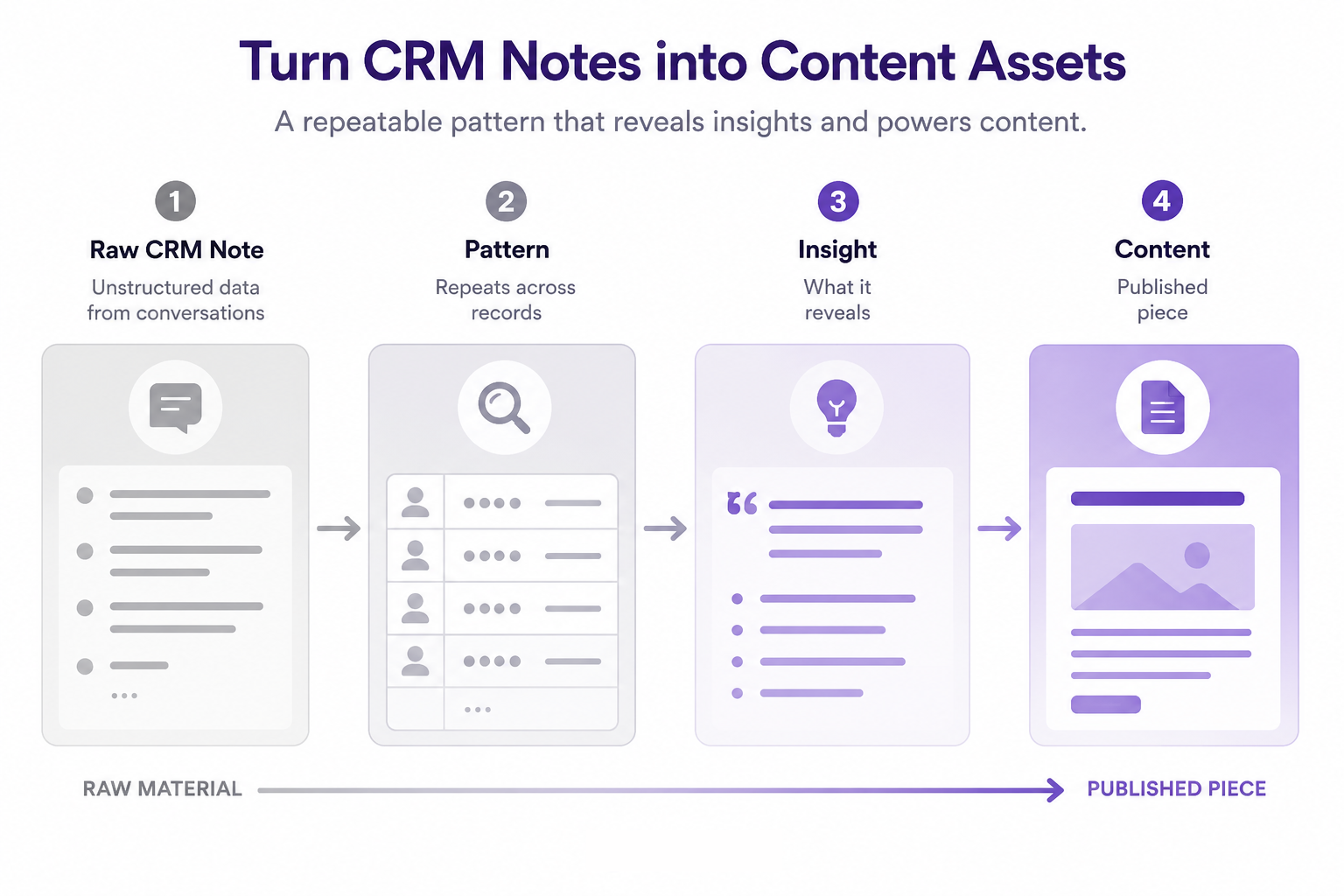
From Raw Note to Published Piece: The Four-Step Filter
Every category above collapses into the same four moves, whether the raw material is a lost-deal note or a support ticket. Skip a step and you end up with either a pile of unusable data or a hot take with nothing underneath it.
Signal. The raw line. A call note, a ticket, an objection your rep typed at 4pm without thinking twice about it.
Pattern. The same signal shows up more than once. One prospect mentioning price is an outlier. Twelve prospects mentioning price in a quarter is a pattern, and patterns are the only thing worth writing about.
Insight. Ask what the pattern is evidence of. Twelve prospects flagging price usually isn't a pricing problem, it's a value-communication problem: the case hasn't been made clearly enough before the number shows up.
Content. Match the insight to a format. A pricing insight becomes an ROI page. A recurring objection becomes a battlecard turned into a comparison post. A support pattern becomes documentation nobody has to go looking for.
Run this filter across sales notes, tickets, and churn interviews, and content stops being a blank-page problem. It becomes a sorting problem, which is a much easier one to solve on a Tuesday afternoon.
The Habit, Not the Project
The mistake most teams make here is treating this as a quarterly audit. Sit down, mine the CRM, produce six blog posts, move on. That gets you one good sprint of content and then the well looks dry again, because it wasn't actually a well. It was a bucket.
The version that works is smaller and more boring: someone owns a standing habit of pulling five or ten fresh notes from the CRM every couple of weeks, tagging what's recurring, and feeding it into the content queue. It's less a campaign and more a maintenance task, the same way you'd maintain a pipeline report. The output compounds precisely because it never stops.
Your competitors can copy your positioning. They can copy your blog format, your CTA placement, your email cadence. What they can't copy is the specific objection your last four deals raised, or the exact wording your support team hears every Tuesday. Nobody's got that locked in a vault. It's sitting in a CRM field most of your company already has access to and nobody's opened this month.
See exactly why your Product Detail Page isn't converting
Thank you! Your submission has been received!
Oops! Something went wrong while submitting the form.




.avif)
%20(1).png)