AI Insights
Agent Memory Has Outgrown Retrieval
Most AI memory systems can find relevant past information but can't tell if it's still true, so agents act on stale data that was technically "retrieved correctly."
September 17, 2026

Most conversations about showing up in ChatGPT, Gemini, or AI Overviews focus on content: better pages, sharper answers, more structured markup. The question that matters more gets skipped: does the business actually agree with itself across the internet?

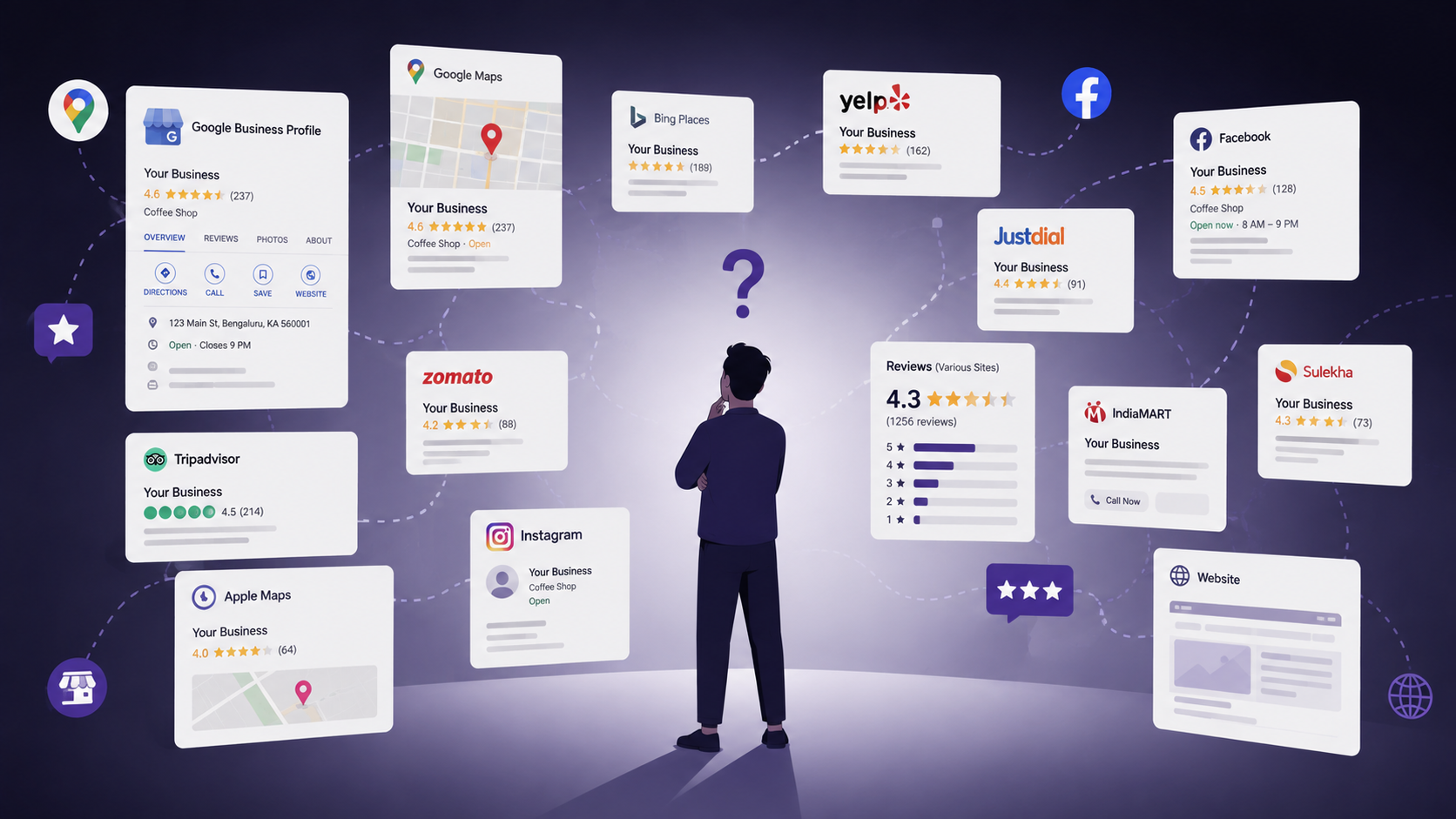

Ask an AI assistant whether a restaurant is open right now and you would expect a clean answer.
What often comes back is a hedge, a suggestion to check the website, or a confident answer that turns out to be wrong. The restaurant told five different platforms five different things, and the assistant just picked one.
Most conversations about showing up in ChatGPT, Gemini, or AI Overviews focus on content: better pages, sharper answers, more structured markup. The question that matters more gets skipped: does the business actually agree with itself across the internet?
For a growing number of brands, it does not. That disagreement is already costing them recommendations they would otherwise have earned.
A single local business can have a working address on ten or more surfaces at once. Its own website. Google Business Profile. Apple Maps. Bing Places. Yelp. Industry directories. A booking or reservation system. A delivery app. Review platforms. Whatever got typed into a directory listing back in 2019 and never touched again.
Enterprise brands multiply this by every location, every franchise, every regional site, every PR mention, and every analyst profile.
No single team owns all of it. Marketing manages the website. Local teams manage the Google Business Profile. A listings vendor handles directories. Reviews pile up wherever customers decide to leave them.
Each system runs on its own update schedule, and most were never built to talk to each other. Change a phone number at head office and the website catches up in a day, the Google listing in a week, and the third-party directory maybe never.
Search engines learned to tolerate some of this mess. AI systems are less forgiving.
According to Search Engine Land, when local data is inconsistent or disconnected, AI systems place less confidence in it and are correspondingly less likely to reuse or recommend that business. This is caution, not punishment. A model choosing between three different addresses for the same location cannot average them. It has to pick one and risk being wrong, or leave the business out of the answer entirely.
The same publication's reporting on structured data spells out the pattern further. AI systems are conservative by design, and information that looks inconsistent or exaggerated is less likely to get reused or cited, even when the schema markup underneath is technically correct. If review markup says 5 stars while the Google Business Profile shows 4.2, the system tends to discount the whole listing rather than try to split the difference.
The same logic holds at enterprise scale, across dozens or hundreds of locations. Coverage of how AI evaluates chains and franchises calls this entity confidence: a brand where every location tells a consistent story earns a clearer read from the system, while patchy or contradictory details at a handful of locations make the whole brand harder to trust, not just the outliers. A separate look at enterprise search visibility names the underlying failure mode schema drift, the gap that opens when human-facing details on prices, hours, or stock keep moving while the machine-readable version underneath stays frozen. Every day that gap sits open, confidence erodes a little further.
And the cost shows up in numbers, not just theory. One analysis of AI recommendation behavior found that inconsistent brand data across platforms, from mismatched names and addresses to conflicting product descriptions, can cut AI recommendation rates by 30 to 40 percent. Long before AI entered the picture, Yext-commissioned research estimated that inaccurate business information cost UK consumers more than £2 billion a year in misdirected spending. AI just reacts to that same inconsistency far faster than a customer ever could.
For years this fight had a name: NAP consistency, the practice of keeping a business's name, address, and phone number identical across every directory and citation. It was treated as SEO housekeeping, useful but low-stakes, back when the worst outcome was a lower local ranking.
That math has changed now that AI decides what gets recommended, not just what gets ranked. As one recent take on the blurring lines between SEO, AEO, and GEO puts it, fragmented data sources create fragmented trust signals, whether the system reading them is a recommendation algorithm or a large language model. Consistency is no longer housekeeping. It is the mechanism by which AI decides what to believe.
Which means the actual job has changed too, from ranking a page or polishing a listing to giving AI one coherent, current, cross-referenced picture of who a business is, where it operates, what it offers, and what customers actually experience once they show up. Every disconnected system holding a fragment of that picture is a place where the story can fall out of sync without anyone noticing.
AI visibility is going to reward operational discipline over content volume. A business whose data agrees with itself everywhere, from the homepage down to the smallest directory listing, will get read into more answers than one still pushing out blog posts every week while its Google Business Profile lists the wrong closing time.
That means someone has to own business data as a living asset rather than a set of forms filed once and forgotten, with a single source of truth and a way to catch drift before an AI model catches it first.
The web has always been messy. AI just made the cost of that mess impossible to ignore.
.avif)

From collection to clarity — we’ll help you make sense of it all.

Giving shape to intelligence