Building an Agentic AI Shopping Assistant for Personalized Fashion Discovery

How a leading omnichannel fashion retailer built a conversational shopping experience that understands intent, recommends real products and complete outfits, and remembers shopper preferences.

90% reduction in campaign planning time
Faster go-to-market
~10,000 analyst hours returned
Overview

A large omnichannel fashion retailer wanted to make online product discovery more intuitive and personalized. Traditional catalog search required shoppers to navigate filters and categories, even when they were looking for an occasion-ready outfit, exploring available styles or refining an earlier choice.

Yarnit built an agentic AI shopping assistant that combines natural-language product search, outfit recommendations and persistent conversational context. Five specialized agents interpret shopper requests, retrieve live product information from Databricks and select relevant recommendations. The assistant supports anonymous and logged-in sessions, using customer history when available and learning preferences through the conversation.

‍

The challenge

Moving Beyond Search to Understand What Shoppers Actually Want

Fashion shopping rarely starts with an exact product name. Shoppers describe occasions, colors, fit, styles and combinations, then refine their requests as they discover options. The retailer needed an assistant that could carry these interactions across a changing catalog without losing context or inventing product details.

‍

Search Could Not Interpret Every Intent

Keyword and filter navigation did not naturally handle broad, conversational or occasion-led requests.

‍

Outfit Discovery Took Multiple Searches

Finding complementary apparel and accessories required shoppers to connect separate product searches themselves.

‍

Personalization Needed Continuity

Profile data, purchase history and emerging preferences needed to inform follow-up recommendations.

‍

Recommendations Had to Be Grounded

Every suggested item needed to correspond to a real catalog product with current price, availability and variant information.

‍

The Solution

A Multi-Agent Shopping Assistant That Understands, Recommends and Remembers

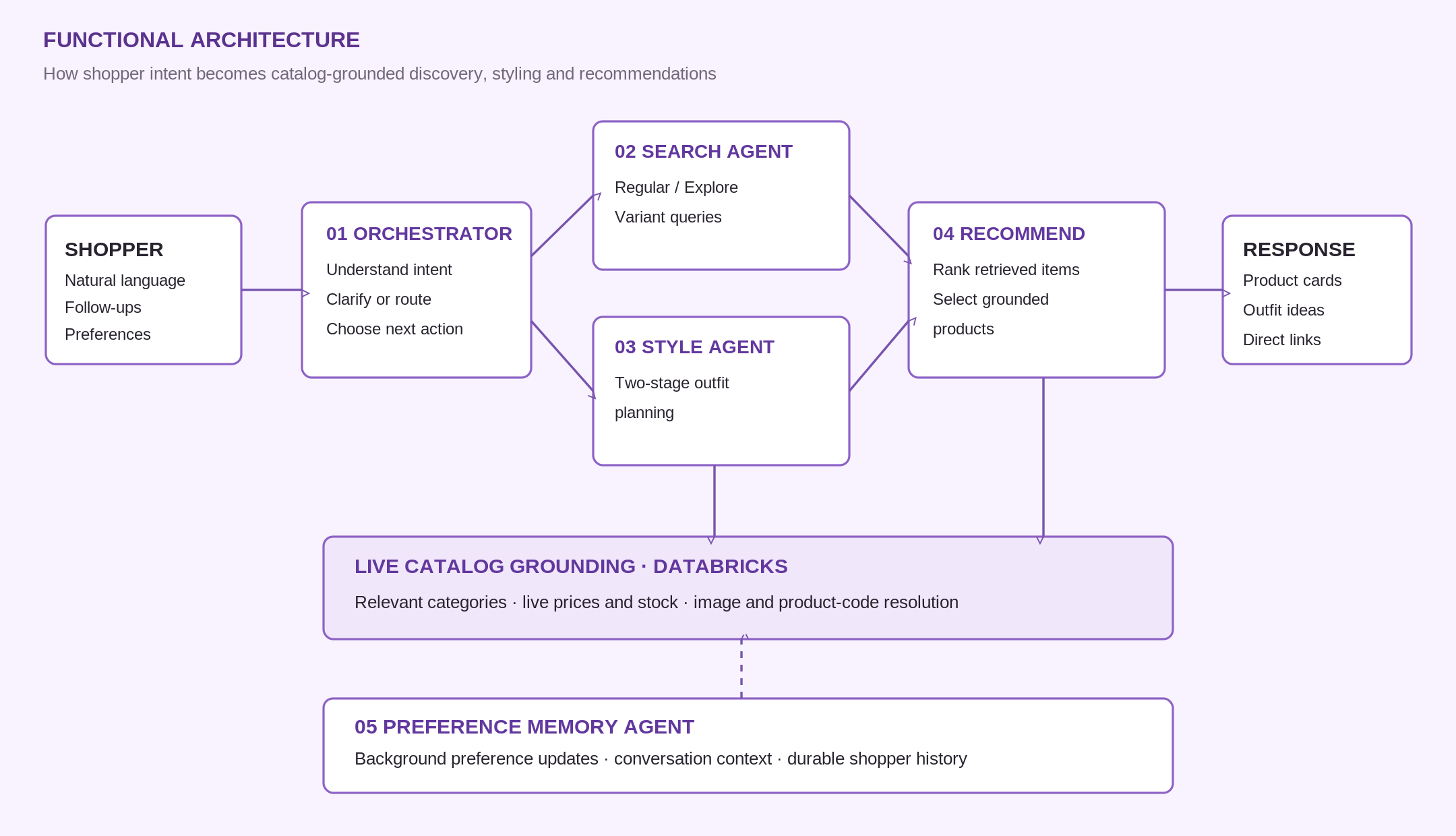
Yarnit engineered a five-agent shopping system that turns a natural-language request into a coordinated product discovery workflow. The assistant decides whether to answer directly, ask a clarifying question, search for products, explore available categories and attributes, find variants or assemble a complete outfit.

For example, a shopper can ask for an outfit for an evening wedding, then say “show me in blue” or “what shoes would go with that?” The assistant carries the original context forward and returns catalog-grounded recommendations, including product imagery, prices, sale flags, stock status and direct product links, with up to four product cards per reply.

‍

Orchestrator Agent interprets shopper intent, selects the next action and routes work to specialist agents.

Search Agent builds catalog queries for regular search, category/attribute exploration and product color or size variants.

‍

Style Agent plans complementary outfit categories in two stages and coordinates relevant item discovery.

‍

Recommendation & Preference Memory Agent selects the most relevant products, assembles catalog-grounded product recommendations, and continuously updates shopper preferences based on conversations and available customer history.

‍

The assistant maintains context for anonymous and authenticated shoppers, supports follow-up requests without restarting the search, and can recover sessions after a server restart. Preference writes are isolated from response generation, so temporary storage failures do not prevent shoppers from receiving an answer.

‍

The Architecture

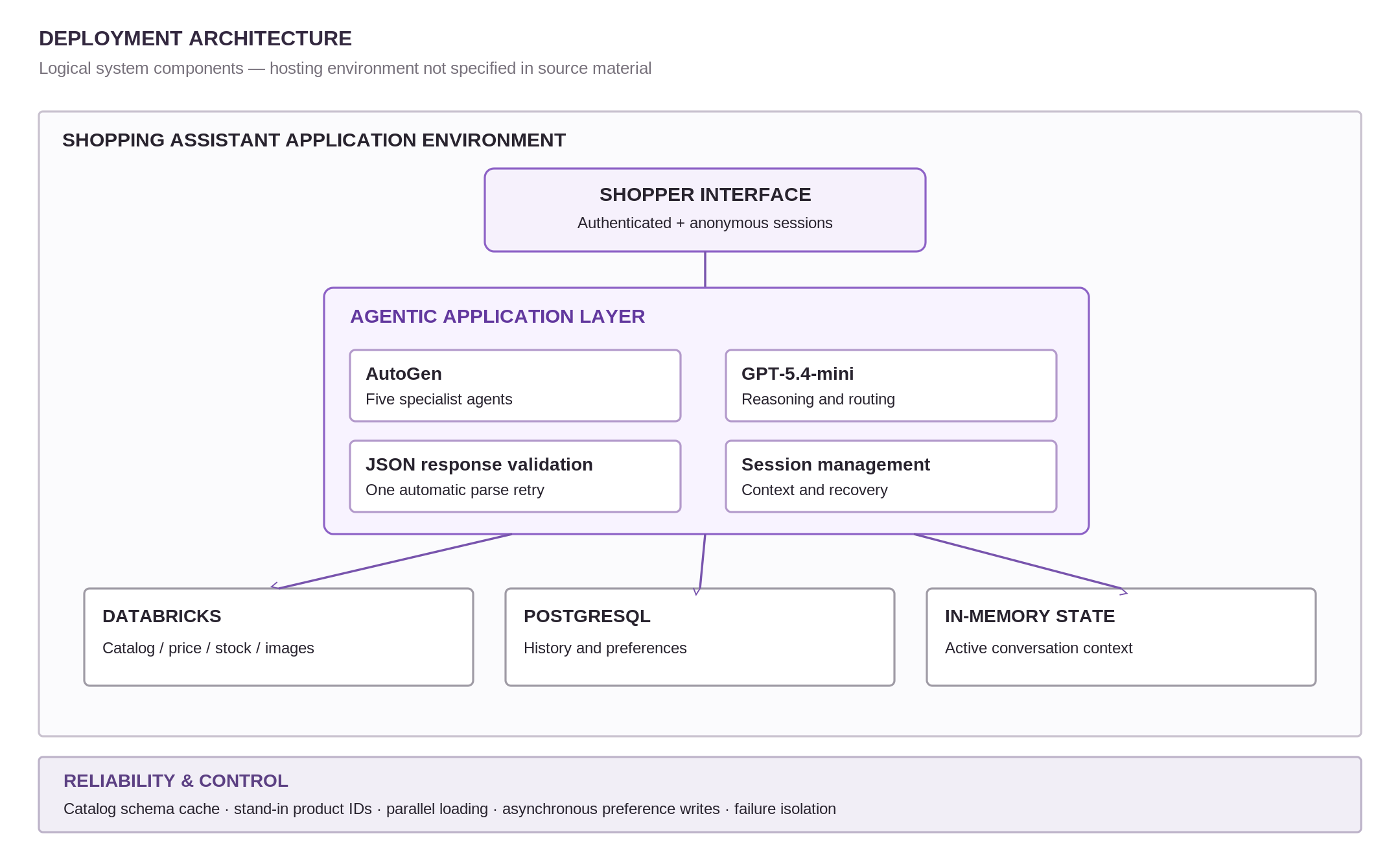
The system uses AutoGen and GPT-5.4-mini to coordinate five specialized agents, while catalog queries run against live Databricks data. Relevant catalog structure is exposed to the agents to improve query precision. Stand-in product identifiers are resolved to actual product codes in application logic, and JSON validation with an automatic retry helps maintain reliable responses.

Image preview
Image preview

‍

Engineered for dependable interaction. Cached catalog structure reduces repeated lookup work; parallel data loading supports responsiveness; two-layer memory combines fast in-memory sessions with PostgreSQL history and preferences; asynchronous preference saving and isolated failure handling protect the shopper response path.

The results

Making Fashion Discovery a Continuous Shopping Conversation

The implementation brings together product search, outfit building, shopper context and catalog accuracy in one experience. Its outcomes are best understood as a change in the shopping interaction model, rather than as unverified claims about conversion or revenue.

‍

8%

uplift in AI-assisted conversions through guided shopping experiences.

‍

7.3%‍

increase in average order value through personalized outfit recommendations.

‍

20%

increase in product card click-through rate through context-aware recommendations

Instead of making shoppers restart their search at every step, the assistant supports a connected journey—from exploring a need to refining options and assembling an outfit—with product recommendations anchored to what the retailer actually sells.

‍

Testimonial

Yarnit has transformed our content creation process at InMobi. We’ve cut our content generation time by over 75%, from an hour to just minutes. Using Yarnit’s AI-generated ad units, we’ve reduced our ad rejection rate to under 5%.

Alakshit Tripathi
Director - InWeb
Enterprise Applications

Your future runs on data let’s create it

From collection to clarity — we’ll help you make sense of it all.

Section Bg