.avif)
The rules of online retail are being rewritten and if you're not paying attention, you're already behind. Forget incremental change. With AI, ecommerce has skipped evolution, and is being reimagined from the ground up, especially in terms of repettitve processes and personalized marketing.
From AI-powered shopping assistants to flexible payment options, today's innovations aren't just changing the game—they're rewriting the rules entirely. With the AI-enabled ecommerce market projected to reach $22.6 billion by 2032 and mobile commerce accounting for 59% of total retail sales, businesses can't afford to ignore these shifts.
Whether you're a marketing professional, ecommerce manager, or business owner, understanding these trends isn't optional—it's essential for staying competitive. This blog explores 12 transformative ecommerce trends that are currently reshaping the industry, backed by the latest statistics and real-world examples.
We'll examine how AI shopping is revolutionizing customer experiences, why hyper-personalization has become non-negotiable, and how emerging technologies like virtual try-ons and livestream shopping are bridging the gap between digital and physical retail.
1. AI Shopping: Smart Assistants Are Here
AI shopping tools have gone mainstream. The AI-enabled ecommerce market hit $8.65 billion in 2025 and analysts project it'll reach $22.6 billion by 2032. Perhaps more telling: generative AI traffic to U.S. retail sites jumped 4,700% year-over-year in July 2025.
Three factors explain this momentum:
- 88% of consumers used AI at some point during the 2024 holiday shopping season, meaning that AI has now become a mainstream tool for shopping
- 53% of consumers now use or plan to use AI for online shopping
- AI-driven revenue-per-visit jumped 84% from January to July 2025
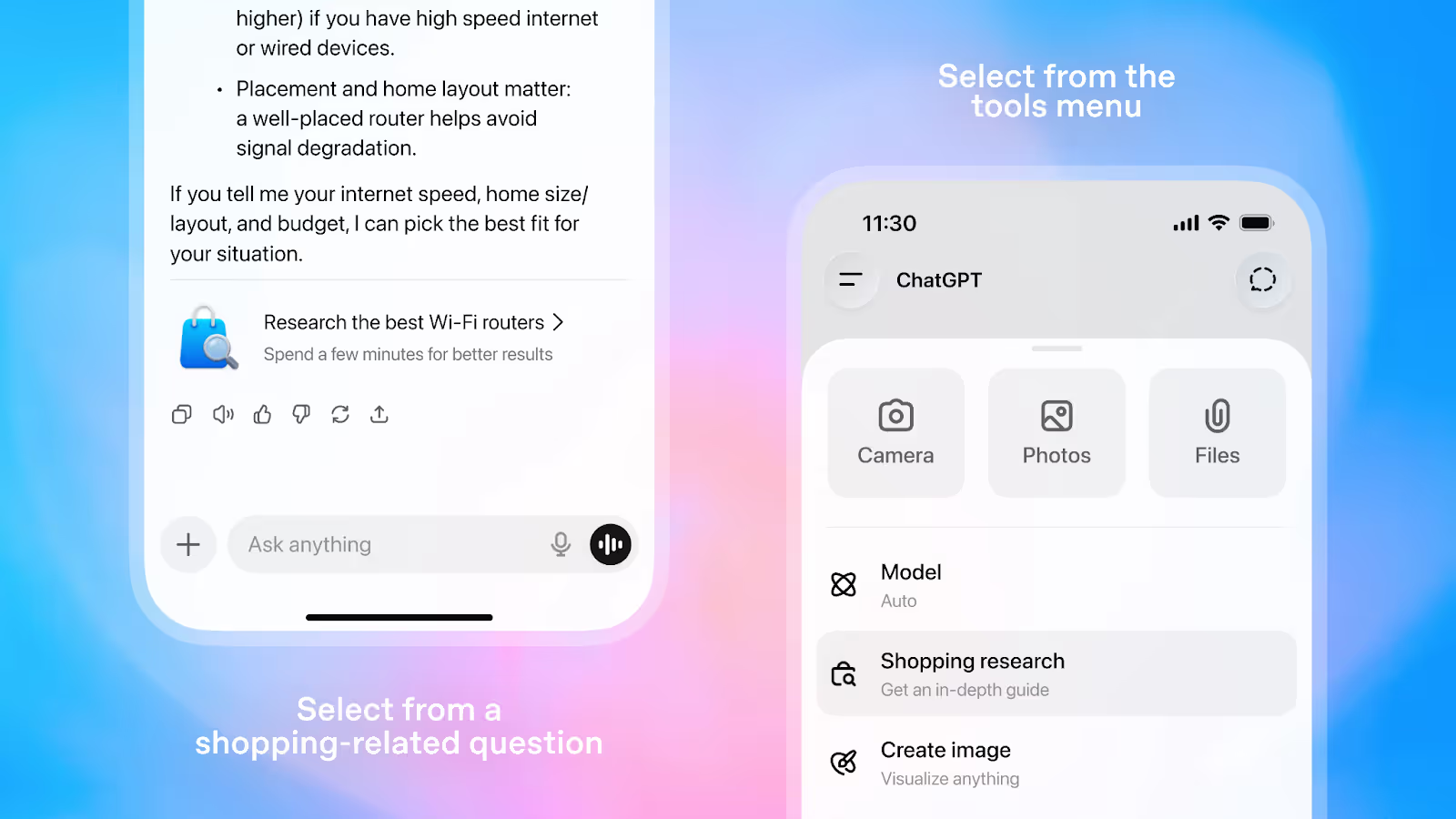
Take Perplexity's "Shop Like a Pro" feature or ChatGPT’s Shopping Research feature. Rather than just another chatbot, these helps users research products through conversational search that remembers context and learns preferences. When a shopping assistant can anticipate what you need and answer complex questions instantly, it changes the entire buying experience.
2. Agentic AI for Content Scaling
Creating quality content has always eaten up time and resources. Agentic AI is flipping that equation. The global agentic AI for content creation market is projected to continue to increase from its current size of $963.4 million with a 46.8% CAGR.
The investment makes sense when you look at adoption rates. Currently, 85% of marketers use AI tools in content creation. Nearly half of these users now write complex, multi-step prompts to get better results. The broader AI agents market is expected to grow from $7.84 billion in 2025 to $52.62 billion by 2030.
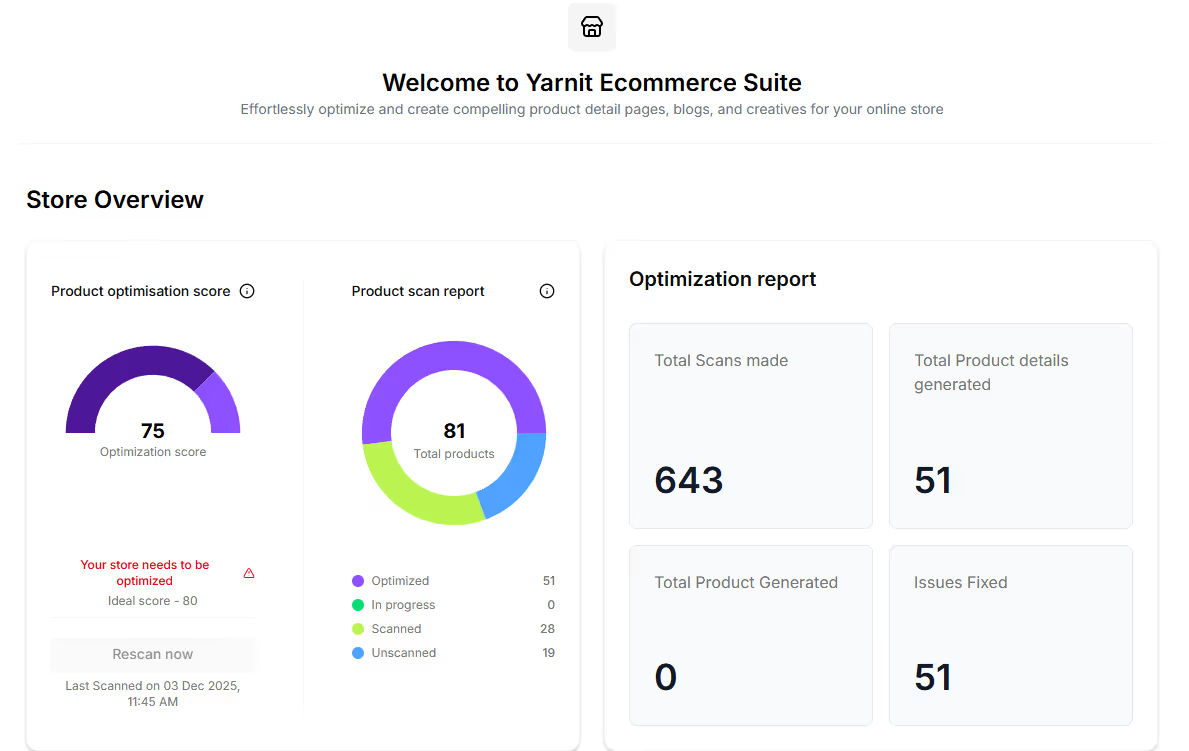
Ecommerce platforms are seeing similar efficiency gains with agentic AI implementations. For example, Yarnit’s Ecommerce Suite uses agentic AI to help online retailers manage product content at scale, autonomously. Our agentic system analyzes product specifications, product images, and competitor positioning to generate optimized descriptions and marketing copy at scale, enabling ecommerce store owners to scale like never before. AI-powered content generation helps teams scale output without sacrificing quality or losing brand consistency.
3. Livestream Shopping Gains Traction
Livestream shopping turns online retail into an interactive event. The global livestream ecommerce market is projected to surge from $14.93 billion in 2024 to $258.76 billion by 2034—a 33.01% annual growth rate.

Companies offering livestream shopping report conversion rates up to 30%—10x higher than traditional ecommerce. Among Gen Z consumers, 83% have used livestream shopping, and 86 million Americans have purchased products through live shopping shows.
Gaming streamers like Ninja and Shroud seamlessly integrate sponsored products—from gaming peripherals to energy drinks—into their broadcasts, demonstrating gear in real-time gameplay while maintaining authentic interaction with their audiences. Unlike traditional influencer posts, these partnerships unfold over hours-long streams where viewers can ask questions, see products perform under genuine conditions, and watch their favorite personalities actually use what they're promoting.
TikTok Shop weaves livestream shopping directly into its platform. Zara's weekly live shows in China pull in 800,000 unique viewers per show. Real-time interaction combined with entertainment value and immediate purchasing options creates something static product pages can't replicate.
4. Hyper Personalized Marketing
Basic segmentation isn't cutting it anymore. Marketers now allocate roughly 40% of their budgets to personalization—nearly double the 22% they spent in 2023.
The investment pays off:
- 89% of marketing decision-makers consider personalization essential for business success
- Companies excelling at personalization generate 40% more revenue from these efforts than peers
- 63% of marketers plan to boost budgets for hyper-personalization initiatives in 2025
Netflix personalizes thumbnails based on what you've already watched. Amazon's product suggestions work because they analyze browsing patterns, purchase history, and even items you considered but didn't buy. That level of personalization feels intuitive because it responds to actual behavior patterns.
5. Virtual Try-Ons to Reduce Returns
Not being able to physically interact with products has always held ecommerce back. Virtual try-ons and 3D visualizations are addressing this at scale. The global virtual try-on market is expected to reach $4.08 billion by 2033, showing the growth of this market in the future.
Retailers implementing virtual try-on solutions report a 30% increase in sales conversion rates. Brands using AR recorded up to 40% reduction in product return rates. 71% of shoppers say they'd shop more often if AR were available.
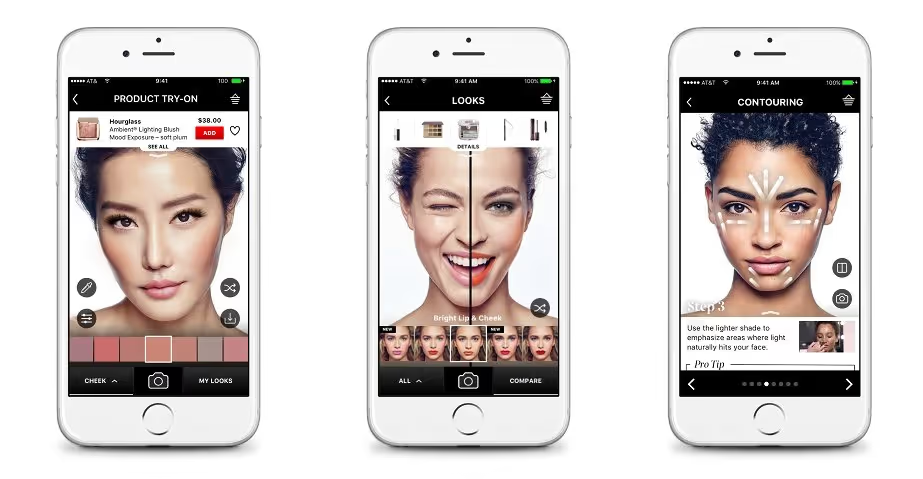
Sephora's AR makeup try-on delivers 72% higher conversions, 31% fewer returns, and gets users to spend 117% more time on product pages. Nike's virtual shoe fitting tool has cut returns while increasing online sales. These numbers directly impact profitability.
For ecommerce brands, virtual try-on technology isn't just a novelty—it's a proven revenue driver that simultaneously boosts conversions, reduces costly returns, and builds customer confidence in buying without touching.
6. Voice Search Becomes a Shopping Channel
Voice search is evolving beyond simple queries, and the launch of Google's AI-powered search modes and ChatGPT's advanced voice capabilities in 2025 have accelerated adoption dramatically. Global voice shopping spend is projected to reach $82 billion by 2025, with 49% of U.S. consumers (128.4 million Americans) using voice search for shopping. By the end of 2025, 153.5 million people in the U.S. are expected to use voice assistants.
What’s more, voice commerce could account for 30% of total ecommerce revenue by 2030. Right now, 62% of smart speaker users plan to make a purchase using voice-enabled shopping within the next month.
As natural language processing improves, voice shopping becomes less about novelty and more about convenience. For ecommerce brands, optimizing for voice search now means capturing the 62% of smart speaker users ready to buy next month, and positioning for a future where nearly one-third of all online revenue flows through conversational commerce.
7. Predictive Analytics Powers Inventory and Personalization
Competitive ecommerce operations now depend on predictive analytics. The global ecommerce predictive analytics market is projected to grow from $2.4 billion in 2024 to $25.4 billion by 2034—a 26.4% compound annual growth rate. The broader ecommerce analytics market is expanding from $29.275 billion in 2025 to $60.592 billion by 2030.
Nearly 70% of ecommerce companies have increased their investment in data collection and analytics. CPG companies embracing data-driven marketing at scale can boost net sales by 3-5% and marketing efficiency by 10-20%.
Predictive analytics drives AI-based demand forecasting for inventory optimization and powers personalized product recommendations based on browsing patterns and purchase history. It's about anticipating customer needs before they're fully formed, then having the inventory and marketing ready to meet that demand.
8. Chat Marketing Meets Customers Where They Are
Conversational commerce is changing how brands engage customers. The conversational commerce market is projected to reach $32.67 billion by 2035 from $8.80 billion in 2025, with global spend via conversational commerce hitting $290 billion in 2025.
Chat marketing effectiveness shows up in the data:
- 87% of chatbot users report positive experiences
- 65% of customer questions are resolved by AI without human intervention
- Proactive AI chats recover 35% of abandoned carts
Some trends to watch: WhatsApp Business allows customers to browse catalogs and place orders directly within the app. AI chatbots integrated into shopping websites, like Amazon Rufus, offer 24/7 customer support and personalized product recommendations.
The advantage is meeting customers where they already communicate, providing immediate assistance without forcing them to navigate elsewhere.
9. Mobile Commerce Dominates Transactions
Mobile commerce now drives the majority of online sales. Mobile commerce is projected to account for $4.01 trillion in 2025, representing 59% of total retail ecommerce sales. The global mobile commerce market is forecasted to reach $14 trillion by 2033.
Here’s what mobile shopping looks like going into 2026:
- 1.65 billion mobile shoppers globally (30% of the digital population)
- 54% of mobile commerce transactions happen in shopping apps
- Average mobile transaction value reached $120 in 2025
Shopping apps like Amazon and SHEIN dominate mobile commerce with seamless, app-native experiences optimized for smaller screens. One-click mobile payments through Apple Pay and Google Pay remove checkout friction, making impulse purchases easier.
For ecommerce brands, mobile optimization isn't optional—it's where more than half of all online sales happen, and without frictionless app experiences and one-tap payments, you're effectively closing your doors to 1/3rd of billion global shoppers. If your ecommerce experience isn't mobile-optimized, you're missing out on the majority of transactions.
Buy Now, Pay Later Boosts Order Values
BNPL has shifted from alternative payment to standard expectation. The global BNPL market is projected to reach $560.1 billion in 2025 with 90 million Americans expected to use BNPL for purchases in 2025.
The impact on business metrics:
- BNPL results in 85% higher average order value than other payment methods
- Up to 40% of BNPL sales come from new customers to the retailer
- Global BNPL market expected to reach $911.8 billion by 2030
Klarna, Afterpay, and Affirm offer installment payment options that make higher-priced items accessible. Major retailers like Amazon, Walmart, and Target have integrated BNPL options directly into checkout, recognizing that payment flexibility influences purchase decisions—especially for younger consumers.
Beyond payment flexibility, BNPL’s ability to unlock higher average order values and give access to 90 million Americans is a must-have for any ecommerce business in 2026.
Influencer Marketing Drives Measurable Results

Influencer marketing has matured into a measurable channel with proven ROI. The global influencer marketing market is estimated to reach $33 billion in 2025, with 86% of U.S. marketers expected to partner with influencers in 2026.
Businesses make $6.50 for every $1 spent on influencer marketing on average, making it one of the highest ROI marketing channels today. Among brands working with influencers, 57.6% have an ecommerce store, and 39% of social media users say influencers affect their buying decisions.
TikTok Shop leverages creator partnerships to drive product sales directly within the app. Instagram Shopping enables influencers to tag products and earn through affiliate links. The power lies in the trust influencers have built with their audiences—when recommendations feel authentic rather than scripted, conversions follow.
Subscription Models Create Predictable Revenue
Subscription ecommerce has expanded far beyond streaming services. The subscription ecommerce sector is anticipated to surpass $450 billion by 2025—representing 30x growth from just $15 billion in 2019. The global subscription ecommerce market is expected to reach $6,369.9 billion by 2033, with a 41.38% compound annual growth rate.
The growth trajectory is notable: subscription ecommerce will grow from $326.44 billion in 2024 to $539.16 billion in 2025, representing a 65.2% annual growth rate. Subscriptions have consistently grown at 60% annually compared to 10% for average industries.
Netflix, Spotify, and Disney+ pioneered digital content subscriptions, proving consumers value convenience and predictability. Dollar Shave Club and Blue Apron extended the model to physical products. Amazon Subscribe & Save makes household essentials automatically replenish.
Key takeaway: Monthly payment frequency holds the largest market share, offering businesses predictable revenue and customers hassle-free replenishment.
Taking Action on These Trends
These 12 ecommerce trends work together to reshape how consumers discover, evaluate, and purchase products online. AI and automation are becoming foundational technologies. Personalization has evolved from optional to essential. Flexible payment options meet modern consumer expectations. Visual technologies bridge the gap between online and offline shopping, while voice and conversational interfaces make shopping more intuitive.
Businesses embracing these innovations will capture market share. Those that wait risk falling behind. The opportunities are substantial, the tools are accessible, and the data proves their effectiveness. Evaluate which trends align with your business goals, start testing, and build the ecommerce experience your customers expect.