



.avif)
You might not remember the exact day the App Store launched, but you’re reaping the rewards of it every time you use your phone. For e-commerce, Google’s Universal Commerce Protocol (UCP) is that same "Big Bang" moment for AI.
In the 2025 holiday season alone, AI-driven sales hit $262 billion. If you aren’t capitalizing on this shift, you’re stuck in the “old way”: watching your conversion costs climb while your competitors use AI agents to close sales before the customer even hits a landing page.
AI traffic is pure gold: bottom-of-funnel prospects landing in your lap, and it costs way less per click than traditional search advertising. But here's where store owners fall short: making their products show up in AI responses with a frictionless path to checkout. If you miss that window, and you’re watching high-intent customers convert somewhere else while your acquisition costs climb.
With the rate AI shopping engines are being released, you might not have the technical bandwidth needed to build connections to each and every one of them. However, with UCP, you can build on top of existing systems, and simply plug your store in and create a seamless checkout experience for your potential customers.
What UCP Actually Does and Why It Matters Now
Put simply, the Universal Commerce Protocol (UCP) is an open-source standard designed to power agentic commerce. In practical terms, UCP solves the N x N integration bottleneck that's been strangling AI commerce growth.
Until now, AI shopping has been a patchwork of proprietary integrations. Every AI platform needed custom integrations with every merchant platform, payment provider, and ecommerce system. ChatGPT launched shopping features. Perplexity rolled out Shop Like a Pro.
This meant that every platform needed its own integration: your storefront needed to integrate with ChatGPT, Perplexity, Google Gemini, and every future AI assistant individually. Each payment provider needed separate connections. It's an exponential complexity nightmare that makes it prohibitively expensive and slow to scale AI shopping experiences.
UCP fundamentally changes this equation. Basically, it brings together digital commerce by creating a common language to enable more connected commerce journeys between consumer surfaces, businesses, and payment providers. Instead of building custom integrations for every AI shopping platform that emerges, you can implement UCP once and automatically gain access to any AI surface that supports the protocol.
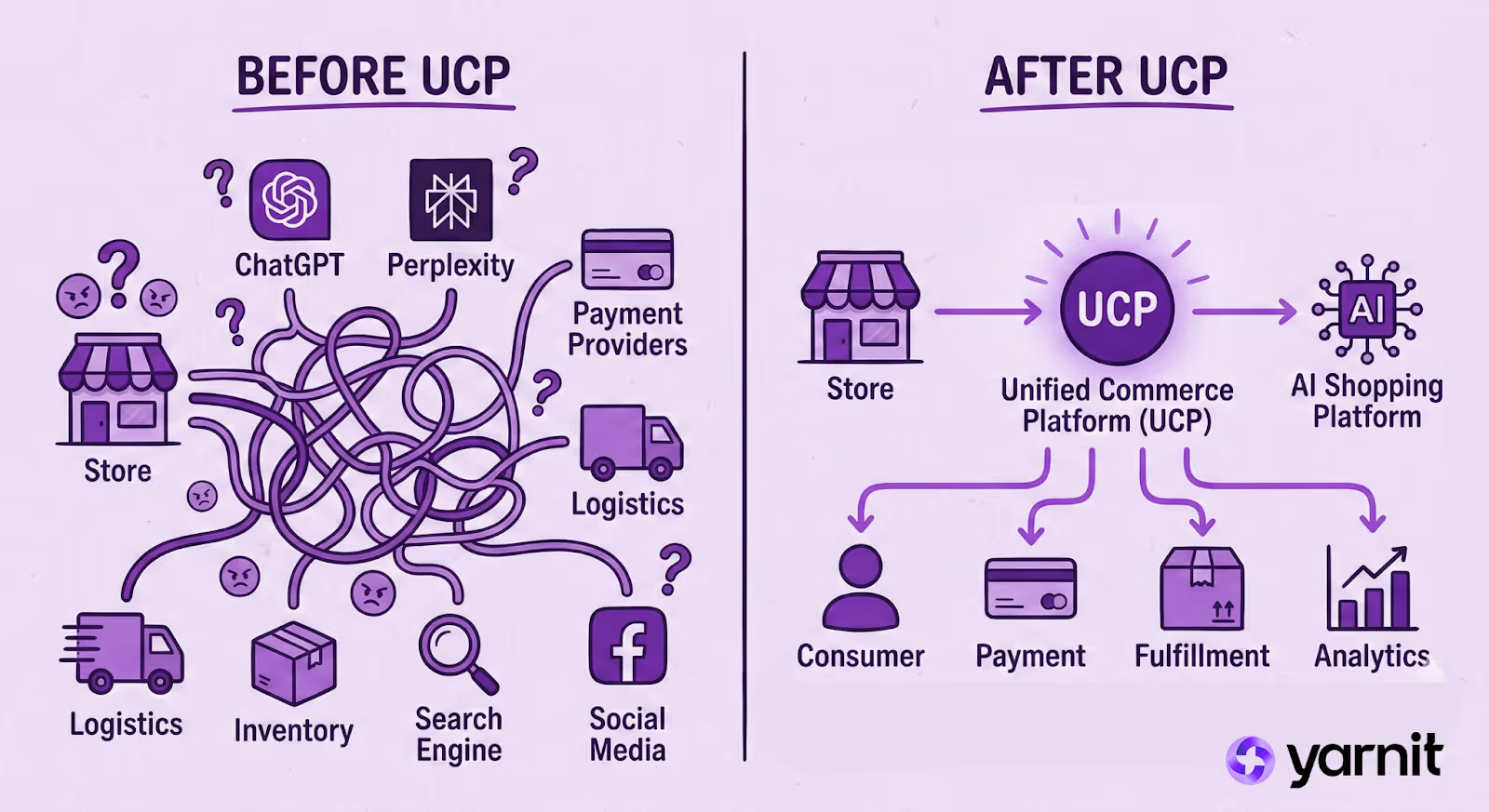
Your product data becomes AI-native, discoverable, contextual, and ready for agentic transactions across the entire ecosystem.
Even at launch, UCP is already endorsed by more than 20 partners across the ecosystem, including major platforms and payment providers. The core development partners include Shopify, Etsy, Wayfair, Target, and Walmart, with more sure to get on board considering Google’s presence in the online shopping space.
For me as a merchant, this consolidation really means something. UCP standardizes product discovery, checkout flows, payment handlers, and even capability discovery through an easy-to-read manifest file. So when someone asks an AI shopping assistant about hiking boots for wide feet or organic baby formula, your products can show up with the right context: specifications, pricing, availability, and a one-click path to purchase.
The kicker? You get to maintain full control over your customer relationships and data. This is critical; UCP doesn't sit between you and your customers, it just standardizes how AI surfaces discover and transact with your backend systems. Think of it like plumbing you actually want: boring but life-saving.
How UCP Consolidates the AI Shopping Experience
The real power of UCP lies in its standardized architecture for the full commerce lifecycle. Let’s break down how this works in practice.
When an AI agent discovers your store, it queries your manifest file to understand what services and capabilities you support. This manifest tells the AI about your checkout capabilities, payment handlers, discount systems, and fulfillment options in a standardized format. The agent can then invoke these capabilities dynamically, creating a checkout session, applying discount codes, selecting payment methods through standardized API calls or protocol bindings.
Basically, UCP separates payment instruments (what consumers use to pay) from payment handlers (the processors that execute transactions). This separation allows UCP to "scale to a diverse set of existing payment providers" without requiring merchants to rebuild their payment infrastructure. This means that you can continue using your existing payment integrations like Stripe, Adyen, Mastercard, Visa, American Express, while exposing them through UCP's standardized payment handler interface.
But what does this mean for your customer? Let’s illustrate with an example. By enabling this through UCP, Indian consumers can skip the manual data entry. Whether they use Razorpay or PayU, they can instantly pay using RBI-compliant tokenized cards or saved addresses from Google Wallet. It turns a multi-step hurdle into a seamless tap, slashing cart abandonment without requiring you to switch your existing payment providers.
More than just making it easy to buy products through AI shopping engines, UCP can help you create what Google calls branded AI shopping experiences. With some minor tinkering, you can deploy "Business Agent" plugins that work directly within Google's AI surfaces, including AI Mode in Search, the Gemini app, and Google Shopping.
For merchants, Google offers two integration paths:
Native checkout: The default path which integrates checkout logic directly with Google AI surfaces Embedded checkout: An optional path for approved merchants with highly customized branding or complex checkout flows
This means that you can create your own AI shopping assistant that knows your catalog inside-out. Even things that are super-specific to your brand, like product fit, use cases, compatibility, and recommendations, are available to this agent. So the next time customers interact with this branded agent, they get the expertise of your best salesperson combined with the instant product knowledge of your entire inventory.
How to Actually Get on UCP: Technical Requirements and Implementation
Getting on UCP requires some technical legwork, but it's designed to work with your existing commerce infrastructure. Here's what implementation looks like:
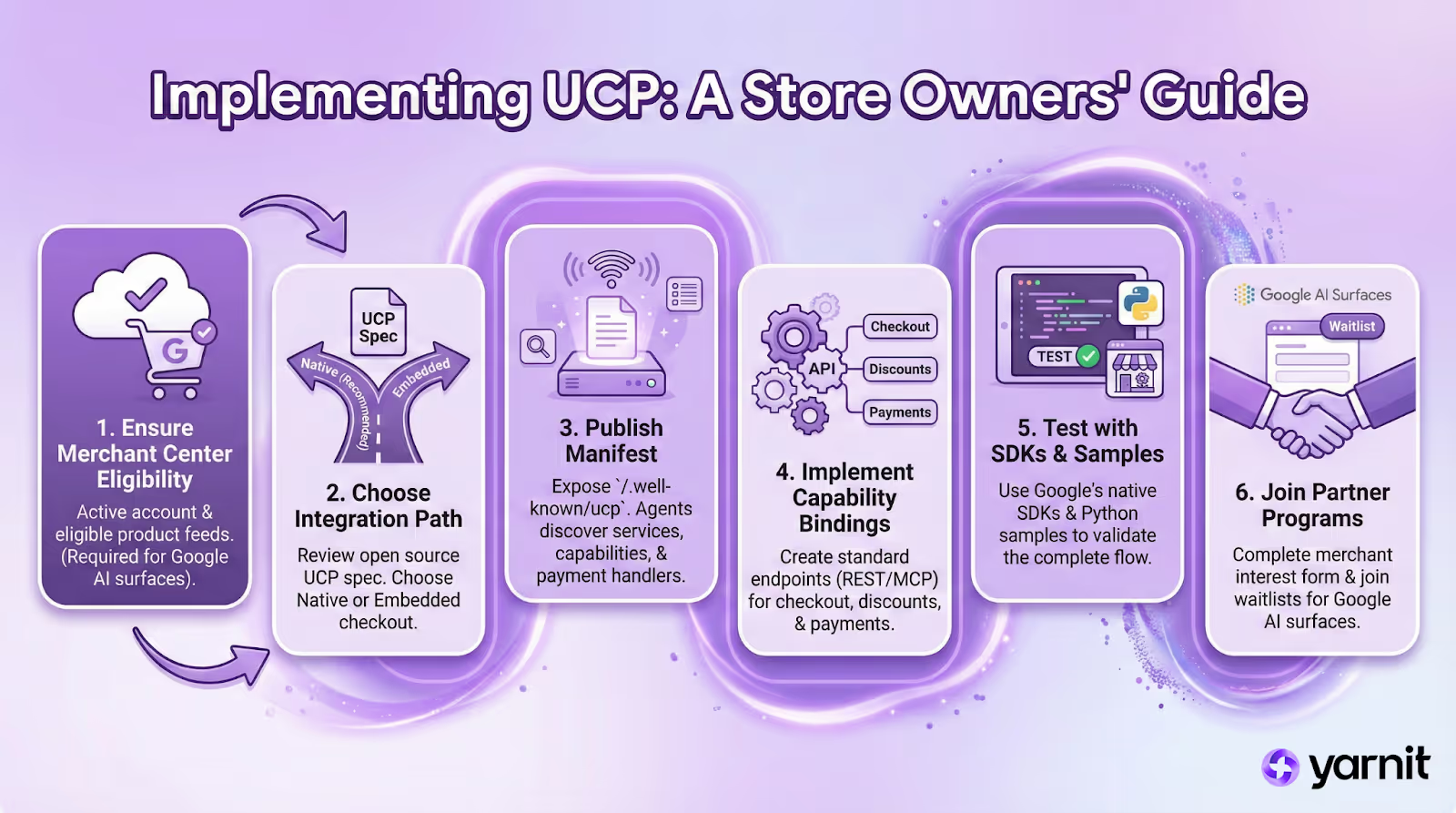
For detailed technical specifications and code samples, you can review the complete documentation here and explore the open-source UCP repository and samples referenced in the Google Developers Blog.
Why This Can't Wait
AI shopping isn't a future trend, it's generating $262 billion in transactions today. The question isn't whether AI will change how people discover and buy products. It already has. The question is whether your products will be part of those AI-driven recommendations or invisible to what is becoming the new status quo of shopping.
UCP gives you a standardized way in, and this early adoption can create a meaningful competitive advantage. The stores that implement UCP now will capture bottom-of-funnel traffic at lower acquisition costs while competitors struggle with fragmented, platform-specific integrations. The stores that wait will watch their CPCs climb as AI traffic consolidates around UCP-enabled merchants. This is infrastructure that's quickly becoming table stakes.
But integrating with AI shopping engines is just the tip of the iceberg. Even if your products are surfaced at the right time and the right place, it shouldn’t stop you from chasing the other channels that are giving you customers for free. With AEO and GEO being more prevalent. UCP should be another tick on your checklist of best practices. Your PDPs need to be optimized for conversions, and you need a more intelligent and automated way of doing it at scale. Yarnit helps you solve for this.
From AEO and GEO optimization to high-impact PDP refreshes on Amazon and Flipkart, we don’t just fill in the blanks; we architect pages that sell. Our approach is rooted in data-driven competitor analysis and platform best practices, ensuring your brand stands out with a professional lifestyle and creative photoshoots that lower CAC and boost trust.
We know that e-commerce isn’t static, which is why we’ve built Fast Scoring, a method way to track market shifts and seasonality in real-time. Whether it’s pivoting for Valentine’s Day or scaling for major festivals, Yarnit helps you capture peak demand and seamlessly revert to baseline once the trend passes. With Yarnit, you can autonomously get things done. We handle the heavy lifting of optimization and execution so you can focus on the big picture while we drive the conversions.
Try Yarnit today and get AI commerce ready seamlessly.


