


.jpg)
Have you ever seen a developer tasked with marketing creatives or a designer handling technical recruitment? It’s a mismatch that sounds odd, yet that is exactly how most of us are using LLMs today.
The main reason? We haven't moved past the "one-size-fits-all" mindset.
There is no doubt that ChatGPT is a powerhouse. By early 2026, its growth had been staggering, reaching 800 million weekly active users globally, with India alone contributing 100 million of those. But popularity doesn't equal perfection for every task. Just as you wouldn't assign a marketing campaign to a DevOps lead, you shouldn't rely on a single AI for everything from deep research to complex debugging.
In 2026, productivity is defined by "Model Literacy," knowing which LLM fits your specific requirement. Some tools are built for the lab; others are built for the studio. Let’s explore the best ChatGPT alternatives for 2026 and find the right tool for your desk.
Why Your 2026 Toolkit Needs More Than One Icon on the Taskbar
Think about your day. One minute you're brainstorming blog ideas, the next you're fact-checking claims for a report, and then designing social posts. A single tool tries to do it all, but it usually does some things okay and others poorly.
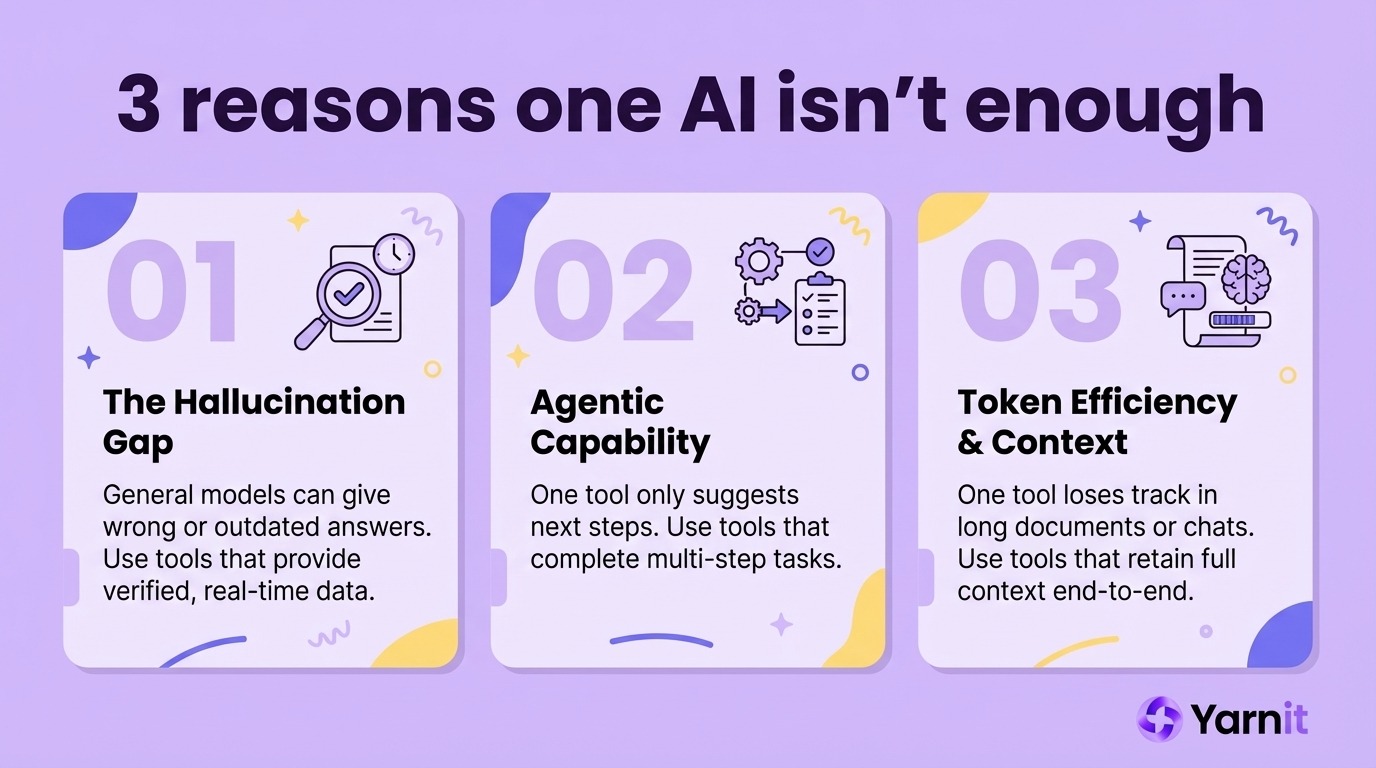
Here are the big gaps that push people toward ChatGPT alternatives right now.
The Hallucination Gap
General models are great at "vibes" and creative brainstorming. They shine when you want ideas or drafts. But if your work requires live data with zero margin for error, like current market stats, product prices, or legal references, you need a tool built for live indexing and citations, not just conversation. ChatGPT can guess or pull outdated info; specialized search-focused tools don't.
Agentic Capability
This is the biggest shift in 2026. We are seeing a clear split between "chatbots" (that talk and suggest) and "agents" (that do the work). Using a chatbot to plan a trip feels old school now. Using an agent to actually book flights, sync your calendar, send confirmations, and update your budget sheet is the new standard. Many ChatGPT alternatives now include agent features or full agent builders.
Token Efficiency & Context
For heavy-duty projects like analyzing a 300-page legal doc, reviewing a massive codebase, or maintaining brand voice across 50 social posts, general models often hit a "memory wall." They forget details from earlier in the chat. Specialized alternatives now offer massive context windows that keep everything in view from start to finish.
The takeaway? Stop forcing every task into one box. Pick the right tool for the job, and your output gets sharper and faster.
The 9 Best ChatGPT Alternatives for 2026
1. Yarnit
If you're tired of juggling five different tools just to plan, create, and publish one campaign, Yarnit is your answer. This isn't just another chatbot; it's a comprehensive AI marketing platform that handles everything from strategy to execution while keeping your brand voice consistent across every piece of content.
What Makes Yarnit Different:
- Brand Voice Consistency: Unlike generic AI that forgets your tone halfway through a project, Yarnit learns and maintains your unique brand voice across all content types—blog posts, social media, emails, and ad copy.
- SEO-Optimized Content Planning: Built-in SEO tools help you plan content that actually ranks. Get keyword research, competitor analysis, and content optimization suggestions without switching platforms.
- Dreambrush Feature: Need social graphics, ad creatives, or visual content? Dreambrush taps into multiple AI models to generate high-quality creatives in minutes—no design skills required. If you want to know
- End-to-End Workflow: From ideation and content creation to campaign execution and performance tracking, everything lives in one platform. No more tab-switching chaos.
Best For: Marketing teams, content creators, and businesses that need consistent brand messaging across campaigns without the usual tool sprawl.
Why Choose Yarnit: If you want an AI that doesn't just write content but understands your brand, researches your competitors, and helps you execute complete campaigns, Yarnit is your specialized marketing co-pilot.
2. Google Gemini
Google Gemini isn't trying to be ChatGPT—it's built to be your productivity partner if you live in Google's world. Deep integrations with Gmail, Docs, Sheets, and Google Ads make it ridiculously useful for anyone already working in that ecosystem.
What Makes Gemini Stand Out:
- Real-Time Search Capabilities: Unlike models trained on old data, Gemini pulls from live Google Search, giving you current information for SEO planning and market research.
- Multimodal Support: Talk to it, show it images, or type—Gemini handles text, voice, and visual inputs seamlessly.
- Native Google Integration: Ask Gemini to analyze data in Sheets, draft responses in Gmail, or create presentations in Slides without leaving your workflow.
Best For: Teams heavily invested in Google Workspace, SEO professionals needing current data, and users who want multimodal AI without switching platforms.
3. Claude
Built by Anthropic with a focus on safety and reliability, Claude is what you reach for when accuracy matters more than creativity. Its massive context window and Constitutional AI principles make it the go-to for professionals handling sensitive or complex information.
What Makes Claude Different:
- Huge Context Window: Feed it entire legal documents, research papers, or product catalogs without worrying it'll forget critical details.
- Safety-First Design: Claude's Constitutional AI means fewer hallucinations and more reliable outputs—crucial for professional use.
- Advanced Features: Projects let you add knowledge bases; Artifacts enable you to create small apps within conversations; strong coding abilities make it a developer favorite.
Best For: Professionals analyzing lengthy documents, developers needing reliable coding assistance, teams requiring brand voice consistency and safety guardrails.
4. Microsoft Copilot
If your company runs on Microsoft 365, Copilot isn't optional—it's your productivity multiplier. This isn't a standalone chatbot; it's AI embedded directly into Word, Excel, Outlook, PowerPoint, and Teams, understanding your organizational context.
What Makes Copilot Powerful:
- Context-Aware Responses: Copilot accesses your company's data through Microsoft Graph, giving answers based on your actual files, emails, and meetings.
- Deep App Integration: Draft emails in Outlook, analyze data in Excel, create presentations in PowerPoint—all with AI assistance that understands your workflow.
- Enterprise Security: Built for business with compliance and security standards that matter to IT departments.
Best For: Enterprise teams using Microsoft 365, professionals who need AI that understands organizational context.
5. Perplexity AI
Perplexity is what happens when you cross a search engine with an AI assistant and add citations. It's designed for one thing: giving you accurate, verifiable answers with sources you can check.
What Makes Perplexity Essential:
- Real-Time Web Search: Every answer includes current web data, not outdated training information.
- Citation-Based Responses: Perplexity shows you exactly where it got its information, reducing hallucination risk dramatically.
- Research Reports: Generate comprehensive reports on topics with properly cited sources.
Best For: Researchers, fact-checkers, competitive analysts, anyone who needs verifiable information instead of confident guesses.
6. DeepSeek
DeepSeek proves that powerful AI doesn't have to drain your budget. This open-source model specializes in reasoning, math, and coding while offering some of the lowest token costs in the industry.
What Makes DeepSeek Attractive:
- Ultra-Low Token Pricing: Running at $0.07-0.27 per million input tokens, DeepSeek is perfect for heavy API usage without financial stress.
- Strong Reasoning: Excels at mathematical problem-solving, debugging, and technical reasoning tasks.
- Document Support: Upload documents and images for analysis without premium pricing.
Best For: Developers on a budget, startups with heavy AI API needs, technical teams requiring math and reasoning capabilities.
7. Grok AI
Built by xAI and integrated with X (formerly Twitter), Grok specializes in understanding real-time trends, sentiment, and social conversations—crucial for brands that need to stay on top of what's happening now.
What Makes Grok Unique:
- X Platform Integration: Direct access to real-time social data for trend analysis and sentiment tracking.
- Multimodal Capabilities: Handles text, images, and soon video for comprehensive content analysis.
- Truth-Seeking Approach: Designed to provide direct, unfiltered information.
Best For: Social media managers, trend analysts, brands doing social commerce and real-time marketing.
8. Meta AI
Meta AI isn't trying to compete with ChatGPT on depth—it's focused on being useful where billions of people already spend their time: WhatsApp, Instagram, and Facebook.
What Makes Meta AI Convenient:
- Native Social Integration: Use AI assistance directly in your social conversations and content creation without leaving Meta's apps.
- Animated Image Creation: Generate and animate images for social posts quickly.
- Group Chat Assistance: Bring AI into group conversations for collaborative brainstorming.
Best For: Casual users, social content creators, brands engaging customers on Meta platforms.
9. Zapier Agents
This is where AI stops being a chatbot and becomes a teammate. Zapier Agents are autonomous AI workers that handle specific tasks across 8,000+ apps without you having to prompt every action.
What Makes Zapier Agents Game-Changing:
- True Autonomy: These agents work in the background, monitoring triggers and taking actions independently.
- No-Code Setup: Describe what you want in plain language; no coding required.
- Cross-App Workflows: Agents can work across your entire tech stack—from lead capture to CRM updates to team notifications.
Best For: Teams looking to automate repetitive workflows, businesses wanting AI that actually does work instead of just talking about it.
Decision Guide: Which Tool Should You Choose?
Picking the right AI depends entirely on your specific use case. Here's a practical decision framework based on what you actually need to accomplish:
- For Perfect Code or Handling Long Documents: Choose Claude. Its massive context window and strong reasoning make it ideal for analyzing lengthy technical documentation, legal contracts, or entire codebases without losing track of details.
- For an All-in-One Ecosystem with Images: Choose Google Gemini or Microsoft Copilot. If you're already using Google Workspace, Gemini's real-time search and multimodal capabilities make it a natural fit. For Microsoft 365 users, Copilot's deep integration saves hours of context-switching between apps.
- For Budget-Conscious Technical Work: Choose DeepSeek. With ultra-low token pricing and strong performance on coding and mathematical reasoning, DeepSeek delivers enterprise-level capabilities without the enterprise price tag.
- For End-to-End Marketing & Brand Consistency: Choose Yarnit. When you need research, content creation, design, and campaign execution all in one place while maintaining perfect brand voice Yarnit's unified platform eliminates the tool sprawl that slows teams down.
Common Limitations Across Tools
Even the best chatGPT alternatives share some constraints worth knowing:
- Hallucination Risks: All AI models can confidently state incorrect information. Always verify critical facts, especially for business decisions.
- Context Window Limits: While improving, most models still have memory limitations. Extremely long conversations or massive datasets can cause context loss.
- Brand Voice Consistency: General models struggle to maintain your specific brand voice without extensive training or custom instructions.
- Cost Considerations: Advanced features often require paid plans. For high-volume usage, costs can add up quickly.
The Prompt Quality Factor
Here's something often overlooked: tool effectiveness depends heavily on what you give the AI. The quality of your prompts matters just as much as which model you choose. A well-structured prompt on a free tool can outperform a vague request to a premium model. Learning to communicate clearly with AI being specific about context, desired format, and expected output multiplies the value of any tool you use.
Match the Tool to the Task
In 2026, success isn't about finding the single best AI, it's about building a toolkit where each AI excels at what you need most.Model Literacy is the new productivity skill. Knowing when to use Claude for document analysis, Perplexity for research, DeepSeek for budget coding, or Gemini for your Google Workspace workflow—that's what separates teams that use AI from teams that master it.
For marketing teams tired of juggling multiple platforms while trying to maintain brand consistency, Yarnit offers something special: a unified platform that handles content planning, creation, SEO optimization, competitor research, and creative generation without sacrificing your unique brand voice. It's not just about doing more—it's about doing better, faster, with less tool chaos.
Ready to see how a unified AI marketing platform handles your entire workflow? Try Yarnit today and experience the difference.


