


.avif)
The AI marketing revolution hit differently than most of us expected. In 2024 and early 2025, every platform seemed to launch with AI capabilities, every agency promised transformation, and marketers scrambled to add "AI-powered" to their tech stacks. We were riding Gartner's "Peak of Inflated Expectations"—that dizzying moment when a technology seems poised to change everything.
For context, Gartner's Hype Cycle tracks how technologies mature through five stages: the Innovation Trigger (initial breakthrough), the Peak of Inflated Expectations (excessive hype), the Trough of Disillusionment (reality sets in), the Slope of Enlightenment (practical understanding develops), and the Plateau of Productivity (mainstream adoption delivers real value). It's a useful framework because it acknowledges that powerful technologies often disappoint before they deliver.
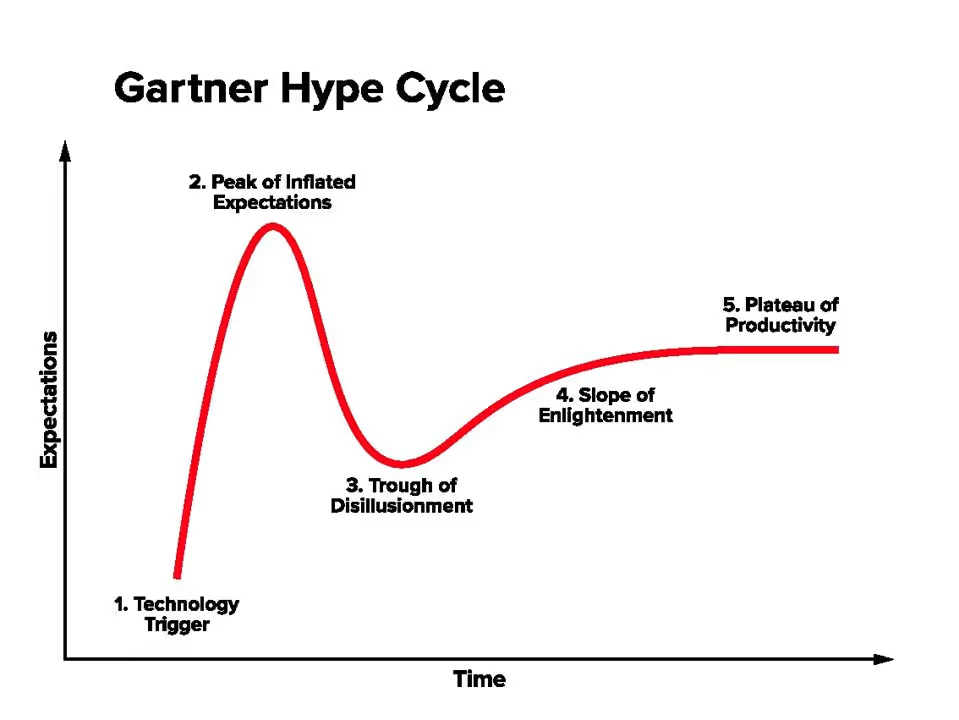
By late 2025, we've tumbled from that peak. The market has become saturated with AI-generated content that blends together—similar tone, similar structure, similar results. Content fatigue has set in. Marketing teams are questioning ROI. Many wonder if they bought into the hype too quickly.
But the technology isn't going away. It's maturing. By 2026, B2B marketing will move into the Slope of Enlightenment and edge toward the Plateau of Productivity. Marketers who understand this shift—who can apply AI strategically rather than superficially—will gain significant advantages.
45% of B2B marketers worldwide are prioritizing investment in AI-powered marketing tools for 2026. Plus, 95% are already using AI tools in some capacity, though most applications remain experimental. The difference between leaders and laggards won't be AI adoption itself, but how thoughtfully it's implemented.
This article explores what AI in B2B marketing will look like in 2026, breaking down opportunities across every stage of the marketing funnel—from awareness to conversion—and highlighting the tools and strategies that will separate strategic practitioners from those still treating AI as a novelty.
Top of Funnel: The Shift from Traditional SEO to AEO and GEO
Marketing to AI, Not Just Through AI
Traditional SEO isn't dead, but its role as the primary awareness strategy is diminishing. High-intent B2B buyers aren't just Googling keywords anymore—they're asking AI assistants, querying ChatGPT, and trusting answer engines to deliver what they need.
This means B2B content needs to shift from "organic marketing with AI" to "organic marketing to AI." Your content isn't just competing for human eyeballs; it's competing to be the source that AI pulls from when answering buyer questions.
Answer Engine Optimization (AEO) and Generative Engine Optimization (GEO) represent the new battleground for TOFU visibility. AEO focuses on structuring content so answer engines can extract and cite it. GEO goes further, optimizing content to be included in AI-generated responses from models like ChatGPT, Gemini, and Claude.
What AI Can Do for TOFU in 2026
AI tools like Yarnit can analyze search patterns and identify niche, high-intent long-tail keywords that human researchers might miss. Ask Yarnit can access People Also Ask (PAA) data at scale, identifying the exact questions your buyers are asking, and help create content that answers them directly. Comprehensive FAQ sections optimized for featured snippets and answer engine indexing become feasible to produce at scale.
Platforms like Yarnit provide cutting-edge access to APIs and data sources, helping marketers make informed decisions about which topics and keywords will drive visibility in answer and generative engines. This level of real-time data integration wasn't possible just a year ago.
According to EMARKETER, 80% of global B2B tech industry buyers use generative AI as much as traditional search when researching vendors, with 47% using it specifically for market research and discovery. If your content isn't optimized for AI consumption, you're invisible to half your audience.
AI-Driven Performance and Programmatic Marketing
While organic visibility remains critical, inorganic tactics are evolving too. AI is transforming performance and programmatic marketing in ways that were impossible just two years ago.
Google recently launched AI-powered tools which enables campaign management via natural language, and AI Max, which optimizes search ad performance automatically. These features reduce manual workload and improve ROI by learning buyer behavior in real time.
Meta has introduced Andromeda, an AI-driven system enhancing programmatic ad targeting across its platforms. Andromeda analyzes user behavior patterns to deliver hyper-relevant ads to B2B decision-makers.
Programmatic platforms now integrate generative AI to create and test multiple ad variations simultaneously, identifying the highest-performing creative combinations faster than traditional A/B testing.
The result? Smarter campaigns, lower costs per acquisition, and better alignment between paid and organic strategies.
Middle of Funnel: Accelerating Content Creation and Personalization
Speed Meets Quality in Long-Form Content
MOFU is the evaluation stage—where B2B buyers download whitepapers, attend webinars, and consume case studies. The challenge has always been creating this content at the speed and scale modern buyers demand.
AI fundamentally changes the production equation. Tools like Google Gemini for Workspace integrate domain expert knowledge directly into content workflows. Subject matter experts can contribute insights in real time, while AI handles structure, formatting, and quality control. What used to take weeks now takes days.
Speed doesn't mean sacrificing quality, though. AI-driven platforms allow marketers to generate in-depth whitepapers with proper citations and data visualization, repurpose long-form webinars into bite-sized social content using tools like Descript, and transform product videos into short-form clips optimized for LinkedIn, Twitter, and YouTube.
This content acceleration matters because buyers don't wait anymore. If your competitor publishes a comprehensive guide faster, they capture the consideration stage—and you lose the deal.
AI-Enhanced Outbound and Cold Email Strategies
Cold email gets a bad rap, but AI is making it smarter. Platforms like Apollo use AI to optimize lead targeting, crafting hyper-personalized messages based on firmographic data, behavioral signals, and intent scoring.
Apollo doesn't just scrape LinkedIn profiles—it analyzes buyer journeys, identifies the best time to reach out, and suggests messaging angles likely to resonate. The result? Higher open rates, better reply rates, and fewer emails ending up in spam.
LinkedIn has also rolled out AI-driven targeting enhancements, allowing B2B marketers to build ultra-precise audience segments based on job function, seniority, company growth signals, and even engagement with competitor content. This level of granularity wasn't possible before AI.
Bottom of Funnel: Closing Deals with AI-Powered Precision
Sales Collateral That Converts
BOFU is decision time—where deals close or fall apart. Buyers need tailored sales collateral: ROI calculators, case studies, implementation plans, and pricing proposals. AI can generate all of this, customized to the buyer's industry, company size, and pain points.
Instead of sales teams cobbling together generic decks, AI platforms pull data from CRM systems, analyze previous successful deals, and create personalized proposals in minutes. This represents intelligent customization at scale, not just template filling.
AI SDRs: The New Sales Development Representatives
AI Sales Development Representatives (AI SDRs) are revolutionizing lead qualification. These AI agents handle initial outreach, qualify leads based on predefined criteria, and schedule meetings—all without human intervention.
They augment human SDRs rather than replace them. AI SDRs handle the volume, freeing human reps to focus on high-value conversations and relationship-building. Companies using AI SDRs report faster response times, higher qualification accuracy, and better pipeline health.
CRM and Email Automation: The Final Push
Platforms like HubSpot have introduced AI-enhanced CRM features that automate retargeting, deal scoring, and email nurturing. HubSpot's AI analyzes historical deal data to predict which leads are most likely to close, recommending specific actions to move them forward.
Email automation has become more sophisticated too. AI determines the optimal send time for each recipient, crafts subject lines proven to increase open rates, and personalizes body copy based on engagement history. Batch-and-blast is over—precision targeting is the standard.
These tools also integrate with sales workflows, triggering alerts when a lead shows buying intent (like visiting pricing pages multiple times or downloading competitor comparisons). Sales teams can act on hot leads immediately, increasing close rates significantly.
Embrace the Slope of Enlightenment
AI in B2B marketing is at an inflection point. The hype is fading, but the real value is just emerging. By 2026, we'll see AI reach Gartner's Plateau of Productivity—the stage where practical, proven use cases dominate and competitive advantage shifts to those who implement strategically.
The marketers who win won't be the ones who jumped on every AI trend. They'll be the ones who understood the fundamentals: optimizing for answer engines, accelerating content creation without sacrificing quality, personalizing outbound at scale, and leveraging AI SDRs to close deals faster.
AI handles the repetitive, the scalable, the data-driven. Humans handle the strategic, the creative, the empathetic. That division of labor is where the real transformation happens.
As you plan for 2026, consider how AI fits into the foundation of your marketing operations rather than sitting on top as a novelty. The 45% of B2B marketers prioritizing AI investment have already made that mental shift. The opportunity is there for those who approach it with both ambition and clear-eyed pragmatism.
If you're looking for an AI partner that understands context, delivers intelligence, and empowers your team to thrive through this evolution, platforms like Yarnit offer the contextual AI capabilities and generative tools designed specifically for modern B2B marketing. The Slope of Enlightenment awaits. Let's climb it together.
Ready to transform your B2B marketing strategy with AI? Start by auditing your current tech stack, identifying gaps in your funnel, and prioritizing AI tools that deliver measurable ROI. The future isn't coming—it's already here.


