It's the third time this week you've pasted an AI-generated draft into a Google Doc, only to spend the next hour making it sound like something a human actually wrote. The sentences are technically correct. The structure is fine. But there's a flatness to it, a kind of generic confidence that signals to any experienced reader, or worse, a search engine, that the content was assembled rather than crafted.
AI writing tools promised to make content creation faster, cheaper, and more scalable. And they have, to a point. But as SEO competition intensifies and audiences grow more discerning, "faster and cheaper" isn't enough if the output still needs a full editorial pass before it's usable. The productivity gains start to look a lot thinner when you factor in the editing time, the back-and-forth with the tool, and the mounting subscription costs that somehow exceed what you budgeted for.
Writesonic is one of the most widely adopted AI writing platforms out there and for good reason. It got a lot of people started with AI content. But a growing number of marketers who built their early workflows around it are now raising some concerns around output quality, credit system and the pricing structure.
None of this makes Writesonic a bad tool. It makes it a tool that a certain kind of user has outgrown. This guide is for marketers, content teams, and SEO strategists who are already asking: is there something better? Here's an honest look at what's frustrating users, and seven alternatives that may be a stronger fit.
Why do you need an alternative to Writesonic?
As AI tools evolve and marketing teams demand more sophisticated capabilities, many users have started exploring Writesonic alternatives. Across G2, Capterra, and GetApp, three limitations show up consistently that affect content quality and workflow efficiency :
1. Outputs that feel obviously AI-generated
According to a roundup of verified G2 reviews compiled by Juma AI, one reviewer put it plainly: "One of the main drawbacks of Writesonic is that the content it generates isn't particularly creative or well written… the generated content often requires a lot of editing before it's ready for publication."
An independent review on eesel AI echoes this: "The output quality is decent for a first draft, but expect to spend time editing. Multiple reviewers note that content can feel generic or 'obviously AI' without significant reworking."
2. A credit system that runs out faster than expected
eesel AI's deep-dive review flags this as the single biggest user complaint: "The single biggest complaint from users is about the credit system. Different features and quality settings eat up credits at different rates, and here's the kicker: they do not roll over at the end of the month."
A Capterra reviewer captured it well: "I am a little disappointed that there are only 50 credits each month for long-form research articles because I am a YouTube content creator, and I will need more credit for some of the months to generate articles."
3. Pricing that grows unpredictably
A review aggregation on getmint.ai found that "the most common complaint, with over 30 combined mentions, is that the platform is too expensive and that the credit system is unfair and confusing."
7 Best Writesonic Alternatives for SEO Blog Generation
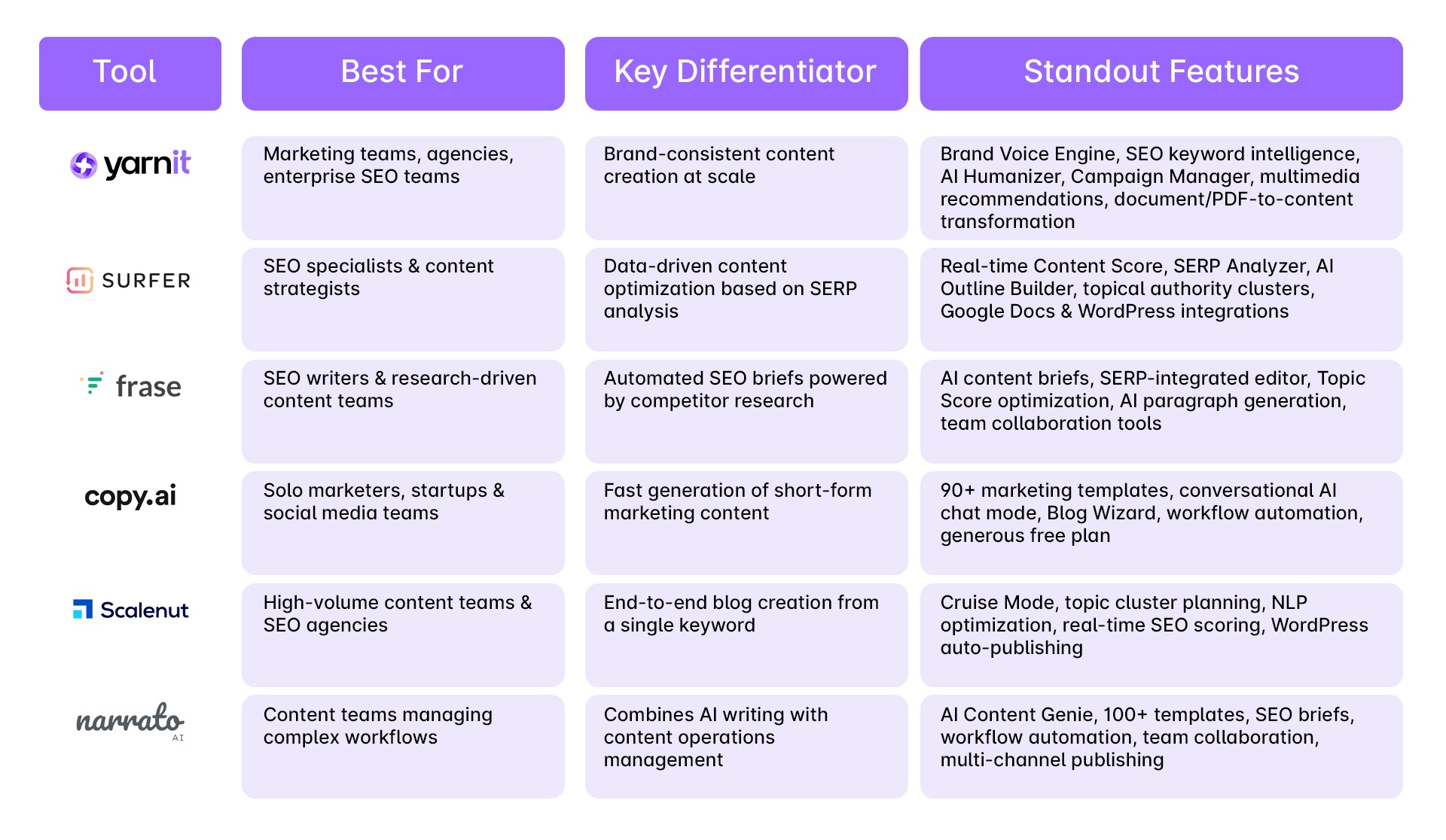
1. Yarnit: Best for Brand-Consistent SEO Content at Scale
Yarnit is an AI-powered content creation platform built specifically for marketing teams. Unlike general-purpose AI writers, Yarnit is designed around contextual intelligence, meaning it generates content that understands your brand, your audience, and your SEO goals. It's built to help teams ideate, write, design, and publish from a single workspace, with enterprise-grade brand compliance baked in from the start.
Key Features
Brand Voice & Personality Engine: Yarnit learns your brand's tone, style, and communication guidelines and applies them consistently across every content type, blogs, social posts, email, and ad copy. No more editing outputs to match your voice; it comes pre-trained on your brand.
SEO Content Ideas & Keyword Intelligence: Yarnit's SEO module helps discover high-performing keywords, generate SEO-qualified content ideas aligned with target keywords, and create search-optimized content using AI writing assistance and expert templates all in one place.
AI-Assisted Writing with Syndicated Data: Yarnit's writing feature enhances credibility by incorporating syndicated statistics and information, generates contextual content briefs tailored to campaigns, and can transform existing PDFs, websites, and documents into new content formats.
AI Humanizer: Yarnit's AI Humanizer takes content that reads as obviously machine-generated and rewrites it into a copy that feels natural, engaging, and human. It removes AI patterns, preserves SEO value, and is built to pass AI detection tools. For teams that regularly produce first drafts with AI and then spend time de-roboticising them, this closes that loop without a separate editing pass.
Campaign Manager: Takes a campaign brief and turns it into ready-to-launch, multi-format content, blog posts, social copy, email, and more in minutes, without the usual back-and-forth between tools.
Multimedia & Design Integration: Recommends best-fit images, icons, and design elements alongside written content, so marketing teams aren't switching between a writing tool and a design tool for every piece.
Best For: Marketing teams at mid-size to enterprise companies, content agencies managing multiple brand clients, and SEO teams looking to produce brand-consistent, research-backed blogs at scale.
2. Surfer SEO: Best for Data-Driven SEO Optimization
Surfer SEO is less of a content generator and more of an SEO content optimization engine. It analyzes the top-ranking pages for your target keyword and tells you exactly what your content needs to compete, structure, word count, NLP terms, keyword density, and more.
Key Features
Real-Time Content Score: Tracks keyword usage, heading structure, and NLP terms against top-ranking competitors as you write.
SERP Analyzer: Breaks down what the highest-ranking pages are doing in terms of structure, internal links, image usage, and content length.
AI Outline Builder: Generates SEO-optimized content outlines based on live SERP data, including recommended headings and questions to cover.
Topical Authority Clusters: Maps keyword clusters and suggests content groupings to build long-term site authority.
Google Docs & WordPress Integration: Works directly inside your existing writing environment.
Best For: SEO professionals and content strategists who want data-backed optimization and want to understand why content ranks, not just generate it quickly.
Frase sits at the intersection of SEO research and content creation. It automates brief generation by pulling competitor outlines, relevant questions, and SERP data directly into a writing interface, making it a strong choice for writers who want research and writing to happen in the same window.
Key Features
AI Content Brief Generator: Compiles competitor outlines, SERP-sourced questions, and key topics into a single actionable brief automatically.
SERP-Integrated Writing Editor: View competitor content and pull in research data directly alongside your writing, eliminating tab-switching.
Topic Score Optimization: Scores your content against NLP terms from top-ranking pages to close coverage gaps before publishing.
AI Paragraph Generation: Generates targeted paragraph-level content for specific sections, useful for expanding on focused points without rewriting everything.
Team Collaboration: Multiple writers and editors can work on the same document with version history and inline comments.
Best For: SEO writers, freelance content strategists, and content teams who want research-backed, SERP-informed articles with structured briefs built into the workflow.
4. Copy.ai: Best for Fast Short-Form Marketing Copy
Copy.ai is a lightweight, template-driven AI writing tool designed for speed and simplicity. It's popular with solo marketers and startup teams who need quick copy without steep learning curves or complex credit systems.
Key Features
Chat & Freestyle Mode: Write in a natural conversational flow with the AI, iterating on outputs in real time without rigid template structures.
90+ Marketing Templates: Covers product descriptions, cold emails, CTAs, value propositions, social posts, and more, all optimized for conversion.
Blog Wizard: A guided multi-step workflow from topic idea to outline to full draft, accessible even for writers with minimal SEO experience.
Workflow Automation: Build and save custom multi-step content workflows (brief → outline → draft → repurpose) for repeatable use.
Freemium Access: Genuinely usable free tier supporting GPT-3.5 and Claude 3 for basic writing needs.
Best For: Solo marketers, startup founders, and social media managers who need quick, conversion-ready copy without a heavy time investment.
Scalenut is an AI-powered SEO and content marketing platform that takes a keyword and automates the full journey to a published, optimized blog post. Its standout feature, Cruise Mode, makes it popular with teams scaling content output across multiple topic clusters.
Key Features
Cruise Mode: Takes a single keyword and generates a complete SEO-optimized blog, keyword research, outline, and full draft in a few clicks.
Topic Cluster Planning: Identifies related subtopics and builds content cluster maps to establish topical authority across a subject area.
NLP-Powered Optimization: Surfaces NLP terms, missing topics, and structural suggestions by analyzing your draft against top-ranking content.
Real-Time SEO Score: Live optimization score tracking keyword usage, readability, and content completeness simultaneously.
WordPress Auto-Publishing: Supports direct publishing, removing the final manual step for bloggers and CMS-dependent teams.
Best For: SEO-focused content teams, bloggers scaling to high publication volumes, and agencies building topical authority for clients.
Narrato is an AI content creation and workflow management platform that handles more than just writing. It functions as a full content workspace, managing briefs, writing, team collaboration, and publishing in one place. It's particularly strong for teams where content production involves multiple contributors and a structured editorial process.
Key Features
AI Content Genie (Autopilot): Automatically generates weekly blog posts and social content based on your website and selected themes, putting recurring content on autopilot.
100+ AI Content Templates: Covers blogs, product descriptions, social captions, email newsletters, and ad copy, all customizable to brand guidelines.
SEO Content Briefs: Generates in-depth briefs with keyword suggestions, competitor insights, topic clusters, and NLP terms.
Team Collaboration & Workflow Automation: Assign tasks, manage freelancers, set custom roles, and automate approval workflows from within the same platform.
Multi-Channel Publishing: Publishes directly to social platforms and CMS tools without additional integrations.
Best For: Small-to-mid-sized content teams, content agencies managing multiple clients, and solopreneurs who want AI writing and project management in one platform.
How does Yarnit help in Scaling Blog Generation?
One of Yarnit's most powerful differentiators for SEO blog generation isAsk Yarnit.
Rather than a single AI generating a blog post, Ask Yarnit deploys ten specialized AI agents that collaborate like a real marketing team. Each agent brings expertise in a specific domain, strategy, SEO, content creation, brand compliance, and they work in concert to produce comprehensive outputs from a single prompt.
For blog generation specifically, the workflow looks like this: you start with a simple prompt, a topic, a competitor article, a trending piece of news, or even a pitch deck. Ask Yarnit's agents to analyze the brief, conduct keyword research, generate an SEO-optimized outline with H1s and H2s, write a full draft aligned to your brand voice, and then allow you to review for consistency.
What makes this especially powerful for SEO content teams is that Ask Yarnit can generate search-optimized pillar pages, supporting blog posts, meta descriptions, and internal linking strategy as part of a single campaign-level request, not just one-off blog posts. It's the difference between generating content and building a content architecture.
Scale your blog production, accelerate organic growth, and turn content into a repeatable growth engine. Book a demo and experience Ask Yarnit firsthand.
See exactly why your Product Detail Page isn't converting
Thank you! Your submission has been received!
Oops! Something went wrong while submitting the form.


.jpeg)

.avif)
%20(1).png)