There was a time when launching a serious marketing campaign felt a bit like organizing a wedding. You needed a planner. A photographer. A designer. Someone who knew someone who could edit video. A copywriter. An agency. Three spreadsheets. Six approval rounds. And, ideally, a budget large enough to absorb at least one questionable decision.
For small marketing teams, the gap was obvious. Big brands had specialists for everything. You had Karen from product marketing learning Photoshop at 11 PM because the webinar banner was due tomorrow.
The accepted wisdom was that great marketing required scale. More people. More budget. More agencies. More process. Turns out, that wasn't entirely true.
The conversation around AI marketing usually revolves around saving time. Faster content creation. Faster research. Faster reporting. Faster everything. That's true, but it's also the least interesting thing happening.
The real shift is that small teams can now borrow capabilities they could never afford to hire for.
A marketer who has never edited a video can create product walkthroughs. Someone who isn't a designer can build campaign assets that don't immediately scream "made in PowerPoint." A lean team can test five campaign concepts instead of betting the quarter on one.
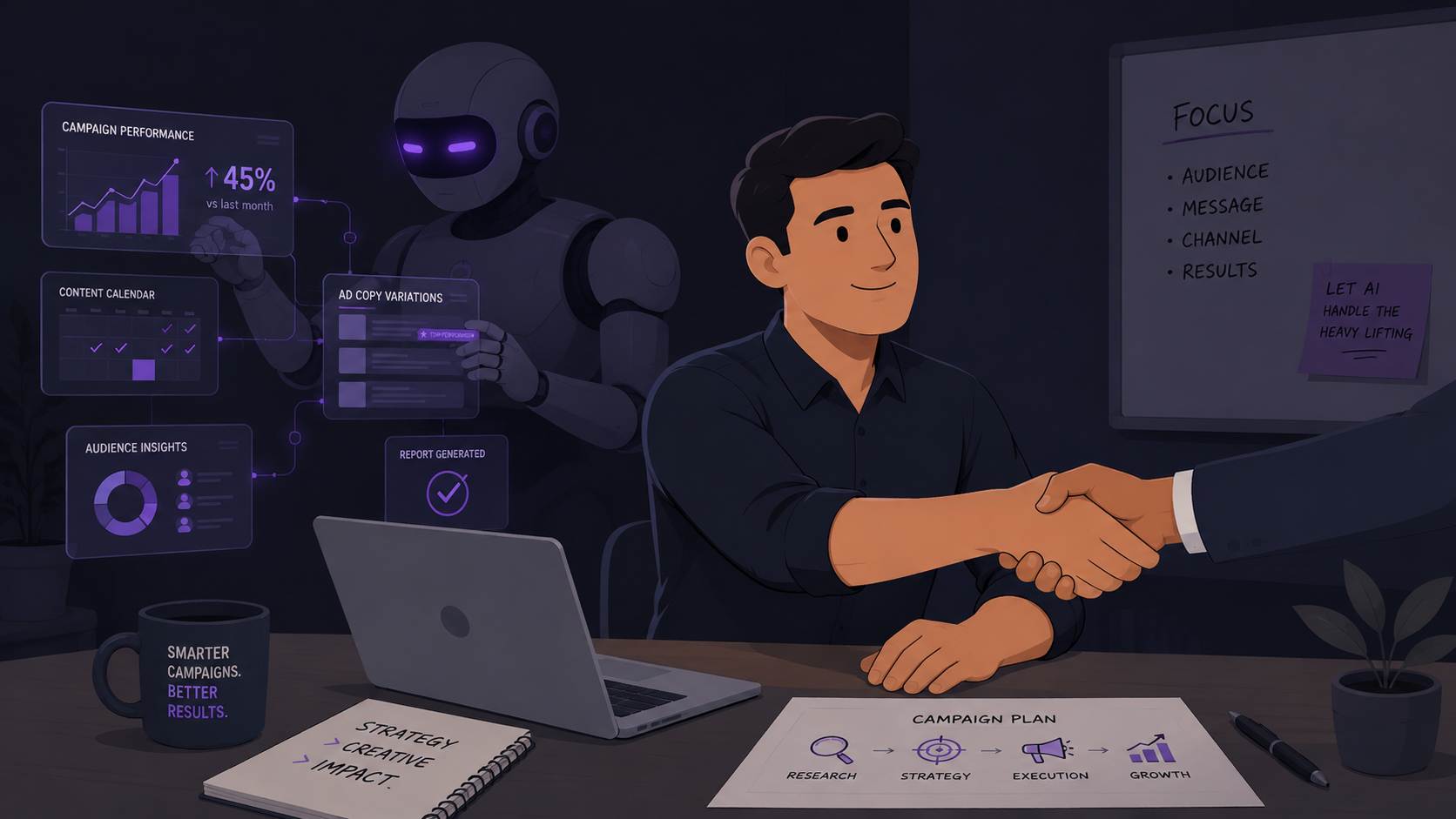
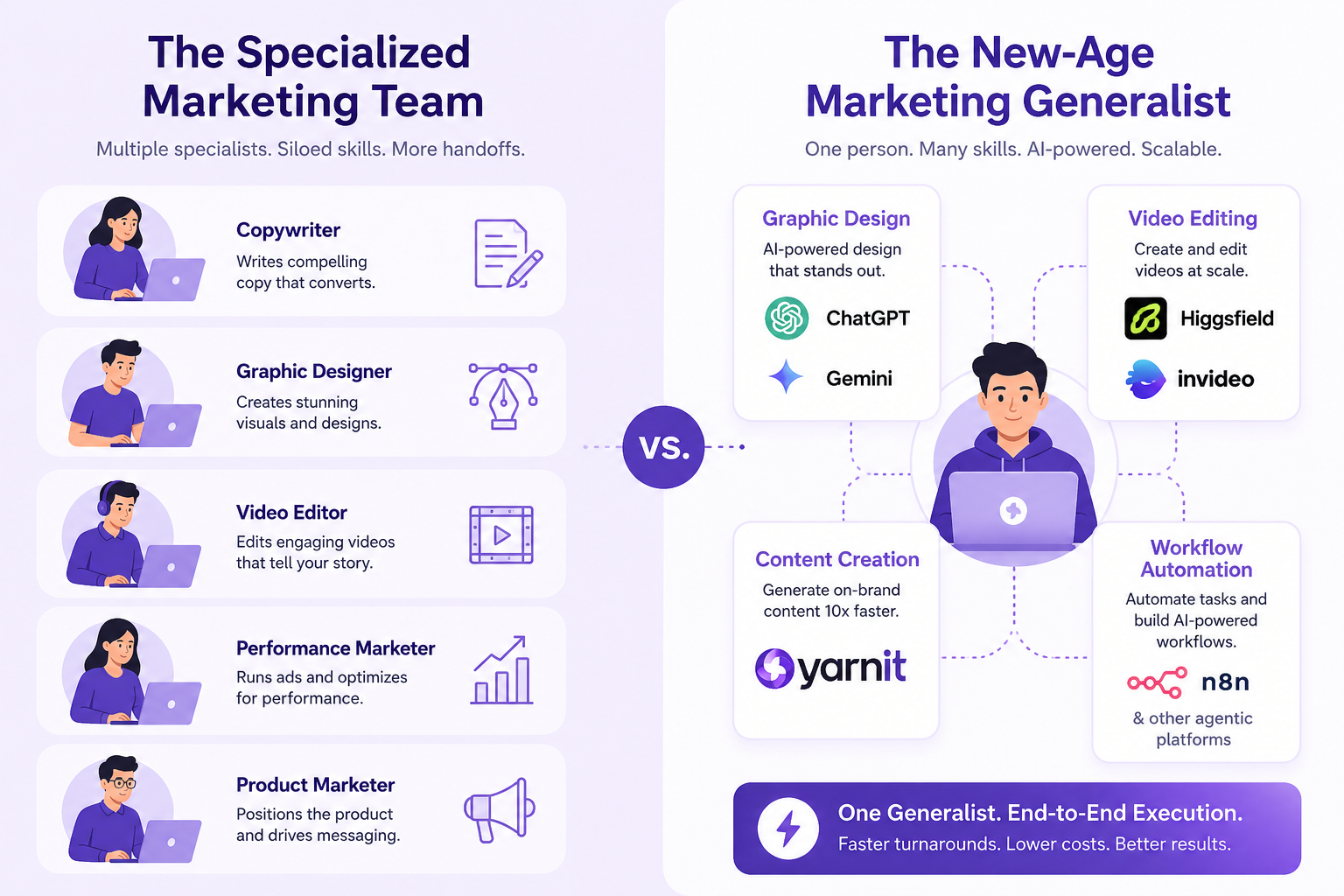
Today, the most in-demand marketers increasingly look less like specialists and more like orchestrators. They know enough about strategy, content, creative, analytics, customer research, and automation to connect the dots. AI handles much of the execution. Humans decide what is worth executing in the first place.
That's why the biggest opportunity isn't learning every new AI tool that appears on your timeline.
It's learning how to think across the entire funnel. In many ways, this is the first time in modern marketing that a three-person team can realistically operate like a team three times its size.
Not because they suddenly have enterprise budgets, but because they finally have access to enterprise-level capabilities.
The New Marketing Generalist: Why You Need to Own the Entire Funnel
The old marketing org chart is dead. Specialists are great when you have a budget for an entire team. Small teams don't have that luxury.
What small marketing teams need are generalists who understand the complete customer journey, from cold traffic to closed deal, and can orchestrate every touchpoint along the way. Not because they're superhuman, but because AI makes this realistic for the first time in marketing history.
Think about what this means practically:
You need to understand awareness-stage content (blogs, social posts, ads) well enough to direct AI in creating it
You need to grasp consideration-stage mechanics (email sequences, retargeting, lead magnets) to build automated workflows
You need decision-stage fluency (sales enablement, case studies, demos) to close the loop
The catch? This only works if you genuinely understand your Ideal Customer Profile. Not surface-level demographics. Deep psychographics. Pain points. Decision triggers. The language they actually use. Because AI doesn’t create understanding, it amplifies it.
Here's how you as a marketer need to upskill:
Workflow comprehension: Map every step of your marketing system from first touch to customer
ICP intimacy: Spend real time understanding customer motivations, objections, and buying behavior
Task discernment: Learn which activities benefit from automation and which require human creativity or judgment
Agent orchestration: Understand how to deploy AI for specific tasks while maintaining control of strategy
The core skill isn't prompt engineering. It's knowing exactly what belongs where in your workflow and why. It's recognizing that AI handles execution brilliantly but you own the strategy, the positioning, and the customer understanding that makes everything work.
What Marketers Actually Need to Learn (Hint: It's Not More Tools)
Every week brings another AI marketing tool. Another "revolutionary" platform. Another promise that this one will finally solve everything.
The key learning for new-age marketers: Stop chasing tools. Start mastering workflows.
The real opportunity comes from deeply understanding the processes that convert customer insights into measurable business outcomes. AI accelerates individual tasks within these workflows. Only you can design, optimize, and evolve the system itself.
Here's what separates marketers who benefit from AI from those who just accumulate subscriptions:
They map everything. Literally. Use mind maps. Use Miro. Use whatever works. But document your entire marketing operation as a visual workflow showing:
Every customer touchpoint from awareness to advocacy
Data sources feeding each stage (website analytics, CRM, social insights, email metrics)
Decision points requiring human judgment
Repetitive tasks ripe for automation
Bottlenecks slowing your system
Hand-off points between different channels or stages
Once you see your marketing system visually, automation opportunities become obvious. So do the places where removing yourself creates more problems than it solves.
They understand their data ecosystem. Which platforms talk to each other? Where does customer data live? What connectors exist between your email platform, CRM, analytics, and content management system? You can't build effective AI agents without knowing what information they can access and how.
They test small before scaling. Don't automate your entire email program on day one. Pick one sequence. One campaign. Prove the workflow works at small scale, then expand. AI fails loudly when given too much autonomy too fast.
Workflow mastery is infinitely more valuable than knowing 47 different AI copywriting tools.
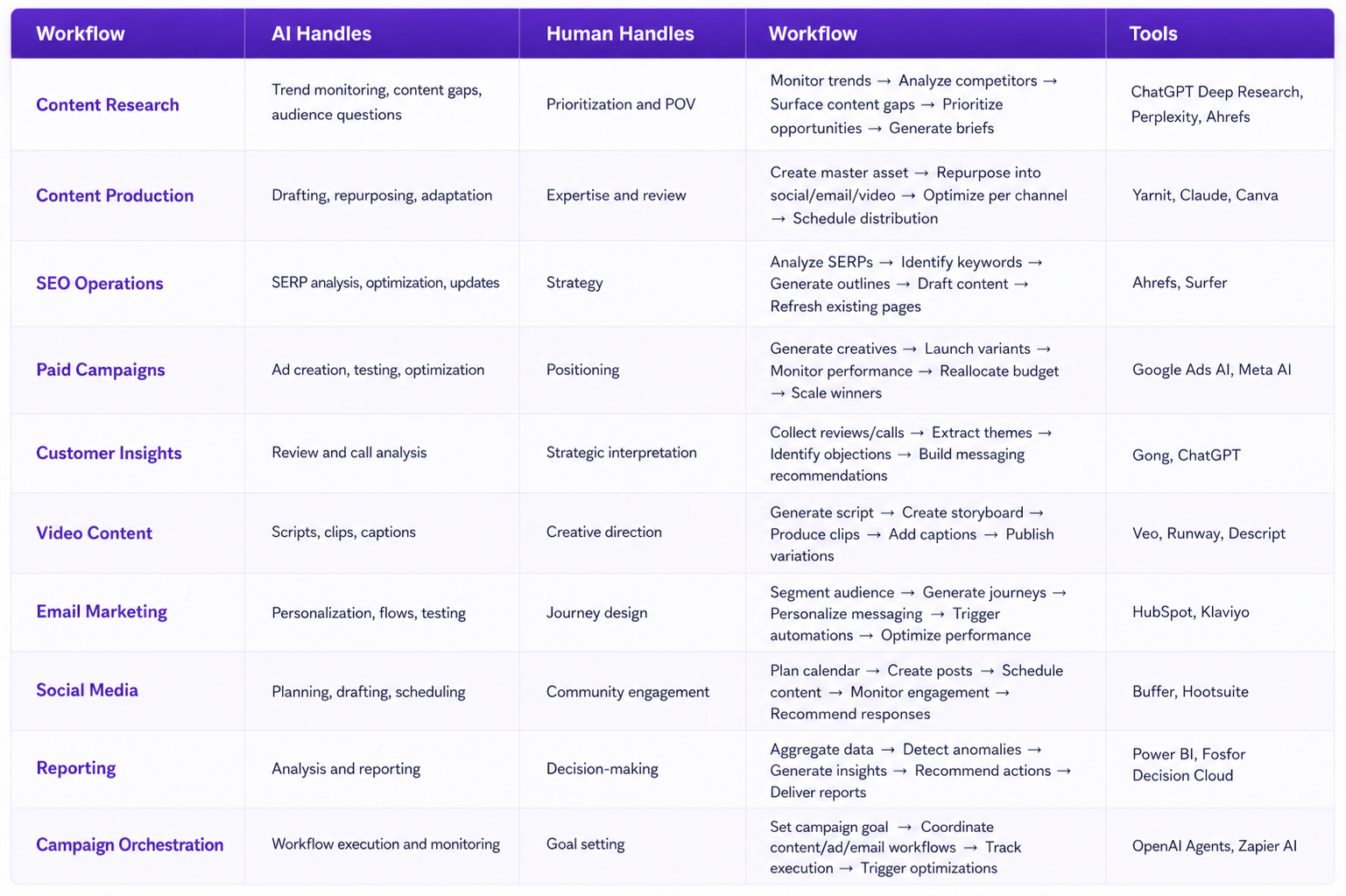
AI Workflows for 10 Common Marketing Tasks
Let's get specific. Here's exactly what AI should handle, where you stay essential, and example prompts for building agents that actually work.
Critical note before we start: Effective AI agents require understanding the complete workflow first. Know your data sources, connectors, input/output requirements, and every step in the process. Generic prompts fail. Context-rich prompts that account for your specific workflow succeed.
The Guerrilla Marketing Mindset: AI as Your Force Multiplier
Small marketing teams can't win by playing the same game as enterprise marketing departments. Different rules. Different weapons.
Your advantage isn't budget. It's speed, creativity, and willingness to leverage AI as the ultimate force multiplier. The companies that figure this out first are punching way above their weight class and loving every minute of it.
Here's your action plan:
This week: Map one complete marketing workflow from start to finish. Just one. Make it visual. Identify every step, decision point, and handoff. Find three tasks you could automate tomorrow.
This month: Build your first AI agent using one of the prompts above, customized for your workflow. Test it. Break it. Fix it. Learn what works in your specific context.
This quarter: Transform how your team operates. Not by adding headcount. By systematically identifying where AI multiplies your capabilities and where your human judgment stays irreplaceable.
The playing field isn't level yet. But it's leveling fast. The question isn't whether AI will change marketing: it already has. The question is whether you'll use it as the force multiplier it is, or watch competitors who do leave you behind.
See exactly why your Product Detail Page isn't converting
Thank you! Your submission has been received!
Oops! Something went wrong while submitting the form.



.avif)
%20(1).png)