Here's a dirty secret the big agencies don't want you to know: the marketing funnel that justified their six-figure retainers is quietly eating itself.
It used to be clean. Orderly. Beautifully billable. Awareness lived up top with the brand team. Consideration was SEO's backyard. Decision belonged to sales. Three departments, three budgets, three separate teams who barely talked to each other. That fragmentation was, for a long time, the moat that kept enterprise marketing looking like rocket science.
Then AI showed up and ruined everything. In the best possible way.
The funnel is collapsing because buyer behavior is collapsing it. Someone watches a Reels ad, drops the name into ChatGPT, gets a comparison breakdown in ten seconds, and either buys or doesn't, all before your carefully nurtured email drip sequence even clears the spam filter. For small marketing teams, this is genuinely exciting. Because when the funnel was long and fragmented, you couldn't compete with teams of thirty. Now that it's compressed, a sharp team of three to five can run the whole funnel with tools that do in hours what used to take weeks.
This article is your step-by-step playbook for doing exactly that. We'll walk through each stage of the ACP funnel, and show you precisely where AI enters the picture, which tools to use, and what to actually do on Monday morning.
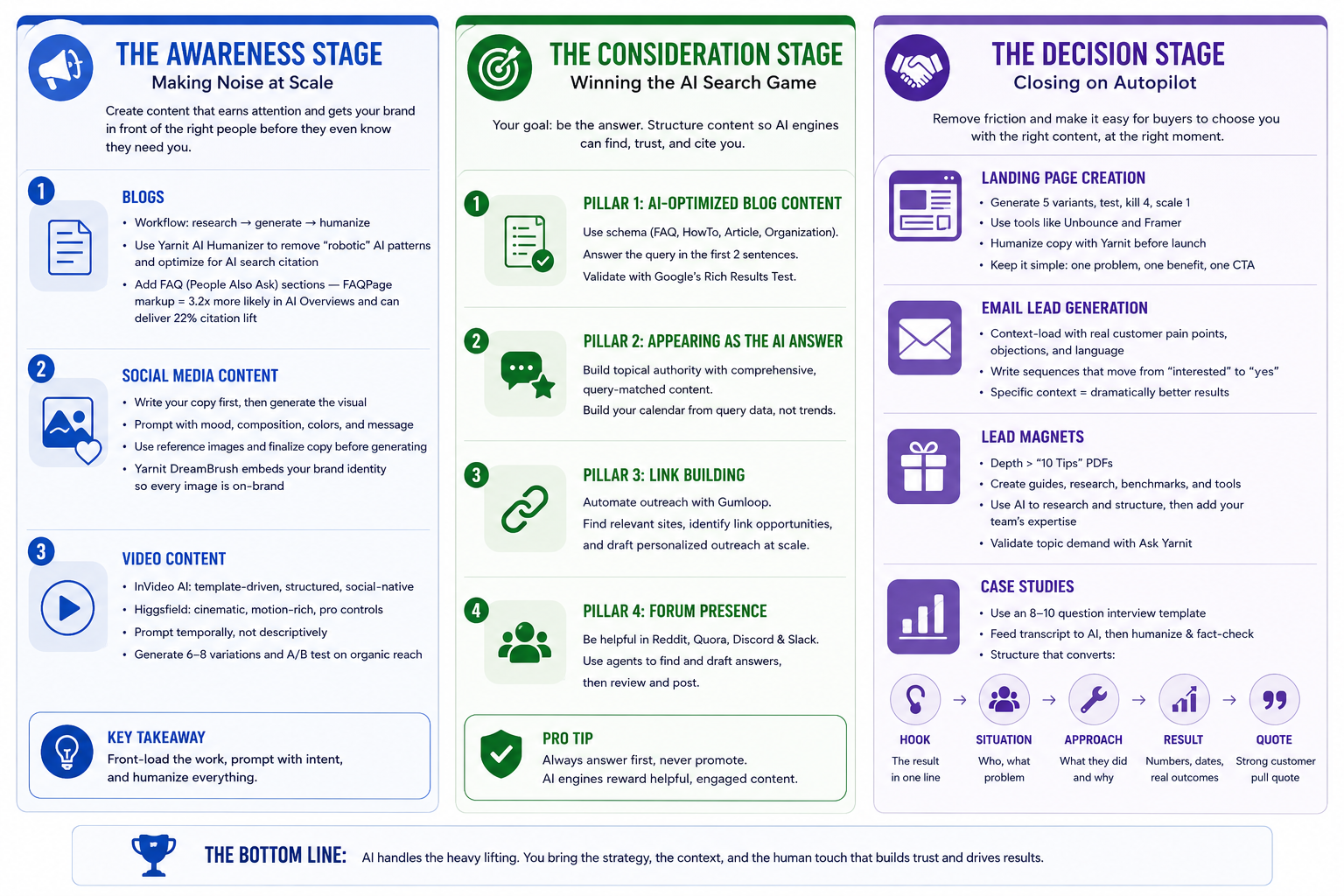
The Awareness Stage: Making Noise at Scale
Awareness content earns attention from people who don't yet know they need you. Blog posts, social media updates, infographics, short-form video, ad creatives, these are the breadcrumbs you scatter across the internet so the right person stumbles on your brand before they know they're looking for it. Here's how AI changes each format:
1. Blogs
AI has been writing blog posts for three years now. But the impressive part is doing it well, which means not shipping content that reads like it was generated by a slightly tired robot who had one too many coffee substitutes. The workflow is research, generate, then humanize. Research your target queries using tools like Semrush or Ask Yarnit. Generate your draft with a properly context-loaded prompt. Then, and this is the step most teams skip, humanize it.
Yarnit's AI Humanizer is built specifically for this problem. It smooths out the mechanical edges that make AI content feel like a legal disclaimer, varying sentence rhythm, introducing natural connective tissue, and adjusting tone so the content reads like a knowledgeable colleague wrote it rather than a large language model. The platform uses specialized AI agents working simultaneously to identify and eliminate what it calls "8 distinct AI content patterns", formulaic transitions, template phrases, artificial enthusiasm, and the rest. Crucially, it also optimizes for AI search citation, the emerging standard where models like Perplexity, ChatGPT, and Gemini decide whether your content is trustworthy enough to surface as an answer.
People Also Ask (PAA) boxes on Google are a goldmine. For every topic you cover, note the PAA queries and turn them into an FAQ section at the bottom of the post. Pages with FAQPage markup are 3.2x more likely to appear in Google AI Overviews, and a study of 50 B2B and ecommerce domains found that implementing FAQPage schema delivered a median 22% citation lift in AI-generated search results across Perplexity, ChatGPT, and Bing Copilot. We'll cover AI search visibility in more depth in the Consideration section.
2. Social Media Content
You don't need a dedicated design tool for most social media visuals. Off-the-shelf image generators, ChatGPT's image generation, Gemini, are now good enough for most social content if you know how to prompt them properly.
The secret is front-loading the work. Most people iterate endlessly because they start with a vague idea. Instead: write your copy first, finalize the message, then generate the visual to match. Not the other way around. Your prompt should describe mood, composition, color palette, and what the image needs to communicate.
Sample prompt for a social creative:
"A clean, editorial-style flat lay on a warm cream background. A single open laptop showing a graph trending upward, next to a small potted plant and a ceramic coffee mug. Mood: calm productivity, smart and minimal, not corporate. Color palette: warm whites, muted terracotta accents, no harsh shadows. Leave the top-right quadrant empty for text overlay. Editorial photography aesthetic, 4:5 aspect ratio for Instagram feed."
Pro tips before you hit generate: Attach a reference image you like, the model will pull from its visual language, not yours. And generate your copy beforehand so you're not doing multiple creative iterations trying to reconcile the image and the message.
For teams with strict brand guidelines, generic image generation creates a new problem: everything looks vaguely on-brand but nothing is actually on-brand. Yarnit DreamBrush solves this by letting you embed your brand colors, logos, and visual identity directly into the generation process, so every image comes out with your actual brand baked in, not bolted on afterward. The platform automatically selects the optimal AI model based on your specific prompt and needs, whether that's photorealistic product visualization, abstract concept illustration, or branded social content.
3. Video Content
Video is the highest-leverage awareness format right now, and it has also been the most expensive to produce. That equation has changed dramatically.
InVideo AI is a template-driven platform that gives you structured control over your output, better for social-native formats, explainer content, and anything that needs consistent text overlays and branding. It recently struck partnerships with both OpenAI (Sora 2) and Google (VEO 3.1), integrating both generative video models into its pipeline and making frontier video generation accessible at a fraction of the standalone cost.
Higgsfield is built for cinematic, motion-rich output with a physics-aware generation engine and professional-grade camera controls. Its Cinema Studio gives you 1,296 virtual camera lenses and the ability to lock character consistency across scenes. The platform now has over 22 million users powering more than 6 million pieces of content per day. The use case here is guerrilla marketing, fast, punchy, culturally relevant clips that feel native to short-form platforms.
Actionable tips for prompting video models:
Be temporal, not descriptive. "A woman walks toward a glass office building, stops, looks up, cut to the interior shot of a conference room, empty" works. "A powerful business scene" does not. Generate six to eight variations, then A/B test on organic reach before putting spend behind anything. Let the algorithm tell you what to amplify.
The Consideration Stage: Winning the AI Search Game
The consideration stage used to be straightforward. Write "how to" content. Write "what is" content. Rank on Google. Win. That playbook is no longer sufficient on its own, for a very specific reason: consideration is increasingly happening inside AI engines, not on blue-link search results pages.
When someone is genuinely evaluating a purchase, they're asking ChatGPT for comparisons, using Perplexity for research, and getting Gemini to summarize options. If your content isn't structured to appear in those responses, you're invisible at the exact moment a buyer is forming their opinion.
The modern consideration strategy has five pillars.
Pillar 1: AI-Optimized Blog Content
AI-optimized means structuring content so that AI crawlers can parse, trust, and cite it. In a controlled experiment run by Search Engine Land in 2025, three nearly identical pages with the same content and keyword difficulty were tested against each other. Only the page with well-implemented structured data appeared in a Google AI Overview. The no-schema page never even got indexed.
Practically, AI optimization means implementing FAQ, HowTo, Article, and Organization schema on every content page using JSON-LD. It means putting the direct answer to the query in the first two sentences before elaborating, AI citation engines pull from the top of content, not from the most eloquently written paragraph. And it means doing real query research using tools like Semrush to understand what people actually type, not what you think they type.
Actionable tip: Use Google's Rich Results Test to validate every page's schema before publishing. Auto-generated schema that doesn't match visible page content can trigger quality penalties.
Pillar 2: Appearing as the AI Answer
This is the new version of ranking number one on Google. When someone asks an AI assistant a question related to your category, you want your content to be what gets cited. The path to that is building topical authority through comprehensive, query-matched content.
Build your content calendar from query data, not content trends. Trends tell you what's popular. Query data tells you what people need answers to right now.
Pillar 3: Link Building
Your domain authority is still the backbone of both traditional and AI search visibility. The more places your content is cited and linked, the more credible you appear to every algorithm. The problem is that traditional link-building outreach is tedious, repetitive, and time-consuming, which makes it perfect for automation.
Gumloop is a no-code AI automation platform that lets marketers build visual, node-based workflows to handle repeatable tasks at scale.The platform supports over 130 integrations and lets you deploy multi-step agents that interact with external data sources, perform recurring tasks, and integrate with tools like Slack, HubSpot, and email without writing a line of code.
Sample agent prompt for Gumloop:
"Search Google for [niche] + blog, [niche] + resources, and [topic] + guest post. Collect the top 20 results. Filter for sites with Domain Authority above 40. For each qualifying site, identify an existing article where a link to [our URL] would add value. Note the article URL and the specific section. Then draft an outreach email: reference the specific article, mention the section where our content would add value, keep it under 80 words, no pitching — just a genuine value add, casual sign-off. Output a CSV with: Site, Article URL, Contact Email, Draft Email. One row per opportunity."
Pillar 4: Forum Presence
Reddit, Quora, and niche communities on Discord and Slack have outsized influence on AI search results. AI models are trained on these platforms, and a well-placed, genuinely helpful answer on a relevant Reddit thread will get cited by AI search engines far more often than you'd expect.
The same Gumloop agent framework applies here. Build an agent that monitors relevant subreddits and Quora spaces for questions in your category, drafts contextually appropriate responses, and flags them for human review before posting. You maintain quality control, you're just not doing the finding and drafting manually.
The one rule that matters here: always answer the question before mentioning your product. Anything that reads as promotional gets downvoted into irrelevance. And since AI engines trained on community data weight engagement, a downvoted response actively works against you.
The Decision Stage: Closing on Autopilot
By the time someone hits your decision stage, they've already decided they want to solve their problem. Your only job now is to make it easy to choose you. The friction is usually content-shaped, the landing page isn't compelling enough, the follow-up emails are generic, the lead magnet is thin, the case study either doesn't exist or reads like a press release.
AI closes each of these gaps efficiently. And unlike the Awareness stage where brand voice matters enormously, the Decision stage is largely about information architecture and personalization, both of which AI handles exceptionally well.
Landing Page Creation
The old approach involved brief a copywriter, wait a week, review, revise, hand off to a developer, wait another week, launch. The AI approach is to generate five landing page variants in an afternoon, run them as a split test, kill four, scale one.
Tools like Unbounce and Framer have built AI generation directly into their interfaces. Describe your offer, the audience pain point, the key proof point, and a CTA and get a structured landing page in minutes. Run the result through Yarnit's humanizer. AI-generated landing page copy has a telltale rhythm that erodes trust. Fix it before launch.
Quick actionable landing page checklist:
Above the fold: one problem statement, one benefit, one CTA.
Social proof: real numbers, real names, real companies
FAQ section: pull from your PAA research, anticipate objections in question form, answer them before they're asked.
Email Lead Generation
The decision stage email sequence has one job: take someone from "interested" to "yes." Most AI-generated sequences fail because they're structurally correct but emotionally inert, they follow the right cadence but say nothing a human actually wrote.
The fix is context loading. When you prompt an AI to write a nurture sequence, give it your actual customer pain points, sourced from sales calls, support tickets, and reviews. Give it the specific language your customers use. Give it the real objections your sales team hears. The output quality difference between a generic prompt and a context-rich prompt is dramatic.
Lead Magnets:
The era of the "10 Tips" PDF as a lead magnet is genuinely over. Buyers are better informed, and AI has raised their baseline for what "useful information" looks like. What still converts is depth, comprehensive guides, original research, benchmarking reports, and tools that solve a real problem. AI accelerates the production of these significantly. Use it to synthesize secondary research, pulling from multiple sources to build a coherent, data-rich perspective on a topic. Use it to structure a comprehensive guide that would take a single writer two weeks to outline. Then add your team's actual expertise on top. The AI handles the scaffolding; you provide the proprietary insight.
A well-structured Yarnit research workflow can produce the backbone of a 20-page industry report in a day. That's a piece of content that previously required a research analyst and a week. The result is a lead magnet that earns its gate because it actually says something worth reading.
Actionable tip: Before choosing a topic for a lead magnet, check Ask Yarnit for query volume data. Build lead magnets around questions that enough people are actively searching for. Depth on a topic nobody is looking for is vanity, not strategy.
Case Studies
Case studies are the highest-converting decision-stage asset and the one most consistently neglected by small teams because they're time-consuming to create. The bottleneck is usually the writing, getting the customer on a call, extracting the story, structuring it into something compelling.
AI handles the structuring and writing once you have the raw material. Build an eight to ten question interview template focused on the before state, the trigger event, the implementation, and the measurable after state. Run the interview. Feed the transcript to an AI with a case study structure prompt. Review, humanize, fact-check. The writing step compresses from a full day to roughly two hours.
The case study structure that converts:
Hook headline: the result "How [Company] reduced churn by 40% in 90 days." The situation: who they are, what problem they faced, two paragraphs. The approach: what they did and why they chose it, specific. The result: numbers, dates, real outcomes, this is the only section people actually read in full. The quote: one strong pull quote from the customer, specific to the value delivered, not generic praise.
Conclusion: Own the Whole Funnel
Here's what the Fortune 500 figured out years before anyone else: when you own the entire customer journey, you win disproportionately. Because you're not leaking at every handoff between disconnected teams.
AI has made that level of funnel ownership available to a team of five. The playbook exists. The tools are accessible. The costs are a fraction of what they were two years ago. The only thing missing is execution.
The marketers who look back on 2025 and 2026 as the years that defined their careers will be the ones who stopped treating AI as a novelty and started treating it as infrastructure. Not a tool you open when you're stuck. The operating layer your entire workflow runs on.
That shift is already happening. The question is whether you're ahead of it or behind it.
Yarnit is built for exactly this, giving small and enterprise marketing teams the AI-powered infrastructure to run awareness, consideration, and decision stages without the headcount that used to require. From humanized blog content and brand-consistent visuals to AI search optimization and automated outreach, it's the force multiplier your team needs to compete at Fortune 500 scale without the Fortune 500 budget.
See exactly why your Product Detail Page isn't converting
Thank you! Your submission has been received!
Oops! Something went wrong while submitting the form.




.avif)
%20(1).png)