Open LinkedIn. Scroll for ninety seconds. You will read that authenticity is the new currency, that AI won't replace you but someone using AI will, and that the best leaders ask questions instead of giving answers. Scroll further and you'll find the same three points wearing different outfits, on a blog this time, then again in a newsletter you didn't ask for.
AI-generated content repeats itself because it's built to. Large language models are trained on a finite pool of existing text, and they generate the next word by predicting what's statistically likely to come next, not what's actually true or new.
Ask ten people to use AI to write about leadership, and you'll get ten versions of the same five ideas, because those five ideas showed up most often in the training data. The model isn't lying to you. It's just doing exactly what it was built to do: return the average of everything that's already been said.
And yet marketers cannot simply put the tools down.
Leadership has seen what AI can do to output volume, and expectations have recalibrated permanently. Twice the content, half the time, same headcount. Nobody is issuing a memo asking teams to slow down and be more original.
So the real brief a marketer is working against is this: use AI to move faster without sounding like everyone else who is also moving faster, also known in the pre-AI age as an editorial problem.
Your Opinions Are Your Content Strategy
Here's the idea this piece is built around: the thing that makes your content distinct isn't your writing style or your production speed. It's your point of view. And the fastest way to build a durable point of view is to stop treating your company's proprietary signals as internal data and start treating them as a content pillar.
Every company sitting on customer conversations, product usage patterns, sales objections, or a graveyard of failed campaigns is sitting on something no AI model has ever seen and no competitor can copy. That's the raw material. The opinion is what you build from it.
Now, generic information has stopped being scarce. It's the default state of the internet. We've written before about why top-of-funnel content, the broad explainer, the "what is X" post, has become dead weight, and it's worth restating why here.
First, it doesn't rank the way it used to, because AI overviews now answer the question directly in the first fold of the search results. Nobody scrolls down to your 2,000-word explainer when the answer is sitting three lines below the search bar.
Second, even the reader who genuinely wants to explore a topic no longer needs your blog to do it. They open a chatbot and have a conversation, one that adapts to their specific confusion in real time, which no static blog post can match.
So the explainer is dying on both ends. It doesn't win the algorithm and it doesn't win the human.
What's left standing is the thing a model can't generate and a search result can't summarize: an actual, defensible, specific opinion, backed by something only you have access to.
From Raw Signal to Original Content
The good news is you're probably not short on material. You're short on the habit of looking at it as content instead of overhead.
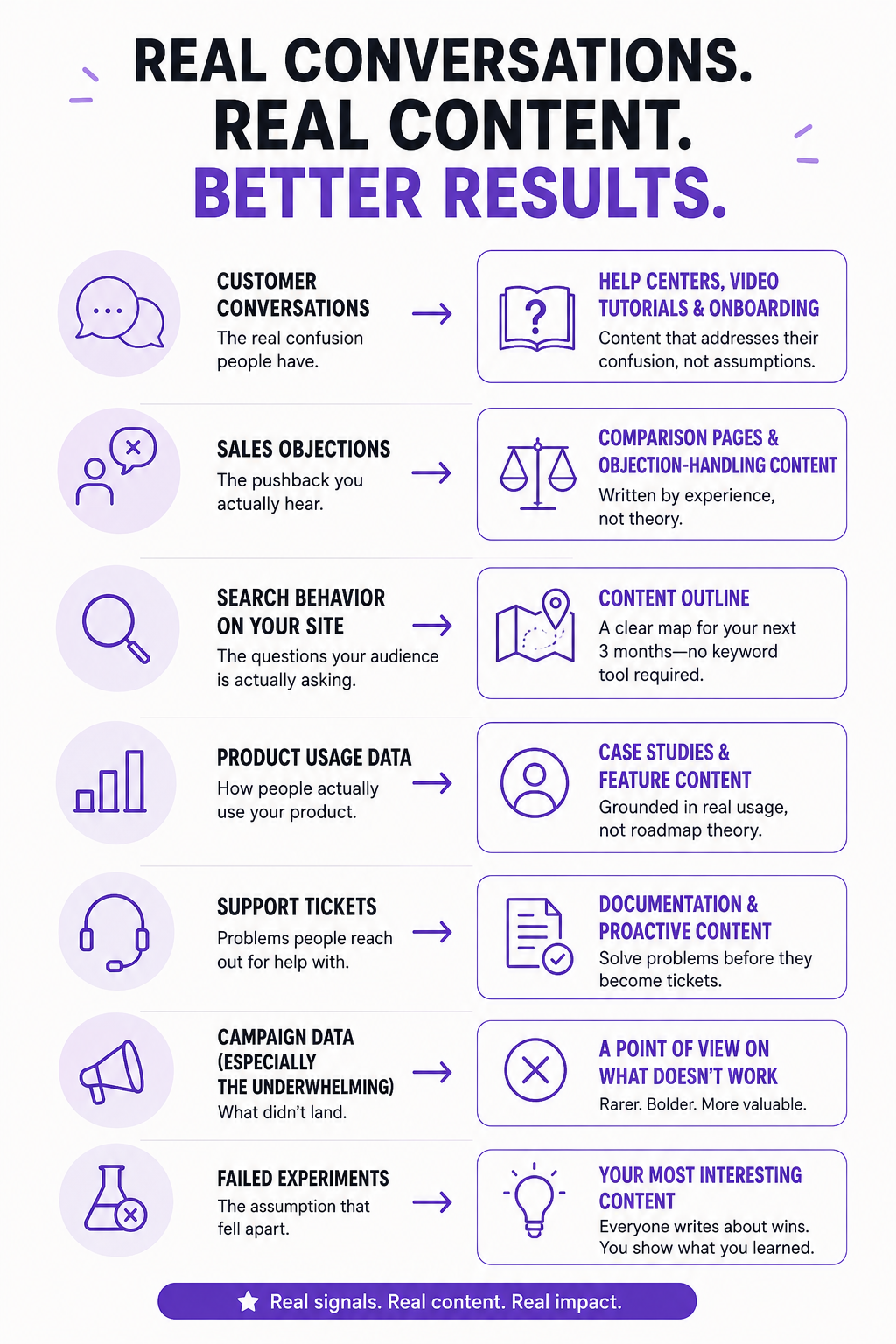
Here's the shift, framed simply: this is the thing you already have, and this is what it can become.
Customer conversations become help centers, video tutorials, and onboarding content that actually addresses the confusion people have, not the confusion you assumed they'd have.
Sales objections become comparison pages and objection-handling content that reads like it was written by someone who has actually sat through the pushback, because it was.
Search behavior on your own site becomes a map of the questions your audience is actually asking, which becomes the outline for your next three months of content, no keyword tool required.
Product usage data becomes case studies and feature content grounded in how people actually use your product, not how the roadmap deck said they would.
Support tickets become documentation and proactive content that solves a problem before it becomes a ticket, which your support team will thank you for.
Campaign data, especially the underwhelming kind, becomes a point of view on what doesn't work in your category, which is rarer and more valuable content than what does.
Failed experiments become the most interesting thing you can publish, because everyone writes about their wins and almost nobody writes about the assumption that quietly fell apart in week three.
None of this is content in its raw form. It's evidence. Your job is to condense it into a position and say it plainly.
There's a practical payoff here too, beyond the philosophical satisfaction of not sounding like a language model. This kind of content maps almost perfectly onto Google's E-E-A-T framework: experience, expertise, authoritativeness, and trust.
You cannot fake experience. A model cannot generate it. But a support ticket resolved last Tuesday or an experiment that failed for a specific, nameable reason is experience, documented. That's exactly the signal search systems are trying to reward, and it's exactly the signal AI models look for when deciding what to cite.
The same content that earns credibility with a human reader also becomes the kind of source an AI overview is more likely to quote. Two KPIs marketers chase separately, ranking and AI visibility, start moving from the same lever.
This Is Just the Starting Point
None of the categories above are a formula you run once and move on from. Customer conversations don't stop happening. Failed experiments don't stop failing, mercifully. The more time you spend looking at these signals as something to repurpose, reframe, and spin into new formats, the more your content starts to sound like it came from somewhere specific, because it did.
Opinion-led content has a bad reputation right now, mostly because it's been confused with hot takes, the contrarian headline with nothing underneath it. That's not what this is. A hot take is an opinion with no evidence. What we're describing is the opposite: evidence that hasn't been allowed to become an opinion yet. Your customer conversations, your objections, your failed campaigns, they're already telling you what you believe.
See exactly why your Product Detail Page isn't converting
Thank you! Your submission has been received!
Oops! Something went wrong while submitting the form.


.png)

.avif)
%20(1).png)