


.png)
“Know your customers,” “Build real connections”—these are the common briefs you might have heard from your bosses if you are in sales and marketing. But nobody tells you about the manual labor required for non-sales tasks. You've got to research prospects, qualify leads, perform multiple follow-ups, and prepare sales pitches manually. This doesn't just take hours; it robs you of the chance to actually talk to your customers.
The AI SDR (Artificial Intelligence Sales Development Representative) solves this by streamlining repetitive tasks and acting as a 24/7 assistant. While you’re on holiday or asleep, it’s taking care of prospects and sending follow-ups. With 60% of the total sales process expected to be handled by AI-driven activities this year, the AI SDR is no longer a luxury—it’s a true differentiator.
The numbers tell a compelling story. The global AI SDR market was valued at USD 4.27 billion in 2025 and is projected to skyrocket to USD 24.32 billion by 2034, growing at a CAGR of 21.2%. We are witnessing the industrialisation of the top-of-funnel sales process.
Let’s understand what these agents are, how they work, and how they turn a good sales rep into a great one.
What Are AI SDRs?
An AI SDR (Artificial Intelligence Sales Development Representative) is specialized software that automates the grunt work of sales—prospecting, lead research, and qualification. Using natural language processing and machine learning, these tools tackle much of what human SDRs do, just faster and with higher volume. They scan data, personalize outreach, and book meetings while your sales reps focus on building relationships and closing deals.
An AI SDR is essentially your tireless teammate—the one handling all the follow-ups and data crunching while you're sleeping. They don't replace human judgment, they just knock out the repetitive tasks so your team can focus on the work that actually needs a personal touch.
How Does an AI SDR Work?
Imagine you are a SaaS company launching a new sales deck tool targeting e-commerce marketing directors. Instead of manual grunt work, an AI SDR executes a five-step autonomous cycle:
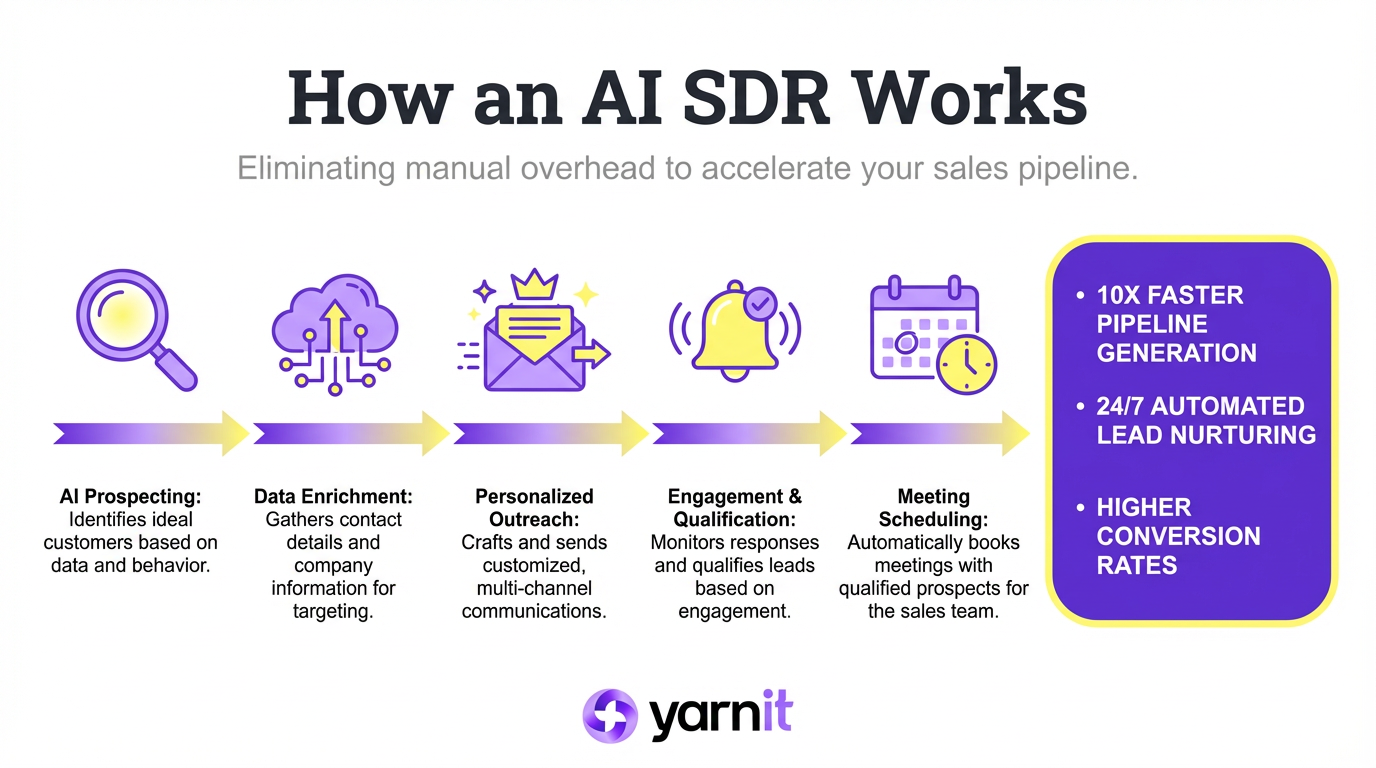
- Prospecting & ICP Segmentation: The AI scans your CRM (like HubSpot) and LinkedIn to find the needle in the haystack—such as marketing directors at Shopify brands that are currently expanding their teams.
- Research: It pulls live data on each prospect, identifying recent tech stack changes or business challenges (like a messy Shopify migration) to find a relevant "hook."
- Personalized Outreach: Using generative AI, it drafts a context-aware opening: "Build faster sales decks for your Shopify rollout—here's a custom demo for your team."
- Follow-ups: If they don’t respond, the AI doesn't just "ping" them. It sends multi-channel nudges on LinkedIn or Email containing high-value assets, like a template to speed up their sales pitch.
- Qualification and Handoff: The AI uses NLP to read the intent of every reply. It filters out the noise, answers basic questions, and schedules meetings via Calendly. Only when a lead is truly "sales-ready" is it handed off to a human rep.
This continuous workflow means no lead sits ignored, and every interaction feels timely and thoughtful rather than generic or pushy.
Want to know how sales teams are actually using AI sales agents today—not just in theory?
Read our blog, Top 5 Workflows AI Sales Agents Automate, where we break down real, end-to-end workflows covering prospecting, personalized outreach, follow-ups, lead qualification, and meeting scheduling.
How Can AI Improve SDR Efficiency?
By automating the repetitive tasks manual data entry, contact research, generic follow-ups AI SDRs eliminate bottlenecks that slow down human reps. Your team can spend more time on strategic activities that require personal judgment: listening to clients, customizing solutions, handling objections, and closing deals.
Here's where the efficiency gains show up most clearly:
- 24x7 Outreach: AI SDRs work continuously, ensuring prospects get timely responses regardless of time zones or holidays.
- Scalability: Handle thousands of prospects with consistent quality—something impossible for human teams alone.
- Personalization at Scale: Each message draws from real-time data to feel custom-crafted, not mass-produced.
- Data-Driven Insights: Sentiment and intent analysis help prioritize the warmest leads and refine messaging over time.
- Faster Sales Cycles: Automated appointment setting and qualification mean deals move forward without unnecessary delays.
What Are the Benefits of Using AI SDR?
Beyond raw efficiency, AI SDRs deliver tangible advantages that reshape how sales teams operate:
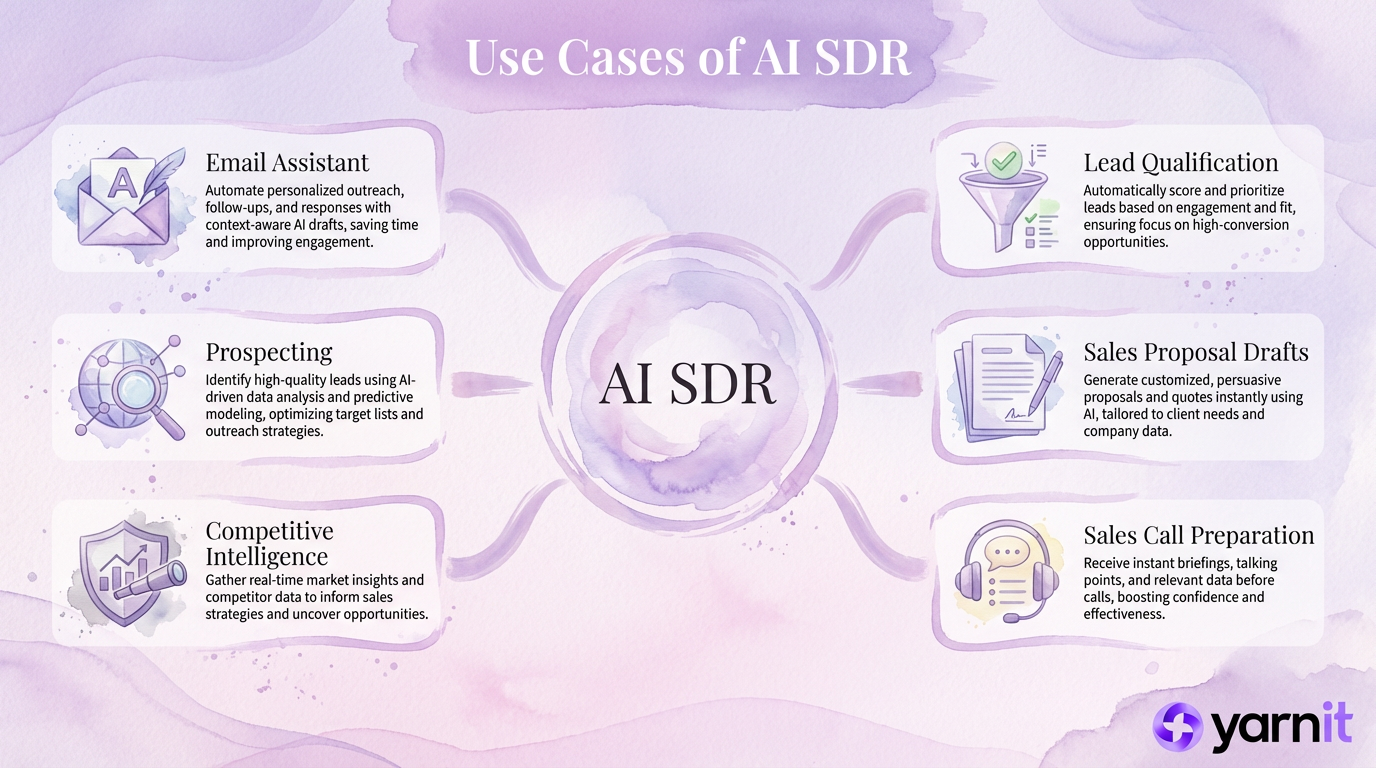
Real-World Use Cases
- Email Assistant: Drafts and sends personalized emails, manages multi-step cadences, and handles automatic replies to common questions. Instead of "Hi, I wanted to reach out about our solution," an AI SDR writes: "Noticed your team just launched the new product line here's how we helped a similar brand scale their launch campaigns."
- Prospecting: Identifies and segments ideal customer profiles by mining internal CRM data and external sources, flagging the most promising leads based on buying signals like recent funding rounds or new executive hires.
- Lead Qualification: Analyzes responses to determine sales-readiness, filtering out low-interest contacts so reps only spend time on quality conversations that are more likely to convert.
- Sales Proposal Drafts: Generates initial proposal outlines based on client needs and previous successful deals, giving reps a strong starting point rather than a blank page.
- Sales Call Preparation: Provides briefs on prospects' recent activities, pain points, and company news so reps walk into calls fully informed and ready to engage meaningfully.
- Competitive Intelligence: Monitors competitors and industry trends, equipping sales teams with timely insights for better positioning during discovery and negotiations.
Top AI SDR Tools
Here are five practical picks based on common B2B needs:
Yarnit excels at targeted, event-driven campaigns (e.g., feature launches or vertical pushes). It defines ideal customer profiles, pulls verified contacts from Apollo or your CRM, builds multi-step email sequences (spread over days with auto-replies), and tracks opens, clicks, and responses—delivering focused outreach with minimal daily oversight.
AiSDR shines for high-volume outbound scaling. It accesses a huge professional database, runs human-like email/text conversations, qualifies leads automatically, verifies emails to reduce bounces, and books meetings—perfect for global, multi-language prospecting at speed.
SDRx handles structured multi-channel plays well. It builds targeted lists, researches prospects deeply, automates personalized email/LinkedIn/call sequences, includes adaptive follow-ups and objection logic, and enforces quality checks—ideal for consistent, end-to-end outbound execution.
Conversica focuses on long-term lead nurturing. It sends behavior-triggered, personalized emails, sustains dialogue over weeks/months, qualifies interest progressively, and keeps leads warm—especially valuable in complex or extended B2B cycles.
Salesforce AI features integrate natively for Salesforce users. They score leads, qualify automatically, route to reps, and schedule meetings inside the CRM—streamlining handoffs and workflows in larger, enterprise setups.
Pick the one that matches your biggest bottleneck whether campaign focus, volume, multi-channel depth, persistence, or CRM flow and run a quick pilot to see the real difference in your pipeline.
Will AI SDRs Replace Human SDRs?
No. They handle volume, speed, and consistency. Humans bring empathy, context reading, creative storytelling, and the ability to navigate politics inside accounts.
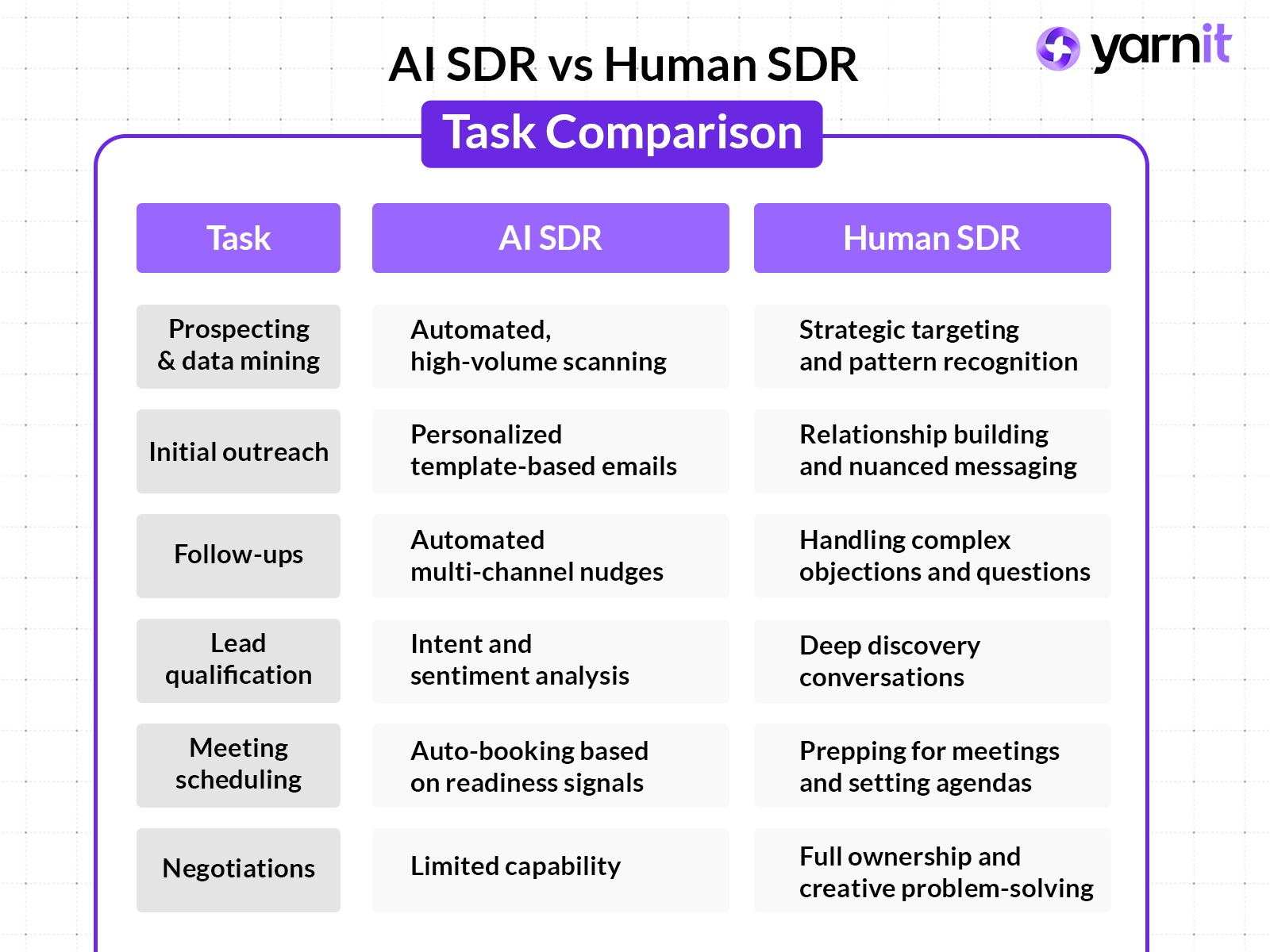
When AI handles the groundwork, human SDRs can focus on what they do best: listening, adapting, and building trust. That combination maximizes efficiency without sacrificing connection quality.
AI SDR Implementation Roadmap
Ready to bring AI SDRs into your sales process? Here's how to start:
1. Identify Processes for Automation: Pinpoint the repetitive steps that slow your team down data entry, basic follow-ups, prospect research. These are your automation priorities.
2. Ensure Accurate Data: AI is only as good as the data it works with. Clean and consolidate your CRM and external data sources before implementation. Bad data in means bad results out.
3. Check Integration Compatibility: Verify that your chosen AI SDR tools integrate smoothly with your existing CRMs (HubSpot, Salesforce), email platforms, and sales stack. Seamless integration prevents workflow disruptions.
4. Design Hybrid Workflows: Combine AI-generated insights with human intelligence. Let AI draft the initial outreach, but have humans review and refine for key accounts. Define clear handoff points between AI and human touchpoints.
5. Run a Pilot Program: Start with a small segment of your prospect list. Test workflows, gather team feedback, and measure performance against clear KPIs (response rates, meeting bookings, conversion rates).
6. Iterate and Optimize: Monitor performance metrics continuously. What message templates work best? Which follow-up cadences drive meetings? Use these insights to refine your approach and scale what works.
AI SDR: Your Path to Sales Dominance
AI SDRs are changing how sales teams operate. Working around the clock, they eliminate time-consuming tasks and let human salespeople focus on what truly matters building relationships and closing deals with advanced strategies. With the AI SDR market growing at over 21% annually, adopting these tools isn't optional anymore; it's necessary for staying competitive.
Platforms like Yarnit, with robust prospect identification and automated outreach workflows, help sales teams scale intelligently without losing the personal touch that wins deals. The future of sales isn't about choosing between AI and humans—it's about combining AI's precision and persistence with human creativity and empathy to win more deals and build lasting client relationships.


