


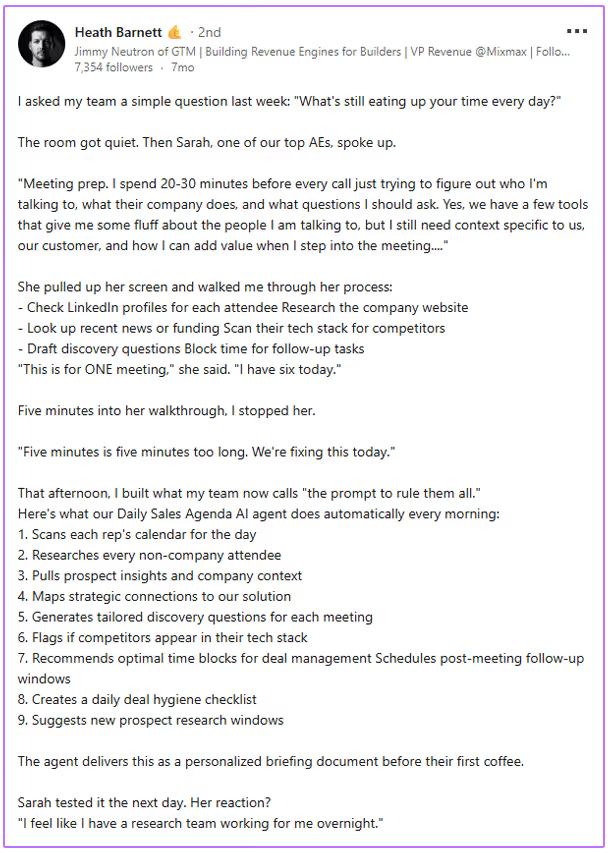
Like Heath Barnett, have you spotted the Sarahs in your meeting room, the high-performing individuals who spend hours prepping for client calls? Time that should be going into deal strategy, negotiations, or pipeline movement is instead lost to manual research, context switching, and prep work.
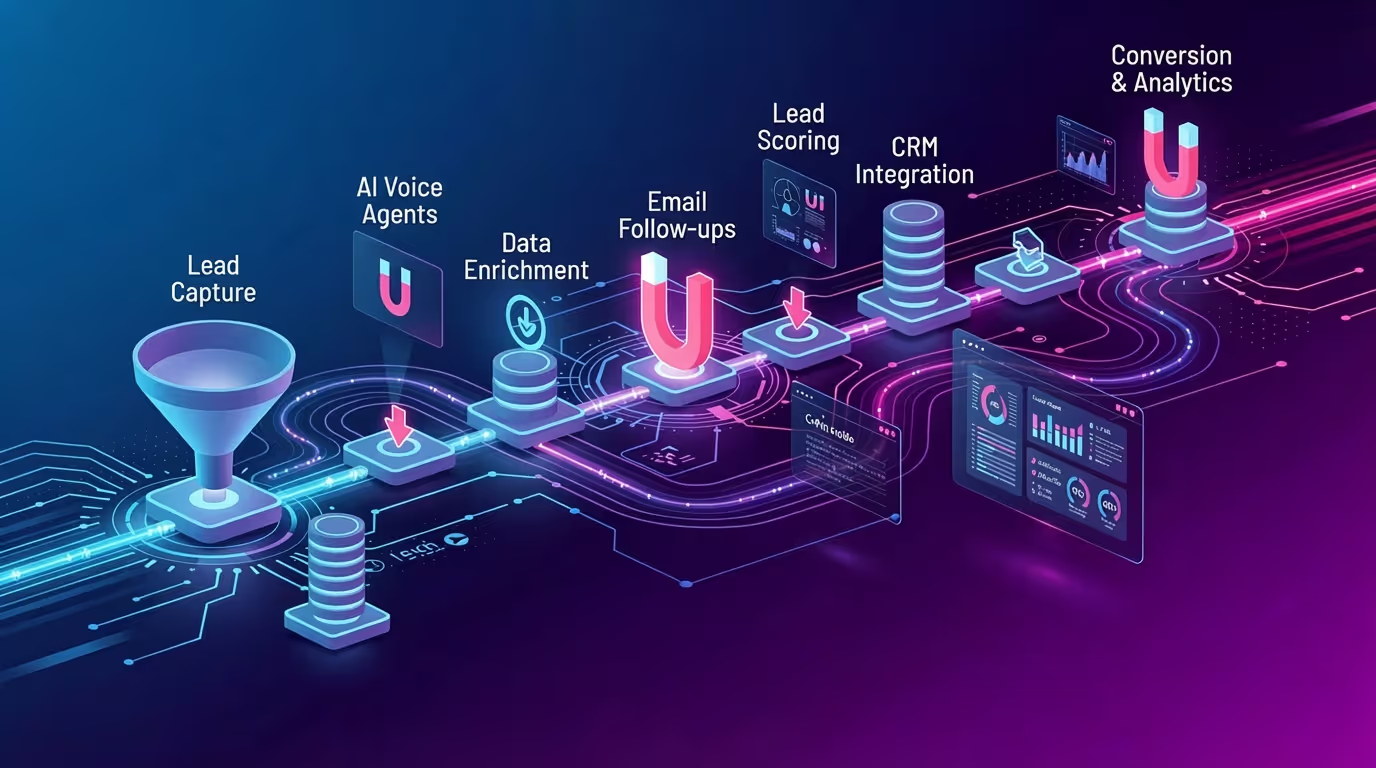
What Heath built was a proper end-to-end AI sales workflow, one that starts with calendar data, pulls in account and prospect intelligence, maps insights to the company’s solution, and delivers a ready-to-use briefing before the rep even logs in for the day.
That’s the shift AI sales agents enable.
Unlike traditional tools, AI sales agents actively execute end-to-end workflows, autonomously gathering context, generating insights, and triggering actions without constant human input. Today, leading sales teams are using them to automate some of the most time-consuming and high-impact parts of the sales cycle.
In this blog, we’ll break down the top 5 workflows AI sales agents are automating today, and how they’re helping sales reps spend less time preparing, and more time closing.
Top 5 Workflows AI Sales Agents Automate Today
Let’s explore some agentic AI workflows in sales with possible scenarios:
1. Account & Buyer Research Before Meetings
Suppose your sales team spends 20–30 minutes before every call researching clients, scanning LinkedIn profiles, checking the company website, looking up recent news, and trying to connect the dots before the meeting starts. Multiply that by five calls a day, and prep time alone eats up hours of selling time.
How an AI sales agent automates this workflow:
AI sales agents turn meeting prep into a repeatable, pre-call workflow that runs automatically.
The workflow works as follows:
- Parse calendar invites to identify attendees, roles, and seniority
- Pull recent company, industry, and stakeholder signals such as funding, hiring, and strategic initiatives
- Review historical CRM notes, emails, and call transcripts for context and continuity
- Map account insights to relevant product use cases and talking points
- Deliver a concise, role-aware briefing to the rep before the meeting
Just like Heath’s workflow!
2. Lead Qualification & Prioritization
Suppose it’s Monday morning. Overnight, your inbox has three demo requests, the outbound team has pushed a fresh prospect list into the CRM, and product usage data shows several free users logging in repeatedly over the weekend. On paper, everything looks like a “hot lead.” In reality, one demo request is from a student researching options, the outbound list includes companies far outside your ICP, and one of those product users is quietly approaching a buying decision. Your SDRs don’t see this nuance. They work top-down in the CRM, follow the loudest signals, and inevitably spend time on leads that were never going to convert, while high-intent prospects wait.
How AI sales agents automate this end to end:
AI sales agents treat lead qualification as a continuous decision-making process and not a one-time score. They pull in signals from forms, emails, product activity, and third-party data, then evaluate those signals in context, not isolation.
The workflow works as follows:
- Automatically enrich every new lead with company size, role, industry, and growth signals
- Evaluate intent using behavioral data such as repeat visits, feature usage, and response patterns
- Re-score leads dynamically as new signals appear, instead of locking them into static buckets
- Segment leads by readiness and ICP fit, not just source
- Route high-priority leads to SDRs with clear context on why they matter
3. Personalized Outreach & Follow-Ups
Suppose your SDRs are running five parallel sequences at any given time. Personalization is expected, but reality looks different: first lines reference job titles, follow-ups repeat the same value prop, and reps rely on reminders to know when to nudge again. Meanwhile, prospects are opening emails, clicking links, or going silent, but those signals don’t consistently change what gets sent next. Outreach becomes volume-driven rather than context-driven, and promising conversations fade simply because no one adjusted the message at the right moment.
How AI sales agents automate this end to end:
AI sales agents manage outreach as a connected workflow that responds to prospect behavior in real time.
The workflow works as follows:
- Uses account research and qualification signals to tailor messaging to the prospect’s role, company context, and current priorities
- Selects the most effective channel and send time based on past engagement patterns
- Executes multi-step outreach and follow-ups automatically, without relying on rep reminders
- Monitors prospect responses and activity, adapting messaging when engagement changes, or pausing outreach when signals go cold
4. CRM Updates & Deal Hygiene
Suppose an AE finishes a discovery call where the buyer confirms budget approval is likely next quarter and flags two internal stakeholders who need to be looped in. The rep means to update the CRM, but another meeting starts immediately. Later that day, they add a quick note, missing the budget signal, forgetting to update the deal stage, and not logging next steps. A week later, the manager reviews the pipeline and assumes the deal is still early-stage.
How AI sales agents automate this end to end:
AI sales agents treat sales conversations as system inputs, not personal memory.
The workflow works as follows:
- Automatically generating call summaries and extracting key signals like intent, objections, timelines, and stakeholders
- Updating deal stages and CRM fields based on what was actually said, not what was manually logged
- Logging follow-up tasks and next steps as structured actions
- Flagging deals where momentum stalls or signals weaken
5. Post-Meeting Insights & Sales Reporting
Suppose it’s Friday afternoon and sales managers are preparing for forecast reviews. They pull reports, skim activity logs, and ask reps for updates to understand which deals are truly on track. By the time risks surface, weak engagement, single-threaded conversations, or long gaps between touches, the quarter is already slipping.
How AI sales agents automate this end to end:
AI sales agents continuously synthesize data across conversations, CRM activity, and engagement signals, then interpret it, not just display it.
Automated outputs include:
- Deal health summaries that highlight momentum, risks, and blockers
- Pipeline risk flags for stalled, single-threaded, or low-engagement deals
- Rep activity and effectiveness insights tied to outcomes, not volume
- Suggested next actions for specific deals and accounts
Brands using AI agents for sales workflow
1. The Media Ant

The Media Ant, a Bengaluru-based advertising agency, was facing a common scale challenge: its sales team and call center were consuming a large portion of operating costs without proportional gains in lead engagement or follow-ups. The sales team were doing repetitive tasks, identifying leads, emailing prospects, and handling common enquiries, which limited the firm’s ability to scale efficiently.
The Agentic AI Workflow:
To address this, the agency deployed generative AI agents to take over entire segments of outbound and inbound engagement work. According to a Reuters report, founder Samir Chaudhary described how the firm eliminated 15 salespeople and replaced a six-member call center with AI bots trained to identify potential customers, answer questions, and drive next steps, effectively integrating conversation, qualification, and response workflows together.
One standout agent was a voice bot named Neha, a voice AI capable of speaking in near-flawless, Indian-accented English. In one observation recorded by Reuters, when asked about advertising on YouTube, Neha replied: “I will email you the details … have a great day.”
What Improved for The Media Ant:
- The team size was reduced by about 40% as AI assumed workflows previously handled by sales and call center staff.
- The AI agents now autonomously identify leads, engage them, and begin qualification conversations, replacing a full sales role with an AI workflow.
2. SaaStr
In an internationally discussed case, SaaStr, one of the largest B2B SaaS founder communities, confronted a sudden team disruption when two experienced sales reps left. Instead of simply hiring replacements, founder Jason Lemkin made a decision to explore AI agent-driven sales execution.
The Agentic AI Workflow:
According to reporting from Business Insider, SaaStr made a deliberate shift from hiring replacement sales reps to training AI agents on its best-performing sales assets, historical emails, outreach sequences, playbooks, and proven scripts. The goal wasn’t automation for efficiency alone, but replication: encoding the behavior, judgment, and cadence of top human sellers into autonomous agents that could run sales motions independently.
By mid-2025, SaaStr had deployed 20+ AI agents handling prospecting, outreach, lead qualification, follow-ups, and CRM-linked workflows, work that previously required around 10 human SDRs and AEs. These agents operate continuously, adapt messaging based on engagement signals, and scale without the constraints of human availability, effectively reshaping how SaaStr executes its go-to-market engine rather than merely supporting it.
What Improved for SaaStr:
- SaaStr now has 20 autonomous AI agents working with a lean human oversight team
- The AI agents are trained to mimic the workflows of experienced reps, promising comparable productivity at lower ongoing cost, and no need to constantly onboard new sales hires.
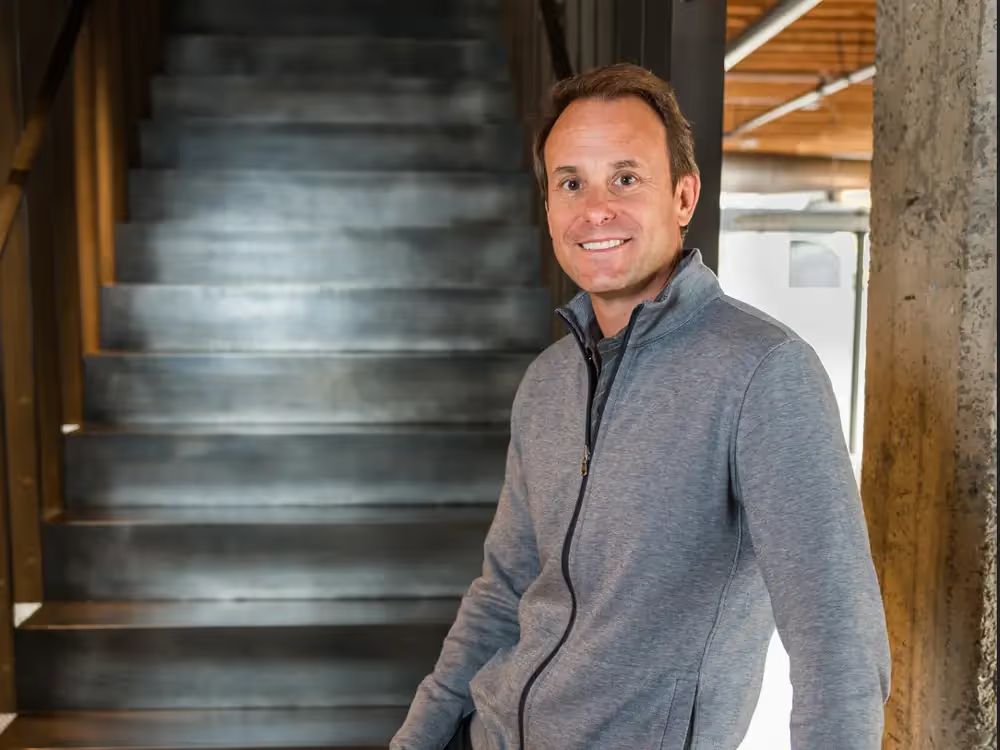
Jason Lemkin summarized the rationale: “Train an agent with your best person, and best script, then that agent can start to become a version of your best salesperson.”
Conclusion
Across research, qualification, outreach, CRM hygiene, and reporting, one pattern is clear: sales teams aren’t short on tools, they’re short on connected execution. Traditional automation handles fragments of work, but AI agents stitch those fragments into end-to-end workflows that run continuously. They observe signals, reason across context, take action, and adapt as the sales cycle evolves. That’s what makes them fundamentally different from scripts, templates, or point tools.
This is where Yarnit AI SDR fits into the picture. Yarnit puts an AI in the loop of your sales cycle, starting with identifying Ideal Customer Profiles, pulling the right contacts from systems like Apollo or your CRM, and executing structured outbound workflows. You can define multi-step email sequences with cadence logic, enable auto-responses when prospects engage, and track performance metrics, all within a single, agent-driven workflow. Instead of reps juggling research, outreach, follow-ups, and tracking manually, Yarnit helps sales teams run focused, repeatable outbound motions where AI handles execution and humans step in where strategy and judgment matter most.


