


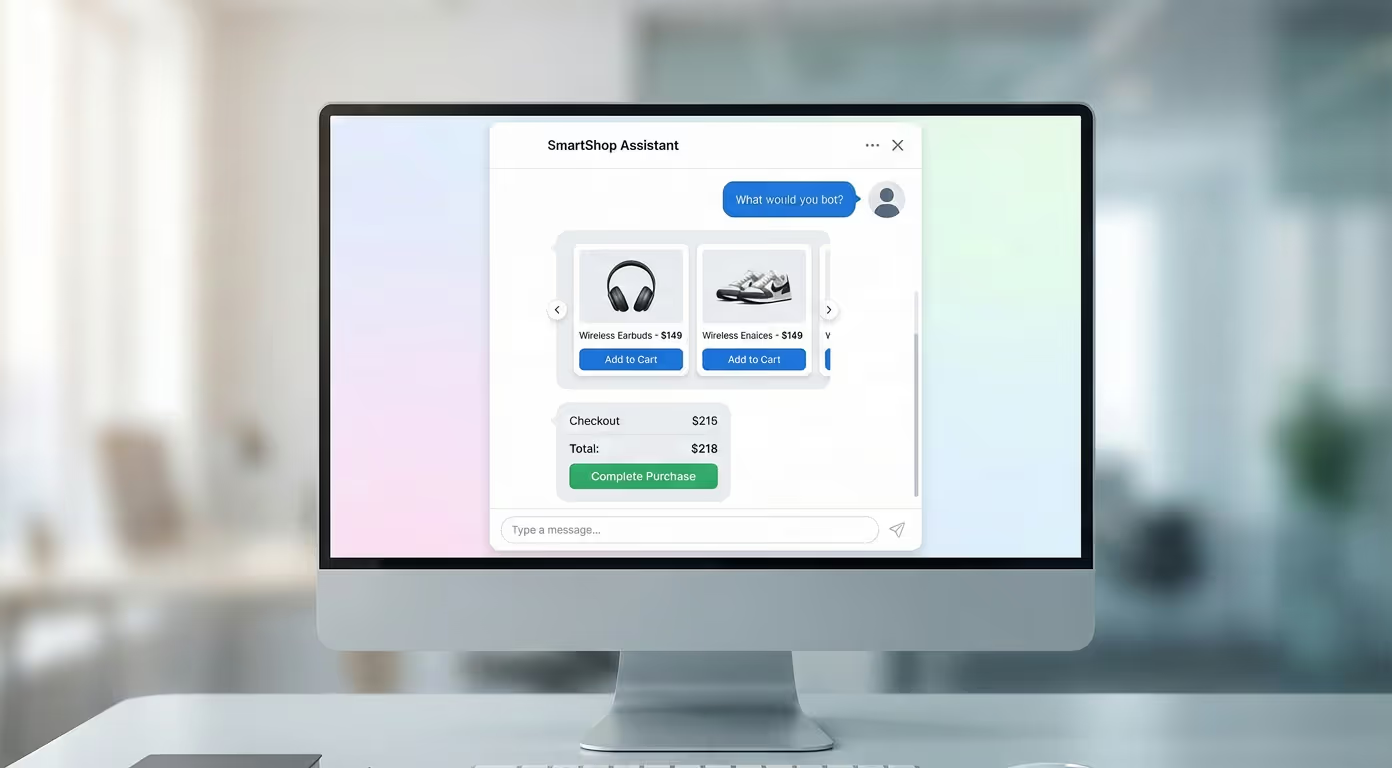
Adobe reported that generative AI drove a 693% increase in traffic to retail sites during the 2026 holiday season. And yet, most brand owners have no idea whether any of that traffic actually bought anything. That gap, between AI-driven discovery and actual purchase, is exactly what the Universal Commerce Protocol (UCP) is designed to collapse. But the way it does it changes far more than checkout.
Shopping online has traditionally followed a predictable path: a user searches, browses a product page, adds to cart, and then completes checkout on a brand’s site. But this linear funnel is breaking apart. With the launch of the UCP, commerce is becoming embedded in AI interfaces where discovery, decision-making, and checkout can occur together in real time. UCP is designed as a standardized language that lets AI agents interact directly with merchant systems, enabling a shift from siloed platforms to a unified commerce surface. For brand owners, this opens new opportunities for conversion, but also introduces new expectations and operational requirements.
This Isn't Just About Google
UCP-powered commerce isn't confined to Google's ecosystem. It's the opening move in a much larger restructuring of where online stores actually live.
Microsoft's Copilot, OpenAI's ChatGPT, and Perplexity AI are all building agentic commerce models where users can discover and purchase directly within the interface. Shopify has already announced a checkout integration with Microsoft Copilot. PayPal and OpenAI are working toward the same inside ChatGPT. What's happening isn't one platform adding a checkout button, it's every major AI surface becoming a place where commerce can complete. Your store's online presence no longer means having a good website. It means being legible, structured, and transactable across every AI surface where your shoppers might be having a conversation.
This is a genuine expansion of what "being online" means for an e-commerce brand. A few years ago, being online meant having a website and maybe a social presence. Then it meant showing up in search. Then it meant being discoverable in AI answers. Now it means being transactable inside AI conversations, on Google, on Microsoft, on OpenAI, and wherever else the conversation is happening. Each of these is a parallel sales channel, and each one operates on the same fundamental requirement: your product data and commerce logic have to be clean enough for a machine to act on.
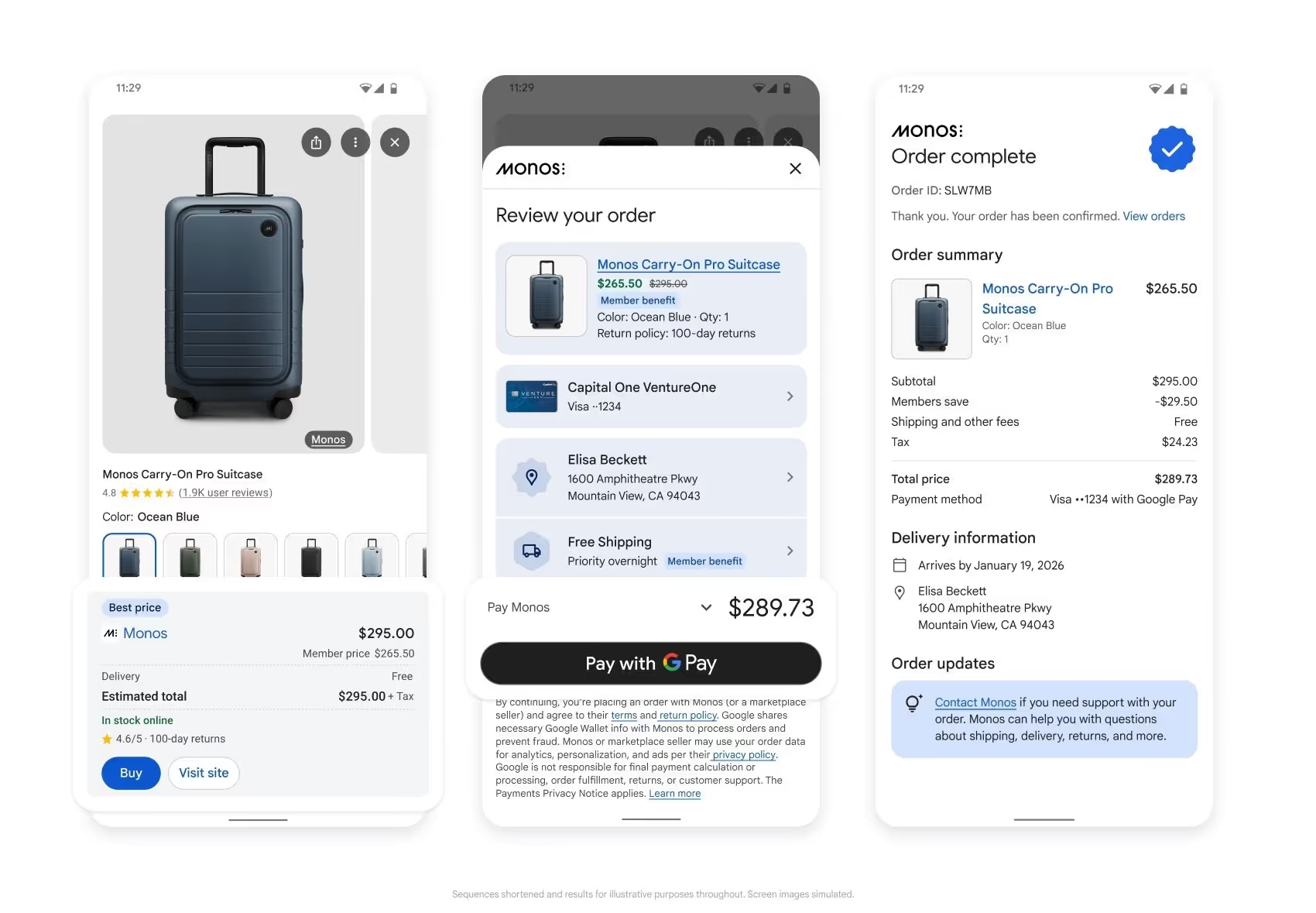
How UCP Relocates Checkout Experience
UCP is a protocol, think of it like TCP/IP, but for e-commerce. Shopify's engineering team put it well: just as TCP/IP proved that layered protocols survive by separating responsibilities and enabling composition, UCP applies that same logic to commerce. Merchants publish a structured profile at a well-known endpoint declaring exactly what they support, checkout flows, discount rules, loyalty integrations, fulfillment options, payment handlers. An AI agent reads that profile, negotiates the intersection of what it can handle and what the merchant offers, and transacts.
What this means in practice: a shopper talking to Gemini can discover your product, receive a real-time discount you've configured for that exact intent moment, pay through Google Pay with their shipping address pulled automatically from Google Wallet, and complete the purchase, all without your website being involved. Google has confirmed this is coming for U.S. merchants imminently. Shopify has already announced a parallel integration with Microsoft Copilot. OpenAI and PayPal are building toward the same thing inside ChatGPT.
So What Does This Actually Break for Brand Owners?
Your product page has been quietly demoted. For the past decade, the PDP was the conversion surface, the place where you optimized imagery, copy, social proof, and urgency signals to turn visitors into buyers. In the UCP era, the PDP becomes a data source. The agent reads it, interprets it, and decides what to present to the shopper. The shopper may never see it at all. That's a fundamental inversion of where design and optimization effort should go.
Your backend logic has to become legible to machines. This is the one most brand owners haven't confronted yet. If your shipping thresholds are inconsistently applied, your discount stacking logic is undocumented, or your return policy lives as a paragraph of prose somewhere in your footer, agents will hit those as walls. Per UCP's own specification, a checkout that hits something an agent can't resolve programmatically either escalates to the buyer or aborts entirely.
Intent-triggered offers are a new marketing surface, and most brands are sleeping on it. UCP lets merchants configure real-time discounts that surface to shoppers at the precise moment they're asking an AI about a relevant product. Shopify CEO Tobi Lutke described the appeal of agentic commerce this way: "I would have never searched for this product, but somehow it found me right on the other side. This kind of serendipity is where the best of commerce happens."
New Opportunities for E-Commerce Brands
The risks are real, but so are the openings, and the brands that move first will have a meaningful head start.
Selling inside AI interfaces is already live: Merchants can now sell directly within the Gemini app and Google Search's AI Mode. Early signals from UCP-enabled stores point to meaningfully higher conversion rates, and that makes sense. A shopper who completes a purchase inside the conversation they were already having never had a chance to lose momentum.
Catalog quality is the great equaliser: AI agents prioritise product-specific attributes over brand aesthetics or web design. A smaller merchant with obsessively clean, detailed product data can now compete directly with a larger brand whose catalog is vague and inconsistently structured. The playing field isn't level, but it's been tilted in a new direction, and it rewards preparation over budget.
Business Agent puts a virtual sales associate on Google Search: Google's new Business Agent capability lets merchants deploy a branded AI-powered assistant directly on their Google Search presence, one that can answer product questions, handle objections, and drive purchases in real time. Merchants like Lowe's, Michaels, and Reebok are already using it. For smaller brands, this is an opportunity to punch significantly above their weight in customer engagement.
Intent-moment discounting is a new performance marketing channel. UCP lets merchants configure real-time offers that reach shoppers precisely when they're in research mode inside an AI surface, not after they've left, not via a retargeting ad two days later, but in the moment the intent exists. Brands that think carefully about which products to promote this way, and at what margin, will reach buyers who would never have navigated to their site through traditional search.
The harder question is whether your store is actually ready for them. If an AI agent were to negotiate a transaction on your behalf tonight, what would it find? Clean, structured data and explicit commerce logic? Or a catalog built for human browsers that a machine simply can't act on? In the UCP-era, your infrastructure is the center of commerce.
UCP signals the start of machine-executable ecommerce. The brands that treat this as foundational will convert inside AI environments while others are still optimizing landing pages.


