


.jpg)
No, your customer didn’t stop caring about their sleep. They just stopped searching the way you expect.
They are not opening Google and typing "best sleep supplement." They open ChatGPT and ask: "What's the best magnesium supplement for someone with chronic stress-related insomnia who can't swallow large capsules and wants a form that actually absorbs well?"
That's not a keyword. That's a conversation. And if your product listing isn't built to answer it, you're invisible, even if your magnesium glycinate is objectively the best thing on the market.
This is the reality of health and wellness ecommerce in 2026. The shopper has changed, the search engine has changed, and the product listing that worked two years ago is now a liability.
Why the Old Way of Thinking About Product Listings Is Broken
For a long time, optimizing a product listing meant stuffing a title with keywords, writing a bullet-pointed description, uploading three clean product shots, and calling it done. That playbook was designed for a world where Google showed links and shoppers clicked through them.
That world is quietly disappearing.
Gartner predicts a 25% drop in overall search engine volume by 2026 as users increasingly turn to AI chatbots and virtual agents. This represents a fundamental shift in where purchase decisions are being made and therefore, what your product listing needs to do.

The Rise of AI-Powered Discovery
Shoppers no longer begin their journey on Google. They're heading straight to AI platforms like ChatGPT, Perplexity, and Google Gemini to ask highly specific questions:
- "Which protein powder is best for women over 40 with lactose intolerance?"
- "Is ashwagandha safe to take with antidepressants? What brand do doctors recommend?"
- "What's the most bioavailable form of vitamin D3 and which supplement has it?"
These questions are loaded with pain points, health history, and purchase intent. And AI engines pull answers from product descriptions, FAQs, reviews, and structured data on product pages. If your listing doesn't contain the language and specificity to answer these questions, you won't get cited. And if you don't get cited, you don't get discovered.
This is the era of Answer Engine Optimization (AEO) and for health and wellness brands, it's the most important shift in discoverability since Google's algorithm updates of the 2010s.
Wellness Buyers Demand Credibility
Health and wellness purchases carry a layer of trust and scrutiny. A shopper buying a vitamin C serum or a sleep supplement wants to know why it works, what's in it, who made it, and whether it's been tested. A thin product description signals low credibility and in wellness, low credibility means no conversion.
Product pages should now read less like listings and more like informed health consultations, packed with ingredient sourcing, clinical references, third-party certifications, and usage guidance. The result: higher trust, higher average order value, and strong AI discoverability.
What to Actually Fix on Your Product Listing
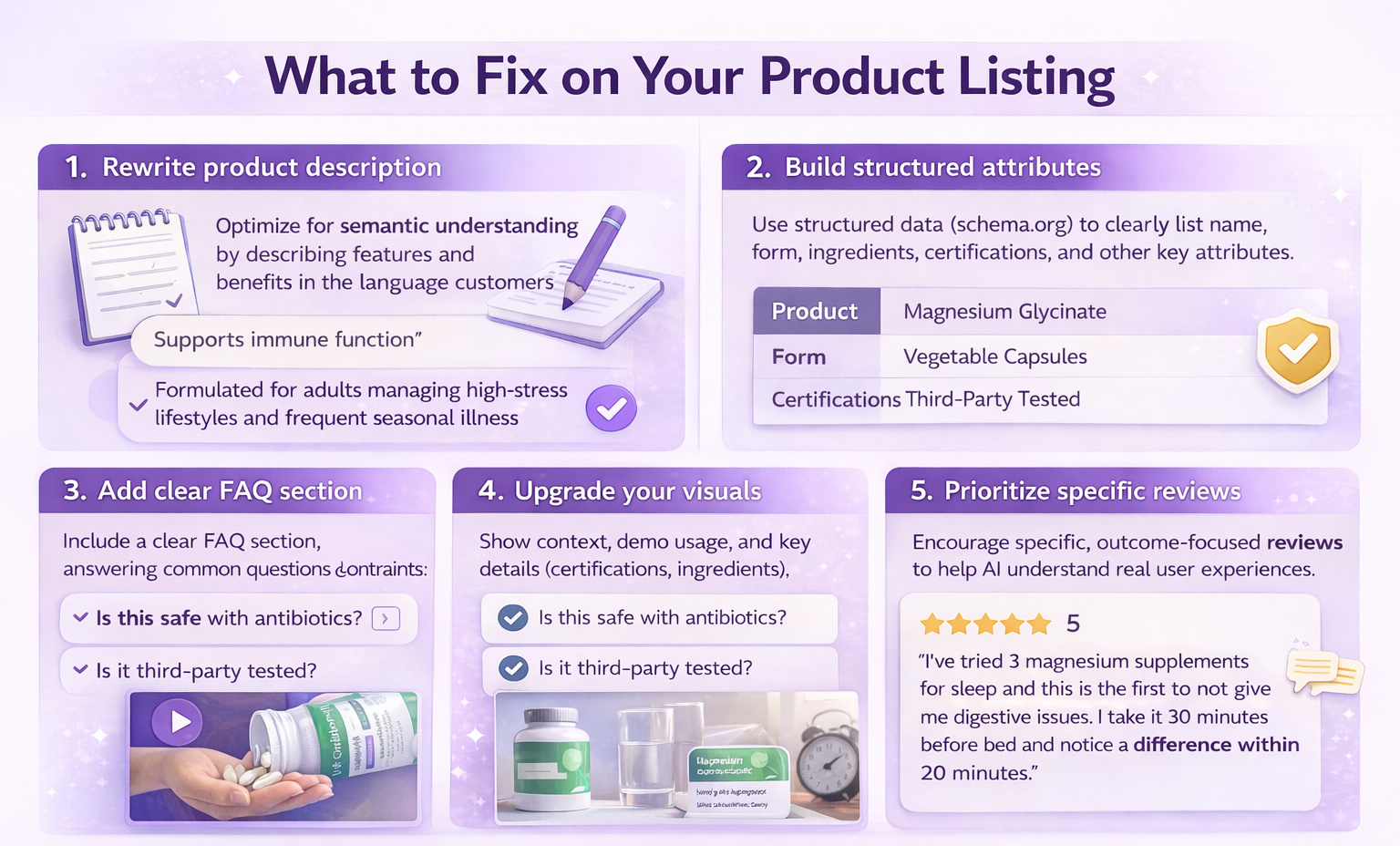
This is where most guides get generic. Let's get specific.
1. Rewrite your product description for semantic intent
Forget writing for a search algorithm that counts keywords. AI engines read for meaning. Product content must be optimized for semantic understanding, natural language descriptions that clearly communicate features, benefits, and use cases.
Practically, this means writing in the language your customer uses to describe their problem. Don't say "supports immune function." Say "formulated for adults with high-stress lifestyles who experience frequent seasonal illness." That second version matches the conversational query. The first doesn't.
Look at how ChatGPT's Shopping Research feature works, it asks clarifying questions about budget, use case, and specific constraints before surfacing a recommendation. Your product description needs to pre-answer those questions before they're asked.
2. Build your product attributes like a structured data table
Structured data, especially schema types related to products, FAQs, reviews, and pricing, makes it significantly easier for generative engines to understand and cite your content. This means implementing Schema.org Product markup with every attribute filled: name, brand, description, SKU, ingredients (for supplements), certifications, dosage, allergen information, reviews, and real-time pricing.
For a magnesium supplement, your schema should explicitly call out form (glycinate vs. citrate vs. oxide), absorption rate, capsule size, and whether it's third-party tested. That's the kind of specific attribute data AI shopping assistants use to match products to constraint-heavy queries.
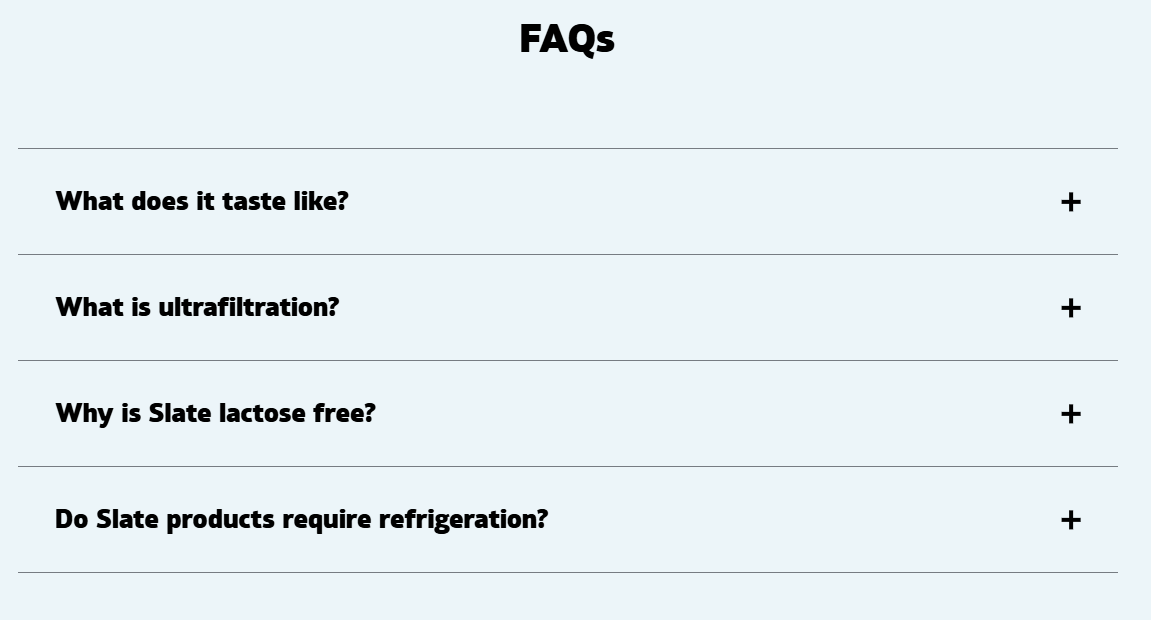
3. Add an FAQ section
AEO means formatting product pages with clear Q&A sections and concise product facts. Each answer should stay under 50 words for clarity, written in natural conversational language that mirrors how customers actually ask questions.
For a probiotic product listing, this means answering: "Is this safe to take with antibiotics?" "Does this need refrigeration?" "Is this suitable for someone with a histamine intolerance?" These are AI-citation bait. They're the exact questions someone asks Perplexity before buying.
4. Visuals are no longer just aesthetics
In health and wellness, trust is everything. High-quality visuals, multiple angles, in-context usage, well-lit product shots, help shoppers imagine and validate the product. But in 2026, visuals serve a second function: they signal legitimacy.
Include a short usage video (30–60 seconds) showing the product being opened, the texture or form, the serving size. Add a lifestyle visual showing the intended context, morning routine, gym bag, bedside table. High-converting wellness listings today include:
- Lifestyle photography showing the product in real-life context (morning routine, workout recovery, bedtime ritual)
- Ingredient call-out graphics that visualize what's inside and why it matters
- Usage demo videos — short clips showing how to take the product, what to expect, and how to incorporate it into a daily routine
- Packaging close-ups highlighting certifications, labels, and key claims
- Before/after visuals where appropriate and substantiated
5. Your reviews need to be specific
Customer reviews have outsized importance because AI systems synthesize sentiment and specific feedback into their recommendations. A 4.7-star average tells an AI nothing useful. A review that says "I've tried three magnesium supplements for sleep and this is the first one that didn't give me digestive issues. I take it 30 minutes before bed and notice a difference within 20 minutes" tells it everything.
Actively prompt your customers to write specific, outcome-based reviews. Build a post-purchase email that asks: "Which specific symptom or goal were you trying to address? Did this product help?" That language, seeded into your review section, is the language AI engines use to justify recommending your product.
The Metric Most Brands Are Ignoring
One more thing nobody's talking about enough: you can now directly measure how much traffic is coming to your store from AI engines.
Use Google Analytics, Shopify Analytics, or your preferred analytics tool and check the referring domain, look for chatgpt.com, perplexity.ai, gemini.google.com. Build a custom channel definition in GA4 that classifies AI referral traffic separately. This tells you which product listings are getting surfaced and which aren't, and that's where your optimization priorities should start.
Research from a 12-month GA4 analysis across 94 ecommerce brands shows ChatGPT traffic converted at 31% higher than non-branded organic search. The buyer coming from an AI engine has already done their research, they arrive closer to a decision. That makes optimizing for AI discovery arguably higher ROI than traditional SEO right now.
How Yarnit Can Help You Build Better Product Listings at Scale
Optimizing a single product listing takes time. Doing it across hundreds of SKUs, while keeping pace with seasonal trends, marketplace algorithm shifts, and the evolving demands of AI search, is an entirely different challenge. This is exactly where Yarnit's Agentic AI for Ecommerce comes in.
Yarnit for E-commerce is purpose-built to help ecommerce brands, including health and wellness, create, optimize, and publish high-converting product listings at scale.
- PDP Evaluation in Minutes: Paste your product page URL and Yarnit evaluates your title, description, images, specs, and metadata against category best practices, competitor pages, and SEO/AEO requirements. You get a clear gap analysis and actionable recommendations
- AEO & GEO Optimization: Yarnit structures your product content to be picked up and cited by AI search engines like ChatGPT, Google Gemini, and Perplexity, so your brand shows up when shoppers ask the exact questions your product answers.
- AI Lifestyle Creative: Yarnit generates high-fidelity lifestyle imagery that places your SKUs in realistic, audience-relevant contexts from a post-gym kitchen counter to a festive seasonal setting in seconds, at a fraction of traditional production costs.
- Market-Responsive Catalog Updates: Yarnit's Fast Scoring engine monitors market shifts in real time and can autonomously update your listings for seasonal peaks, say, an "immunity boosting" angle heading into winter then revert to your evergreen version once the window closes.
- Omnichannel Publishing: One click to push optimized listings to Amazon, Flipkart, your D2C Shopify store, and more, with each version formatted to meet that platform's specific requirements.
For health and wellness brands managing large catalogs, Yarnit reduces catalog update timelines from weeks to hours and cuts creative production costs by up to 70%. It's the difference between constantly playing catch-up and running your catalog on autopilot.


