


Put yourself in the shoes of your ideal customer. Do you think they’re Googling "best organic dog food"? It’s 2026, they're obviously asking ChatGPT, or Perplexity or whatever AI assistant they've bonded with this week. 77.6% of consumers have used AI to shop in the past six months, and that number isn’t going down any time soon.
Unlike the search engines of yesteryear, AI engines don't just regurgitate the first result from page one of Google. They're synthesizing data from across the web, weighing product safety reports, mining Reddit threads where actual pet parents discuss what works and what doesn't, and cross-referencing reviews like a particularly thorough helicopter parent.
For pet supply ecommerce stores, this shift is a goldmine. The pet ecommerce industry is evolving rapidly, driven by AI-powered shopping experiences that aggregate vast amounts of product information. When someone asks an AI, "What's the safest chew toy for a Labrador puppy?" and your store gets cited as the answer, you're winning trust with high-intent buyers ready to click "add to cart."
AI engines are becoming the new word-of-mouth, the new product researcher, the new "ask three friends and read 47 reviews" all rolled into one conversational interface. And if your store isn't optimized to be cited by these engines, you're invisible to a growing segment of shoppers who've already moved past traditional search. Let's fix that.
Hygiene & Technical SEO: The Foundation AI Engines Actually Need
Before we get fancy, let's talk plumbing. AI engines need to crawl, index, and understand your store. If your technical infrastructure is a mess, you're not getting cited. Period.
Start with the cutting edge: Adopt the Universal Commerce Protocol (UCP) if you can. This emerging standard is designed specifically for AI-driven commerce, making your product data machine-readable in ways that legacy formats simply can't match.
Register your store with AI shopping platforms like Perplexity and ChatGPT Shopping. These aren't optional anymore. They're your ticket to the AI commerce table. AI-powered ecommerce tools are evolving fast, and early adopters are already seeing the benefits of being first to these platforms.
Now for the classics that still matter:
- Clean sitemap structure: Your XML sitemap should be tight, up-to-date, and submitted to all the usual platforms (Google Search Console, Bing Webmaster Tools). AI crawlers often start where traditional search engines do.
- Meta titles and descriptions: Write them for humans, but make sure they're keyword-rich enough for AI to understand context. "Organic Grain-Free Dog Food for Sensitive Stomachs" beats "Premium Nutrition Solution" every time.
- Robots.txt configuration: Don't accidentally block AI crawlers. Check your robots.txt file and make sure you're not shooting yourself in the foot.
- Schema markup: This is where it gets fun. Use Product schema, AggregateRating schema, and Offer schema liberally. AI engines love structured data because it removes ambiguity. They don't have to guess what your price is or whether you're in stock—they can read it directly from your markup.
And don't sleep on Google Shopping. While it's not purely an AI platform, it's increasingly feeding AI-powered commerce signals. Products listed on Google Shopping with complete, accurate data are more likely to get pulled into AI responses about "where to buy X product."
How to Write Product Descriptions for AEO/GEO
Here's where most pet supply stores faceplant: they write product descriptions like they're filling out a form. Boring. Generic. Utterly forgettable.
AI engines don't cite boring. They cite useful.
Your product descriptions need to do two things simultaneously: educate pet owners and give AI engines enough context to confidently recommend your product. That means addressing real pain points.

Take an example of this slow feeder bowl from Supertails.The product description mentions that the bowl features “meal-lenthening ridges” and “multiple challenging mazes” to keep pups engaged for 10x longer. This gives the AI something substantive to work with while also solving for specific conversational queries from pet parents who are actually facing this issue.
Rich media is non-negotiable. Product videos showing the bowl in action? Gold. High-quality images from multiple angles? Essential. But these images need to be properly tagged, because AI models don’t actually look at your images, they look at the alt text. Use descriptive alt text that actually describes what's in the image (not just "dog bowl image 1").
Add schema markup for videos and images so AI models can parse what they're looking at. AI-powered personalization in pet ecommerce is all about turning storefronts into advisors, and rich, well-tagged media is how you do that.
Here are two sections every product page needs:
FAQ section with FAQ schema: Mine People Also Ask queries and mimic actual user flows to find questions that pet owners actually ask, and write answers for them. "Is this safe for puppies?" "What's it made of?" "How often should I replace it?" Each answer is a potential citation opportunity for an AI engine fielding a similar query.
Robust reviews section with Review schema: Most ecommerce stores still use outdated FAQ plugins that just display reviews. For AI to actually regard these issues as social proof, you need to use review schema to mark them up properly. AI engines mine review sentiment and specifics. A review that says "This toy lasted three months with my aggressive chewer" is gold for someone asking an AI about durable dog toys.
Value-driven copy, rich media with proper markup, FAQs, and reviews. That's the on-site foundation for AI citation.
Just Your Website Isn’t Enought Anymore: Social Q&A Platforms
AI engines aren't just crawling your website. They're also analyzing conversations happening on Reddit and Quora.
If you think that doesn't matter, you're missing a massive opportunity.
Pet owners are obsessed with Reddit. There are entire subreddits dedicated to specific breeds, pet nutrition, training, gear recommendations, you name it. When someone posts "What's the best harness for a husky that pulls?" and gets 47 replies, AI engines are paying attention. They're learning which brands and products get recommended by real people, not just marketing copy.
Take a look at the conversation below on the r/India subreddit. This is also fairly common question you can expect at least once or twice a month on pet-focused subreddits.
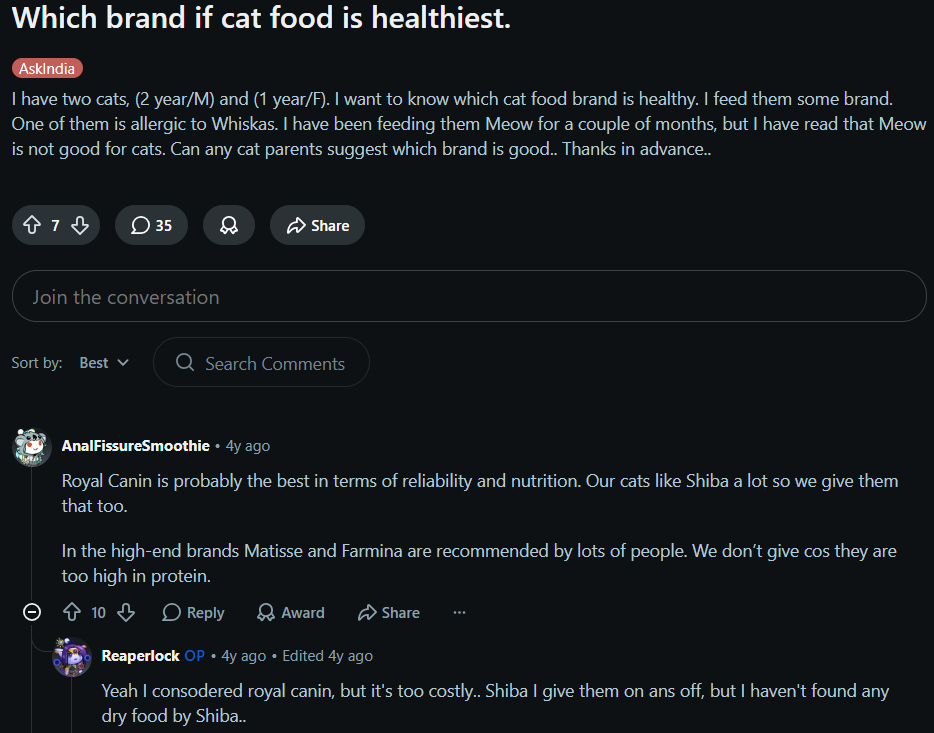
This post appears as one of the top results when asking ChatGPT for cat food brand recommendations.
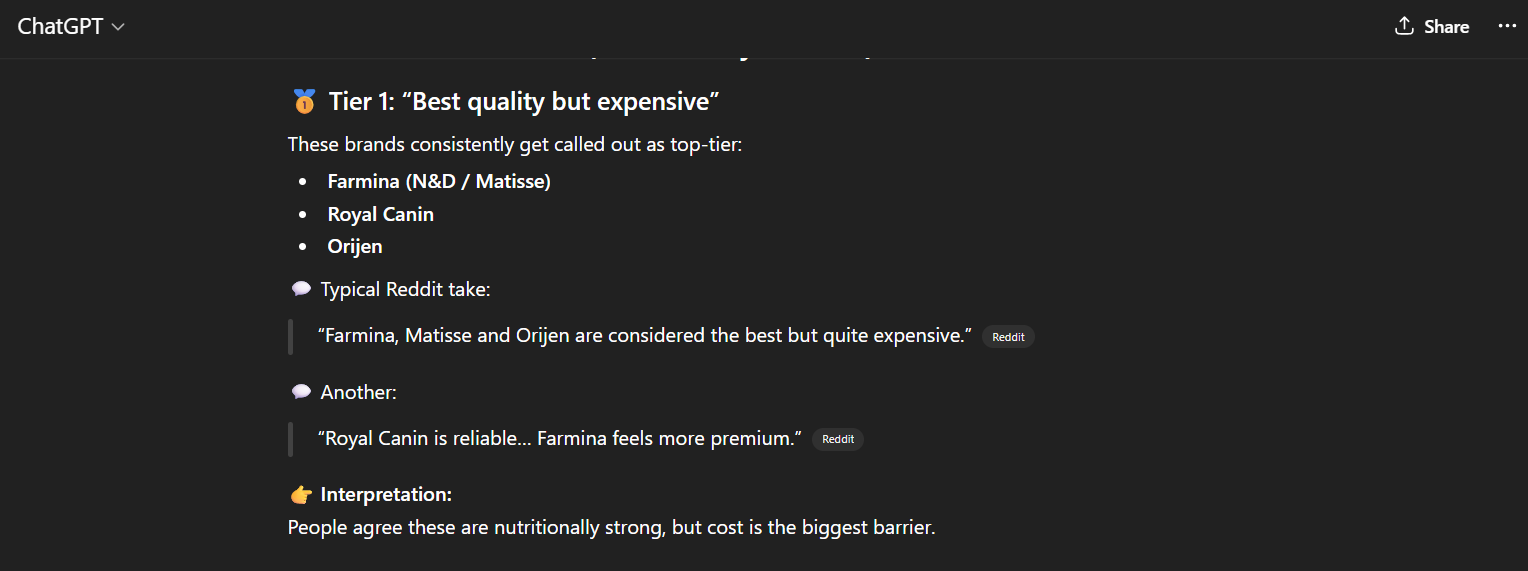
So how do you actually crack this formula?
Here's your move: create a branded account and engage authentically. Not spammy. Not salesy. Helpful. Answer questions in r/dogs or r/cats or r/parrots with genuinely useful recommendations. If someone's asking about grain-free cat food, share what you know: ingredient breakdowns, safety considerations, which formulas work for specific dietary needs. Mention your products only when they're genuinely relevant and helpful.
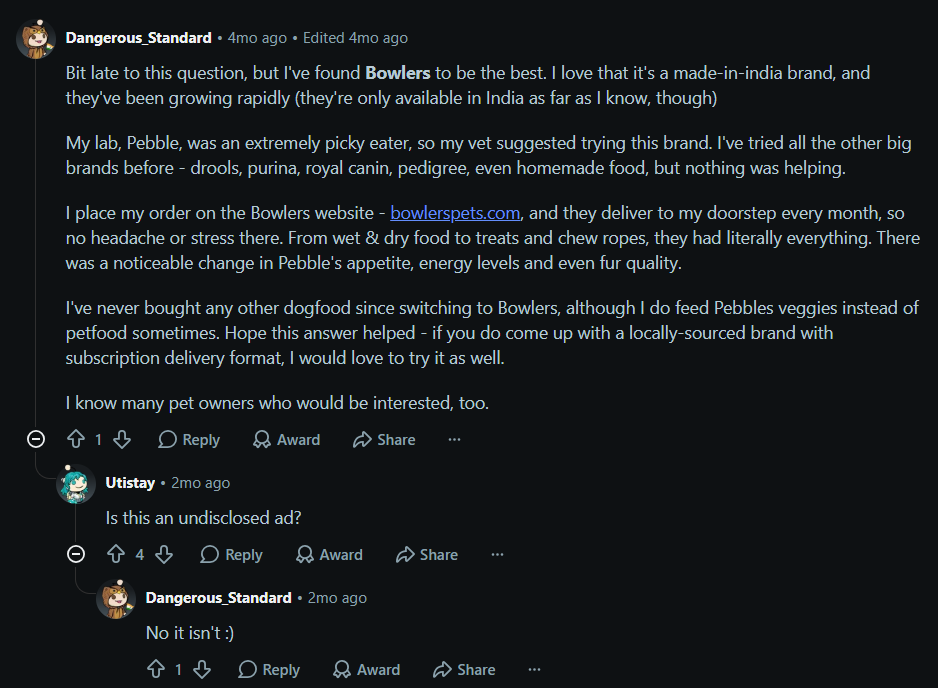
This is important: don’t be too salesy. Reddit communities are exceptionally talented at sniffing out undisclosed ads, so keep the intention of being informational first, and let your branded account do the talking. Otherwise, you might run into a situation like this:
Same deal with Quora. Find questions in pet-related spaces and provide thoughtful, detailed answers. Link back to your store when appropriate, but focus on building authority first. When AI engines see your brand associated with trusted, upvoted community answers, you're building social capital that directly improves discoverability.
Think of it as SEO for social proof. You're not just optimizing for search engines: you're optimizing for the conversations AI engines use to understand what products people trust and why.
Your AI Commerce Action Plan (No More Excuses)
Let's recap: getting cited by AI engines isn't magic.
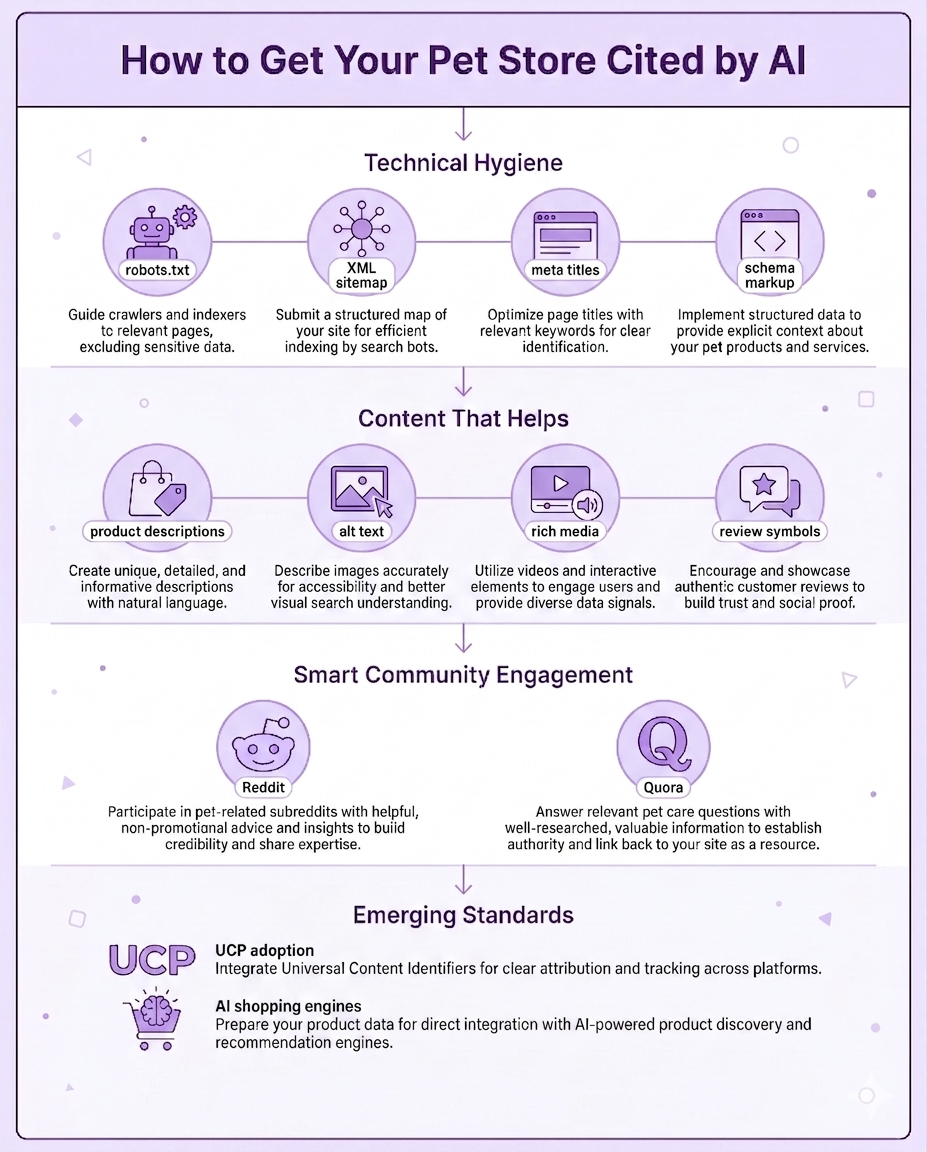
Do all that, and you're no longer invisible to the AI engines your customers are using to research pet products. You're cited. You're trusted. You're the store they buy from.
But here's the thing: doing all of this manually is a grind. Especially if you're managing hundreds or thousands of SKUs. That's where Yarnit for Ecommerce comes in. We help stores like yours gain visibility in AI-powered commerce by generating AEO and GEO-optimized product catalog content at scale, creating AI-crafted product images and videos that look great and are properly tagged, and giving actionable suggestions to improve the technical SEO infrastructure AI engines need to cite you.
With Yarnit handling the heavy lifting, you get to focus on what you do best, which is engaging with customers, building your brand, and maximizing your visibility and reputation.
Because the future of ecommerce isn't just about being found. It's about being cited. And we're here to help you. Ready to get cited by AI engines? Let's make it happen. Try Yarnit today.


