



.avif)
SEO is dead. Long live AEO. Dramatic? Maybe. True? Absolutely.
In 2026, we're not optimizing for search engines anymore—we're optimizing for answer engines. And if you're still chasing rankings like it's 2019, you're already behind. Marketers already know that AI tools like ChatGPT, Gemini, and Perplexity don't just retrieve pages, they synthesize answers from their training data.
But here's their Achilles' heel: that training data has cutoff dates. Gaps. Blind spots. When someone asks about recent developments, niche topics, or hyper-specific information, these models have to do something they hate—admit they don't know and go hunting for external sources.
That's where you come in.
The new game isn't about ranking on page one. It's about becoming the source AI has to cite because you're filling the exact informational void it can't answer on its own.
Think of it as supply and demand: AI models demand missing information, and your featured snippets supply it in precisely the format they need. Welcome to Answer Engine Optimization, where being cited beats being ranked every single time.
The Gap Strategy: Identifying AI Information Needs
AI Search has fundamentally rewired how people search. Nobody wants a list of blue links anymore, they want conversational, complete answers. Google's AI Overview, Bing's Copilot, and standalone AI assistants like ChatGPT have already trained an entire generation to ask questions naturally and expect synthesized responses.
But LLMs are only as current as their last training cycle. GPT’s knowledge typically lags several months behind real-time. Gemini and Claude face the same problem. When users ask about anything that happened after the model's training cutoff, like emerging industry trends, niche technical specs, recently updated regulations, hyper-local information, the AI has to perform web retrieval.
That moment right there? That's your window. Instead of competing for rankings, you're engineering content specifically designed to be extracted, cited, and attributed by AI systems. The prize isn't traffic anymore. It's becoming the default answer source in your domain. Here are some blank patterns that AI turns to the web to fix:
- Vague generalities: When ChatGPT responds with "Many experts suggest..." or "It's generally believed..." without citing specific sources, that's a gap. The model knows the topic exists but lacks precise, citable information.
- Hedge language: Phrases like "As of my last update..." or "This information may have changed..." signal the model knows its knowledge is stale. These are prime opportunities for fresh, timestamped content.
- Citation absence: When Perplexity or Gemini provides an answer but shows no citations or only cites broad sources like Wikipedia, the space is wide open for authoritative niche content.
Spotting these gaps is only half the battle. The harder part is presenting information in AI-digestible formats. Your content architecture has to serve both human readers and machine extractors simultaneously.
Phase 1: Reconnaissance - Identifying the Gaps
Targeting the "Unknowns"
Start by interrogating AI tools directly. Open ChatGPT, Perplexity, Gemini, and Claude simultaneously. Ask the same niche question across all platforms. Document the responses. Look for which models admit knowledge gaps explicitly, which provide answers without citations, which cite outdated or generic sources, and where answers conflict between models.
These discrepancies are your opportunities. If three models give vague answers and one cites a two-year-old article, you've found your entry point. Create the definitive, current answer with the specificity AI models crave.
Pro tip: Test queries with temporal modifiers like "in 2026," "latest updates," or "recent changes." AI models struggle most with time-sensitive information, making these queries goldmines for citation opportunities.
Analyzing the "People Also Ask" Loop
Google's "People Also Ask" boxes remain one of the most reliable indicators of underserved query intent. These aren't randomly generated—they represent actual user questions that Google's algorithm identifies as related but distinct from the main query.
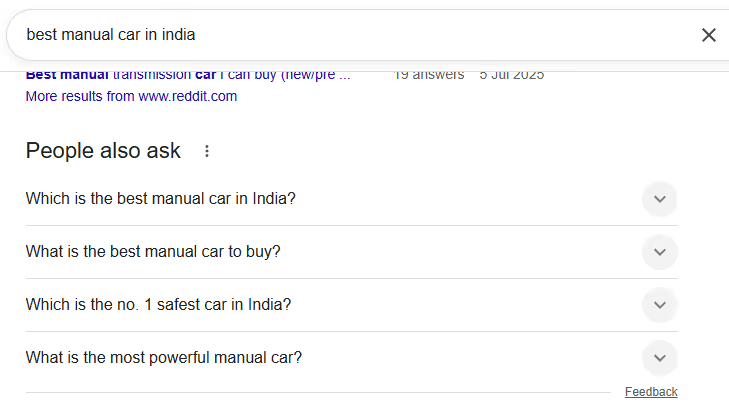
Do this: Query your target topic, then expand the PAA cascade by clicking each question to reveal additional related queries (Google typically shows 2-4 new questions per click). Document the question chain and note questions that lead to thin, generic, or outdated answers.
Then cross-reference with AI tools—ask these PAA questions in ChatGPT or Perplexity to see if AI provides better answers than the featured snippets.
The sweet spot? PAA questions where Google shows a snippet, but AI models either don't cite that snippet or provide superior answers from other sources. That gap indicates the current featured snippet is vulnerable and ripe for replacement.
The Competitor Citation Audit
Tools like Profound and Rankscale have emerged specifically to track citation patterns in AI-generated responses. These platforms monitor when and where competitors get cited across multiple AI models, creating a citation map of your competitive landscape.
Here's the play: Identify your top 5-10 competitors (focus on content leaders, not just business competitors), input their domains into citation tracking tools, and map the citation clusters to identify topics where competitors dominate citations. Then find the voids—look for adjacent topics or specific subtopics with low citation density.
The goal isn't to directly compete where competitors are already cited—it's to identify parallel topics where citation share is distributed or nonexistent.
Phase 2: Execution - The 60-Word Snippet Strategy
AI crawlers don't have patience. They scan for immediate answers, not narrative buildup. The rule: put your definitive answer in the first 40-60 words of any section targeting snippet capture.
Traditional blog structure: "Email marketing remains one of the most effective digital marketing channels. Many businesses struggle to measure success effectively. Understanding key metrics is essential. Let's explore the most important email marketing KPIs you should track..."
Answer-first structure: "The five essential email marketing KPIs are open rate (15-25% average), click-through rate (2-5% average), conversion rate (1-3% average), bounce rate (under 2%), and unsubscribe rate (under 0.5%). These metrics directly measure campaign effectiveness and ROI."
See the difference? Immediate extractable value. AI models prioritize the second example because it delivers complete information in a context-independent format. A reader encountering just that first sentence understands the core answer, and so does an AI parser.
The Anatomy of a High-Citation Snippet
Target 15-20 words per sentence within your snippet blocks. Shorter sentences create standalone units that AI can extract without requiring surrounding context.
- Weak snippet structure: "SEO professionals and content marketers who want to improve their rankings should focus on several key factors including content quality, technical optimization, and user experience, all of which contribute to better search performance."
- Strong snippet structure: "SEO success requires three core elements. Content quality ranks first. Technical optimization ranks second. User experience ranks third. Each element independently impacts search performance."
Data-backed snippets show 40% higher citation rates than purely conceptual answers. AI models prioritize verifiable information—statistics, dates, specific numbers, percentages, and concrete examples.
Each data point is a citation hook. When AI models evaluate source credibility, factual specificity weighs heavily. Generic advice gets summarized; specific data gets cited.
Semantic signals dramatically improve AI extraction rates. Phrases that explicitly label summary information act as beacons for AI parsers. These phrases function as extraction triggers. When Gemini scans a 2,000-word article, a sentence beginning "In summary, conversion rate optimization improves revenue by 20-30% on average" immediately signals high-value content worth extracting.
Don't overuse these markers—one per major section maintains effectiveness. Overuse dilutes their signaling power and reads as manipulative to human audiences.
When someone asks ChatGPT "What is a good email open rate in 2026?" and your article has an H2 with that exact question followed by a concise, data-rich answer, you've engineered a near-perfect citation opportunity.
Apply this structure across your content: Use H2 for primary questions ("What Are the Best SEO Tools for Small Businesses?"), H3 for supporting questions ("How Much Do SEO Tools Cost?" or "Which SEO Tool Has the Best ROI?"), place the direct answer with data in the first 60 words after each heading, then follow with explanation, examples, and context.
Phase 3: Technical Considerations - The Technical Seal
Schema markup is no longer optional for AI optimization—it's the translation layer that makes your snippets explicitly comprehensible to machine readers. Two schema types dominate AI citation success: FAQPage and TechArticle. Read our in-depth article on technical SEO for AEO and GEO to know more.
Becoming the "Source of Truth"
Traditional metrics shouldn’t be your North Star anymore. Click-through rate, time on page, and bounce rate measure engagement, but not AI citation success. The new north star metric: Citation Share of Voice (CSV).
CSV measures what percentage of AI citations in your topic category come from your content versus competitors. If 100 AI-generated responses about "email marketing KPIs" cite sources, and 23 cite your content, your CSV is 23%.
Track CSV using citation monitoring tools (Profound, Rankscale, and emerging platforms specifically track AI citations), manual auditing (regularly query AI models with your target questions, documenting citation patterns), and brand mention tracking (monitor when AI responses reference your brand, even without formal citation).
The ultimate prize: becoming the default answer source in your niche. When AI models encounter questions in your domain, your content should be the first—and ideally only—source they need to cite. This level of dominance transforms your brand into the recognized authority, not just among human audiences, but within the AI systems that increasingly mediate information discovery.
Manual snippet optimization at scale becomes unsustainable fast. Tools that automate structured content creation, schema implementation, and snippet formatting dramatically accelerate your path to citation dominance.
Yarnit can help you become AEO ready by streamlining the creation of AI-ready snippet blocks directly from research, automatically applying the 60-word answer-first framework, generating appropriate schema markup, and ensuring clean HTML delivery.
So here's where we are: AI already mediates information discovery. The only question left is whether your content will be the source AI turns to, or the source it overlooks.
Start filling the gaps. Engineer your snippets. Become the source of truth.


