



If you've been running Google Search or Meta campaigns for a while, you know the drill. Someone types a keyword, you bid on it, your ad shows up next to a list of results, and the user decides whether to click.
That model has held steady for roughly two decades. In 2026, it's being rewritten, and the place it's happening is inside the AI engines millions of people now use instead of typing a search query.
ChatGPT started selling ads in February. Google is weaving sponsored placements directly into AI Mode. Amazon put ads inside its shopping assistant. And in the middle of all that, Perplexity walked away from advertising entirely, betting that staying ad-free is worth more than the revenue.
If you're a marketer then you would realise that it's a genuinely different kind of advertising, with different rules for how you get seen, what you're allowed to control, and how you prove it worked.
Let's walk through what's actually launched, how it's different from the performance ads you already know, and what it means for how you'll need to think about budget going forward.
So What Exactly Are Ads in AI Engines?
The simplest way to think about it: instead of an ad sitting next to an answer, the ad now lives inside, below, or attached to the answer itself.
You don't type "best running shoes" and scroll past three sponsored links before hitting the real results. You ask an AI engine something closer to a real question, it generates a conversational response, and somewhere in or around that response, a paid placement shows up.
That single change flips how targeting works. The context is fundamentally different because ads now appear within an active, trusted dialogue where the user is explicitly asking for a recommendation or a comparison, rather than scanning a results page on their own terms.
The user now comes from a conversation, not a results page, and that changes how you plan, execute, and measure a campaign from the ground up.
Who's Actually Running Ads Right Now
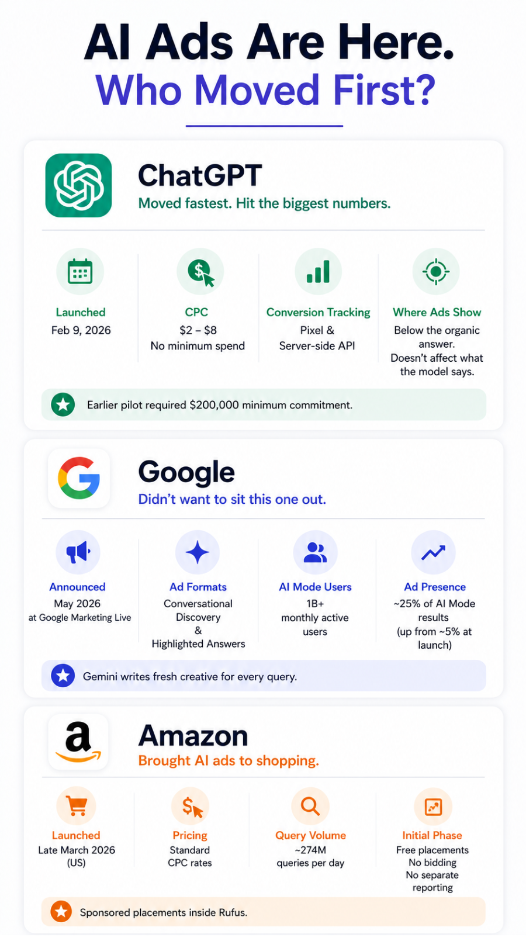
ChatGPT moved fastest and hit the biggest numbers. OpenAI had spent years describing advertising as something close to a last resort, then launched ads inside ChatGPT on February 9, 2026. The self-serve tool that followed runs on cost-per-click pricing between $2 and $8, needs no minimum spend, and tracks conversions via pixel and server-side API, though the earlier closed pilot had asked participating brands to commit at least $200,000.
One thing worth knowing: these ads buy a slot below ChatGPT's organic answer and don't touch what the model says above it, a distinction folkfox's writeup on the OpenAI-Perplexity contrast spells out clearly.
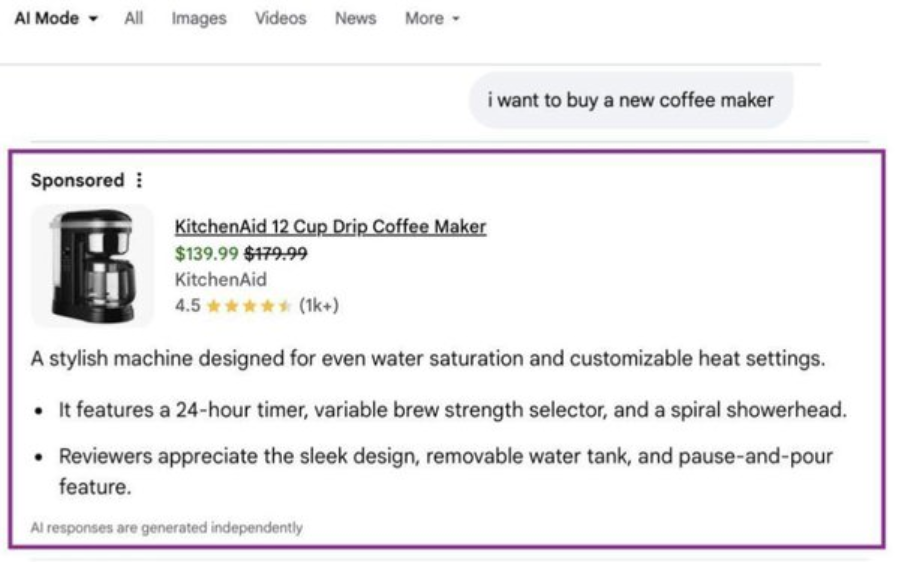
Google didn't want to sit this one out. At Google Marketing Live in May, Google introduced two formats built for AI Mode, Conversational Discovery ads and Highlighted Answers. What makes these different from a normal search ad is that Gemini writes fresh creative for every query instead of serving something pre-built. AI Mode has passed a billion monthly active users, and query volumes more than doubling every quarter since launch, with ads now appearing in roughly a quarter of all AI Mode results, up from just above 5% at the start of the year.
Source: Mediapost
Amazon brought the same idea to shopping. Sponsored placements inside Rufus, went generally available across the US in late March at standard CPC rates, with existing Sponsored Products and Sponsored Brands advertisers auto-enrolled. Rufus reportedly handles around 274 million queries a day. In the initial phase, the ads were running for free with no bidding and no separate reporting line, calling it a data-collection phase ahead of monetization.
Why This Isn't Just Google Ads With a New Coat of Paint
Once you line all of that up, a few real differences from the performance advertising you already run become pretty clear.
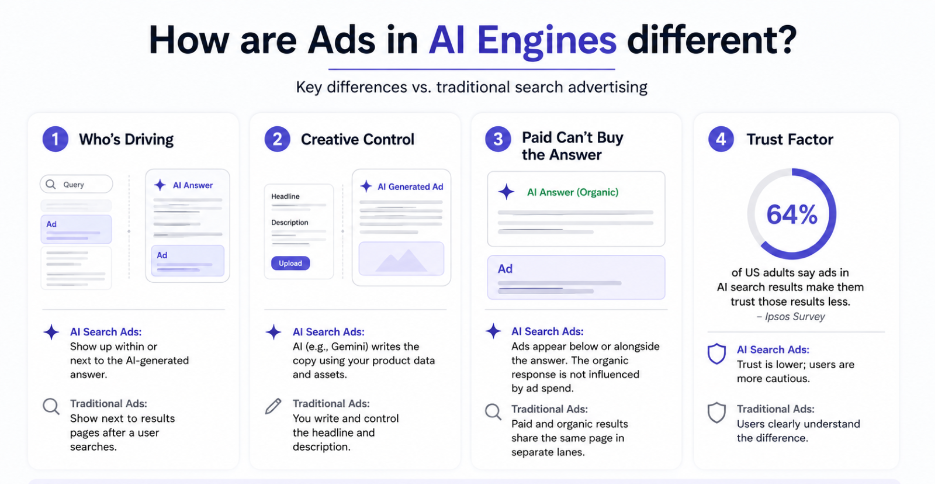
The first is about who's driving. Traditional search advertising runs on a keyword auction: someone types a query, sees ads next to organic results, and chooses whether to click, entirely on their own terms.
AI search advertising doesn't work that way: the platform is generating an answer, and your ad shows up within or next to that generated response. The user didn't come looking for a results page to scan.
The second is creative control, and this one genuinely surprises a lot of marketers the first time they hear it. On Google's new AI Mode formats, you're not uploading a headline and description the way you would in a normal Search campaign. Gemini writes the ad copy itself, tailored to whatever the user actually asked, pulling from your product data and assets rather than a static ad you built in advance.
That means the job shifts from writing punchy copy to making sure your underlying product data is clean, complete, and trustworthy enough for an AI to build a good pitch out of it.
The third, and probably the most important structural rule across every platform currently running ads, is that paid spend can't buy the answer itself. You can pay for a placement that sits below or alongside what the AI says, but on ChatGPT, Google's AI Mode, and everywhere else this has launched, the organic response stays untouched by ad dollars.
That's a genuinely different relationship between paid and organic than what you're used to on a Google results page, where the two have always shared the same real estate as clearly separate lanes.
And then there's trust, which isn't really a variable in traditional search advertising the way it now is here. Users have understood the difference between a sponsored link and an organic one on Google for a very long time
. An Ipsos survey found that nearly two-thirds of US adults say ads inside AI search results make them trust those results less. That single data point is probably the clearest explanation for why Perplexity walked away from the category entirely rather than trying to compete on ad revenue.
What This Actually Means If You're Planning Budget
A few practical implications fall out of all this once you put it together.
Paid AI ads and getting your brand cited organically inside AI answers, often called Generative Engine Optimization, are two genuinely separate investments, not two names for the same thing. Since ad dollars can't buy the organic recommendation on any platform running ads today, showing up well in the unpaid answer is its own discipline, built on clean, well-sourced, citable content rather than a media budget.
Measurement is going to look different too. Because platforms like ChatGPT and Google AI Mode don't hand over the same query-level detail Google Search Ads has trained marketers to expect, leaning on first-party data and CRM systems that can tie an ad exposure to downstream revenue is going to matter more than it currently does.
Creative work shifts as well. If Gemini or another model is writing your ad copy from your own product feed, the highest-leverage thing you can do is make sure that underlying data, specs, pricing, descriptions, is accurate and complete, since it's effectively becoming your ad copy whether you write it or not.
And finally, it's worth treating any single platform's ad product as something that could genuinely change shape or disappear. Perplexity tested ads for over a year and then reversed course entirely. Rufus reportedly ran free placements before switching to paid ones. These products are still being negotiated in public, and a strategy built entirely around one of them carries real platform risk.
Where This Leaves Us
What's happening here is a new category of advertising with its own logic: conversational context instead of keyword bidding, AI-written creative instead of copy you control, an organic answer that stays firmly out of reach of ad dollars, and a trust problem serious enough that one major platform decided the safest move was to opt out entirely.
Google, OpenAI, and Amazon are betting that users will tolerate ads inside their AI answers the same way they've tolerated them everywhere else online. Perplexity and Claude are betting that staying ad-free is the more durable advantage. Nobody knows yet who's right.
For marketers, the smart move right now is simply understanding the mechanics well enough to move quickly once the picture gets clearer, rather than waiting for a settled playbook that, honestly, might not exist for a while.


