Which Enterprise Content to Automate With AI and Which to Keep Human
The industry has agreed on how to handle AI content. Disclose it, edit it harder, keep a human in the loop. Sensible advice, and none of it explains why your team is publishing more than ever while engagement keeps sliding.
The industry has agreed on how to handle AI content. Disclose it, edit it harder, keep a human in the loop. Sensible advice, and none of it explains why your team is publishing more than ever while engagement keeps sliding.
Half the US consumers in a Gartner survey of 1,539 people said they would rather buy from brands that keep generative AI out of their ads and customer-facing content. Editing harder does nothing for that reader. They have decided that visible AI means nobody at the company cared enough to do the work.
You are not going to stop using it. CMI's 2026 B2B research found 89% of B2B marketers already use AI to write or optimize copy, and nobody is handing those hours back. What you can still decide is where the AI shows. It should carry the work your audience never sees. People should lead where ver a reader is deciding whether there's a real company behind the content.
Consumers also say the volume itself is wearing on them. In Gartner's May to June 2026 survey of 1,006 consumers, 65% said brands produce too much AI content and 57% said it has made them trust brand messaging less. In Klaviyo's research, the most common giveaways were replies that arrive too fast or sound too formal. They judge the style, because they can't see how the content was made.
Which enterprise content to automate with AI: 15 content types mapped
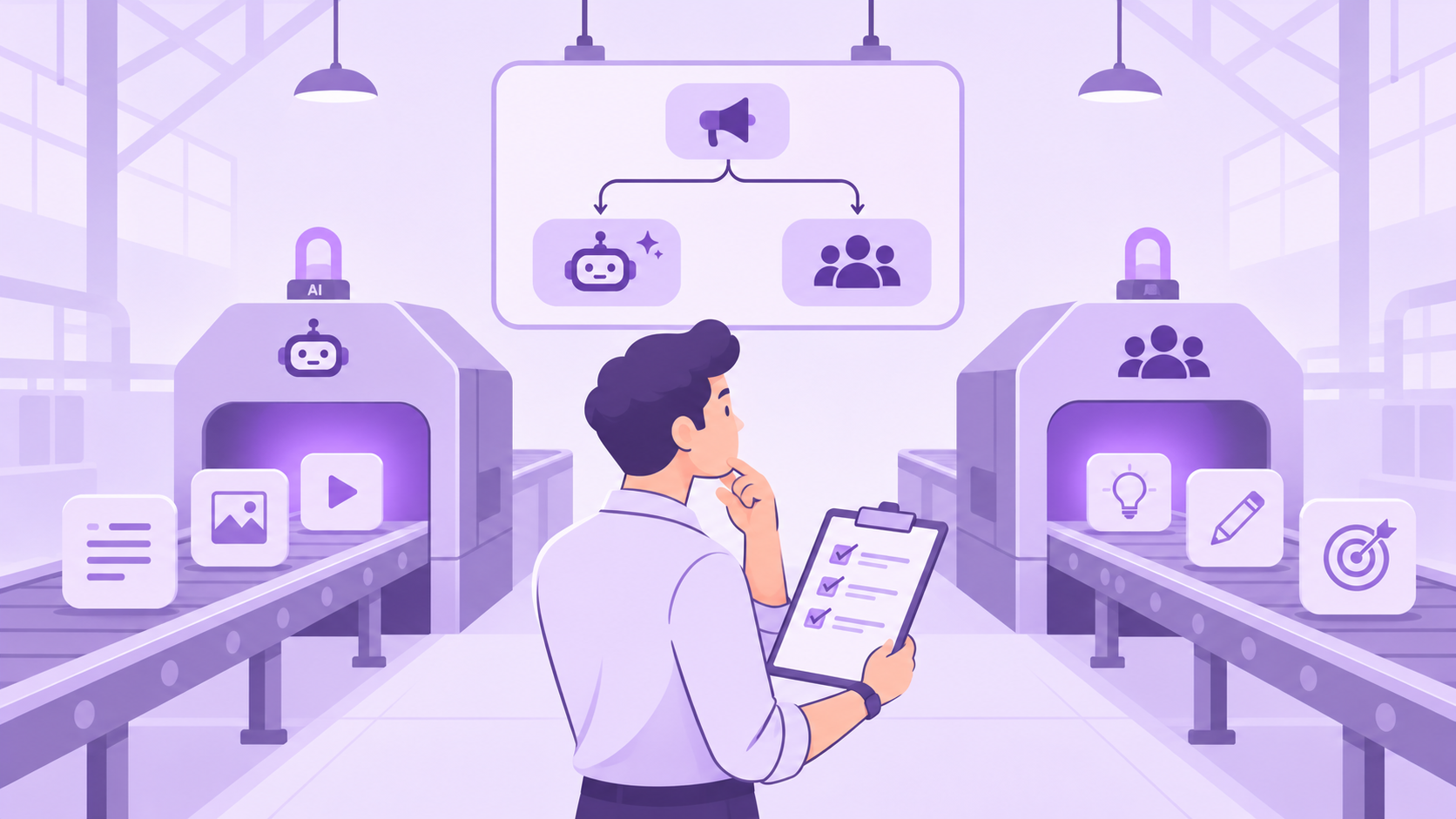
Ask two questions of every piece. How many people outside the company will see it? And when they do, are they forming a view of who you are? The answers put each content type in one of four zones.
[embed: node/6151233d-a1fc]
Zone one is the work nobody sees (1 to 5). Metadata, briefs, research digests, first-pass localization and catalog attributes are infrastructure. Nobody judges your brand on an alt tag, and most of a team's volume sits here. Let it lead, and have a person check a sample every week.
Zone two is seen by a few, at high stakes (6 and 7). RFP answers and battlecards reach a small audience at a bad moment to be wrong: procurement reviews and live sales calls. AI can assemble the first draft from approved sources. A named owner rewrites every product claim and every number.
Zone three is visible but rarely judged (8 to 11). Readers open a help article or release note for an answer, so clarity counts for more than voice. AI drafts and structures. An editor owns accuracy and strips out phrasing that reads as machine-made.
Zone four is where buyers judge you (12 to 15). Executive bylines, the launch story, customer stories and campaign creative are what people check to decide whether a real company stands behind the product. McDonald's Netherlands pulled its fully AI-generated Christmas ad three days after release last December. People lead here. AI can transcribe interviews, pull data and check facts, while the argument and the final edit come from a person.
How to split a product launch between AI and your team
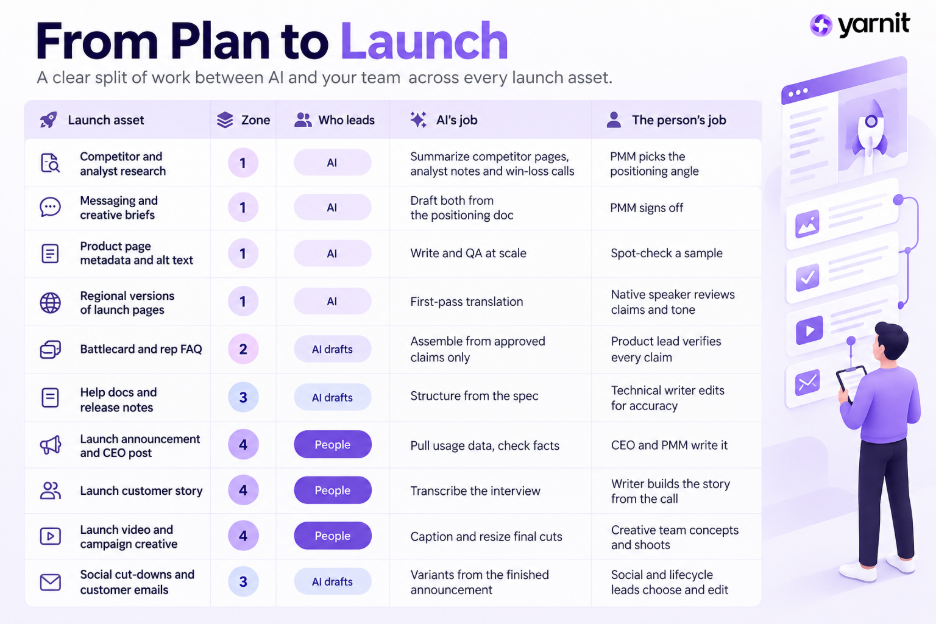
Take a typical enterprise launch: a new forecasting module for an existing platform, going out to current customers and a target account list. Seven of its ten assets can start with AI. The three that can't are the ones a buyer reads to decide whether you're worth a call.
Write the people-led announcement before anything else, because the battlecard, the emails and the social cut-downs all inherit its claims. When AI drafts the core story and everything downstream copies it, the template spreads into every channel at once.
How to build an AI content strategy your audience trusts
Tag last quarter's output by zone. Fix anything AI drafted in zone four first, then move the hours people spend hand-writing zone-one material. The zone-one layer also matters more than it used to, since AI assistants now read your metadata and specs when buyers ask them to shortlist vendors.
Give every zone-two claim an owner. Build one approved-claims library for RFPs and battlecards, let AI draft only from it, and put a name next to each product statement. When a claim is wrong in procurement, someone should already know it was theirs.
Spend the saved hours in zone four. Customer interviews, executive time and original data are the inputs AI can't produce, and they're what buyers read to judge you. Small teams feel this most, and the real gain from AI for them comes from shifting time across the funnel. On LinkedIn, the strongest format is often a person on camera, where buyers can hear your tone and decide whether they trust you.
Edit for tells, whoever wrote the draft. Review zones three and four for stock openers, tidy triads and templated structure regardless of who drafted them, and organize zone-three explainers into topic clusters so each page answers one question well.
Use AI where your audience can't see it
Your audience can't see your tools, and it has no reason to care about them. What it does see is the byline, the launch story, the customer quote and the answer that landed in an RFP. Those are the moments it decides whether anyone at your company was paying attention.
So let AI run the back office at full speed: the metadata, the briefs, the research and the first drafts. Then put your people where readers are looking. Teams that make that split will publish more than they ever have and still read like a company with people in it.
See exactly why your Product Detail Page isn't converting
Thank you! Your submission has been received!
Oops! Something went wrong while submitting the form.