Why Named Authors and Human Editors Matter for AI-Assisted Brand Content
Learn why named authors, visible editors, and clear content ownership help brands maintain accuracy, establish credibility, and build trust while scaling content production with AI.
When a reader suspects that what they are reading came out of AI, what would actually change their mind? It's not the disclosure label because it only confirms the suspicion rather than answering it.
As AI-generated content fills websites, search results, and social feeds, readers have more reasons to question what they're seeing. Is the information accurate? Does the writer have experience with the subject? Has anyone checked the claims?
We're beginning to see this shift reflected in regulations and platform decisions. The European Union is placing greater emphasis on human editorial responsibility, while LinkedIn is giving its members more ways to identify content they consider inauthentic. For brands using AI to scale content production, named authors, visible editors, and clear publishing ownership are becoming essential parts of building credibility.
Regulators, platforms, AI search and readers are asking who is accountable
The EU AI Act puts editorial responsibility in focus
Article 50 has applied since 2 August 2026, and the text obligation turned out to be narrower than the headlines suggested. It covers AI-generated or manipulated text published to inform the public on matters of public interest, and it falls away where the content has had human review or editorial control and a natural or legal person holds editorial responsibility for publishing it. Three details decide whether your operation clears that bar.
The first is scope: most ordinary sales and product copy is not caught at all, because it is not published to inform the public on a matter of public interest, though your opinion pieces, research reports and policy commentary are a different story. The second is depth: the review has to be substantive, and proofreading or grammar checks do not qualify under the Commission's guidance, nor does an anonymous "Editorial Team" credit with no contact details, which is worth knowing if that is what sits on your blog today. The third is the pleasant surprise: the evidentiary bar is low, because the code of practice does not require a record for each individual text, so a written editorial policy naming who holds responsibility is enough.
LinkedIn is bringing authenticity feedback closer to creators
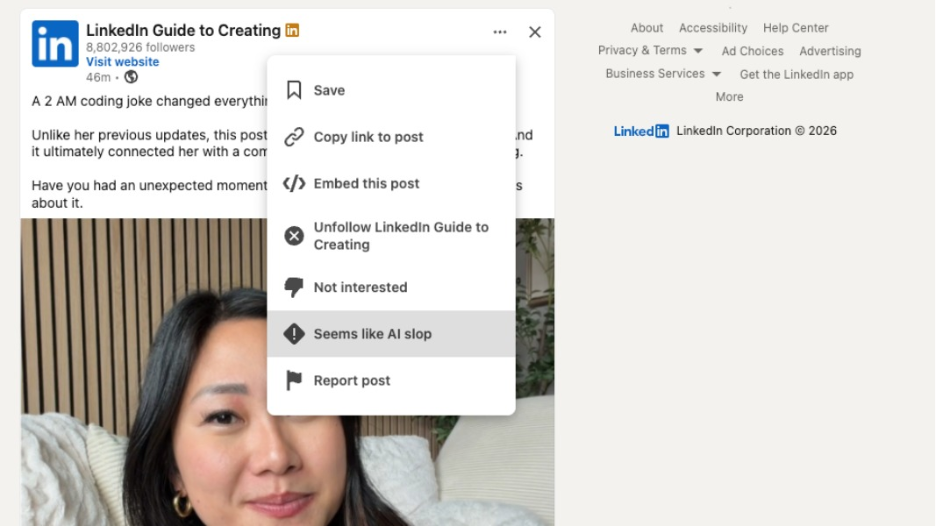
LinkedIn arrived at the same place from the opposite direction, not through law but through complaints. On 30 July 2026 it added a "Seems like AI slop" option to the three-dot menu on every post and retired its own "Enhance Post" AI writing tool the same day, and three weeks later chief product officer Hari Srinivasan reported that more than a million people had used the button in its first fortnight.
The more interesting piece for anyone running executive content is the test running on the other side, which is a private notice in creator analytics telling you when members felt your post came off as inauthentic or heavy on AI. The test is not tool use but whether a recognisable person is behind the post, and the scale explains the urgency: AI detection firm Pangram estimated that more than 40% of long-form LinkedIn posts were likely machine-written.
Why Every Brand Needs Named Authors, Visible Editors, and Clear Content Ownership
Give every article a real author
A byline might seem like a small detail, but it helps establish who is responsible for communicating the ideas in an article. Instead of publishing everything under "Marketing Team" or "Admin," brands should identify the person who meaningfully contributed to and owns the content. That could be a content strategist, subject-matter expert, product specialist, or another qualified contributor.
For example, imagine a cybersecurity company publishing an article about data protection. Knowing that the article was written by someone with cybersecurity experience gives readers more context than a generic corporate byline. The same principle applies to B2B software, finance, healthcare, retail, and other industries. A named author makes expertise easier to evaluate.
But the name must represent genuine involvement. Assigning an employee's name to an entirely AI-generated article they haven't reviewed doesn't create meaningful accountability.
Make human editing part of the publishing process
AI is useful for drafting, summarizing research, and suggesting improvements. However, it can also produce inaccurate claims, outdated references, and statements that sound convincing without sufficient evidence. That's where human editors become essential.
A good editor does more than improve readability. They question unsupported claims, verify important information, identify missing context, and check whether the article actually answers the reader's question. They also ensure the content reflects the brand's perspective rather than sounding like something any competitor could have published.
That single decision can prevent misleading information from reaching readers.
Establish clear ownership from draft to publication
When several people and AI tools contribute to a piece, responsibility can become unclear. The writer assumes the editor checked the facts. The editor assumes the research was verified. The publishing team assumes the article was already approved.
That's how mistakes slip through. Every published article should have a clearly defined owner who is responsible for its accuracy and final approval.
A practical workflow could look like this:
Author: Develops the article, contributes original insights, and checks the initial research.
Editor: Reviews the argument, verifies key claims and sources, and improves clarity.
Content owner: Approves the final version, confirms it meets publishing standards, and coordinates corrections or updates when needed.
For AI-assisted content specifically, the objective should be to create a workflow where technology speeds up production without weakening editorial standards. And that requires people who are empowered to challenge, rewrite, or reject what AI produces.
The Future of Brand Content Needs a Human Name Behind It
AI has changed how quickly brands can create content. But it hasn't changed the fundamental reason people read it. They want useful information they can trust.
A fast draft isn't valuable if nobody checks its accuracy. A polished article isn't credible simply because it sounds professional. And publishing at scale means very little if every piece lacks a clear perspective. That's why named authors and human editors matter.
They make it easier for readers to understand who contributed the expertise, who reviewed the information, and who stands behind the final publication.
Use AI to accelerate research, organize ideas, and improve drafts. But keep humans responsible for the thinking, verification, judgment, and final decisions. In a world where anyone can generate an article, the brands that clearly show who's willing to stand behind it will have a stronger foundation for earning trust.
See exactly why your Product Detail Page isn't converting
Thank you! Your submission has been received!
Oops! Something went wrong while submitting the form.