As a digital marketer, the adage 'don't put all your eggs in one basket' couldn't be more relevant. A staggering 52% of marketers now utilize between three to four marketing channels for their campaigns, highlighting the growing importance of a multi-faceted approach to digital advertising.
By advertising across multiple platforms, you can diversify customer touchpoints and create a cohesive narrative that resonates across different stages of the customer journey. This approach broadens your audience base and reinforces your message through repeated, varied exposures.
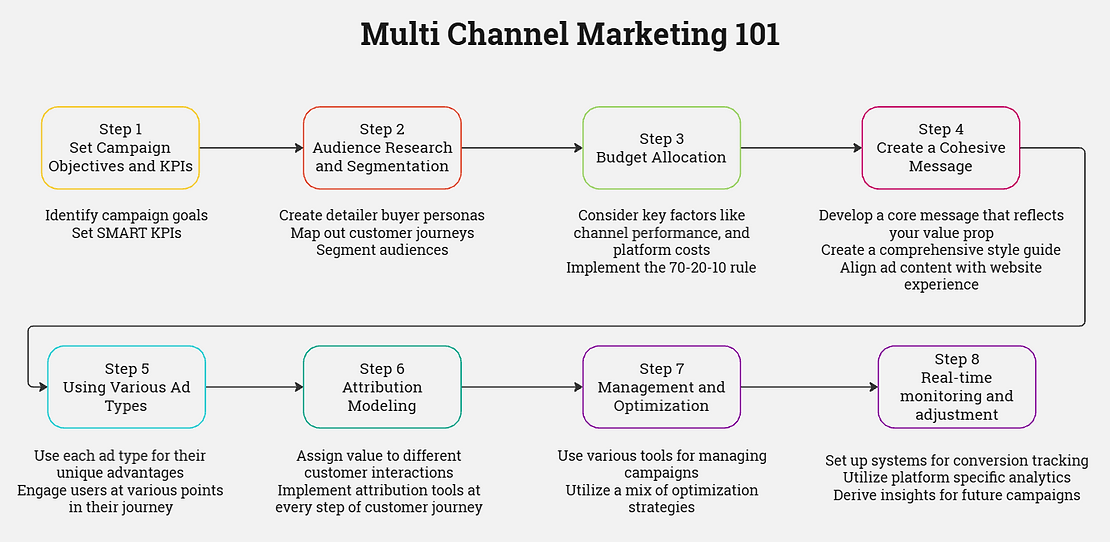
In this blog, we'll explore a step-by-step multichannel methodology that encompasses everything from setting clear objectives to real-time optimization. Read on to equip yourself with the knowledge and strategies to craft campaigns that cut through the noise and deliver tangible results.
Here's a handy infographic to give you an idea of what we'll be covering.
Step 1: Setting Campaign Objectives and KPIs
The foundation of any successful multi-channel marketing campaign lies in clearly defined objectives and key performance indicators (KPIs). This crucial first step sets the direction for your entire campaign and provides a benchmark against which to measure success.
Begin by identifying your primary campaign goals. These typically fall into three categories:
Awareness: Increasing brand visibility and recognition among your target audience. This campaign will target metrics such as reach, impressions, and brand lift.
Consideration: Encouraging potential customers to engage with your brand and consider your products or services. This type of campaign will focus on engagement rates, time spent on site, or lead generation
Conversion: Driving specific actions, such as purchases, sign-ups, or downloads. This campaign will prioritize metrics such as conversion rate, cost per acquisition, and return on ad spend (ROAS).
Once you've established your overarching goals, it's time to define success metrics. These KPIs should be SMART: Specific, Measurable, Achievable, Relevant, and Time-bound. The key to effective goal-setting is alignment with your broader business objectives.
Step 2: Audience Research and Segmentation
Understanding your audience is paramount in multi-channel marketing. This step involves audience research and segmentation to ensure your messages resonate across all channels.
Start by creating detailed buyer personas. These semi-fictional representations of your ideal customers should go beyond basic demographics to include psychographic information such as values, interests, pain points, and motivations. Utilize a mix of quantitative data from analytics tools and qualitative insights from customer interviews or surveys to build comprehensive profiles.
Once you have your personas, map out their customer journeys. This involves charting the typical path a customer takes from awareness to purchase and beyond. Identify key touchpoints and potential barriers at each stage. This exercise will reveal opportunities for targeted messaging and help you tailor content to different stages of the funnel.
Audience segmentation is the next critical component. Divide your audience into distinct groups based on shared characteristics or behaviors. Common segmentation criteria include:
By investing time in thorough audience research and segmentation, you'll be able to craft more personalized, relevant messages for each channel.
Step 3: Budget Allocation Across Platforms
Effective budget allocation is a critical factor in the success of your multi-channel marketing campaign. This step requires a strategic approach to distributing your resources across various platforms and ad types to maximize ROI.
When determining how to allocate your budget, consider the following factors:
Channel performance: Analyze historical data to identify which channels have been most effective for your brand in the past.
Audience presence: Allocate more budget to platforms where your target audience is most active and engaged.
Campaign objectives: Align your spending with your primary goals. For instance, if brand awareness is key, you might allocate more to display and video advertising.
Competitive landscape: Research where your competitors are investing and consider how you can differentiate or compete effectively.
Platform costs: Be aware of the varying costs associated with different channels and ad types.
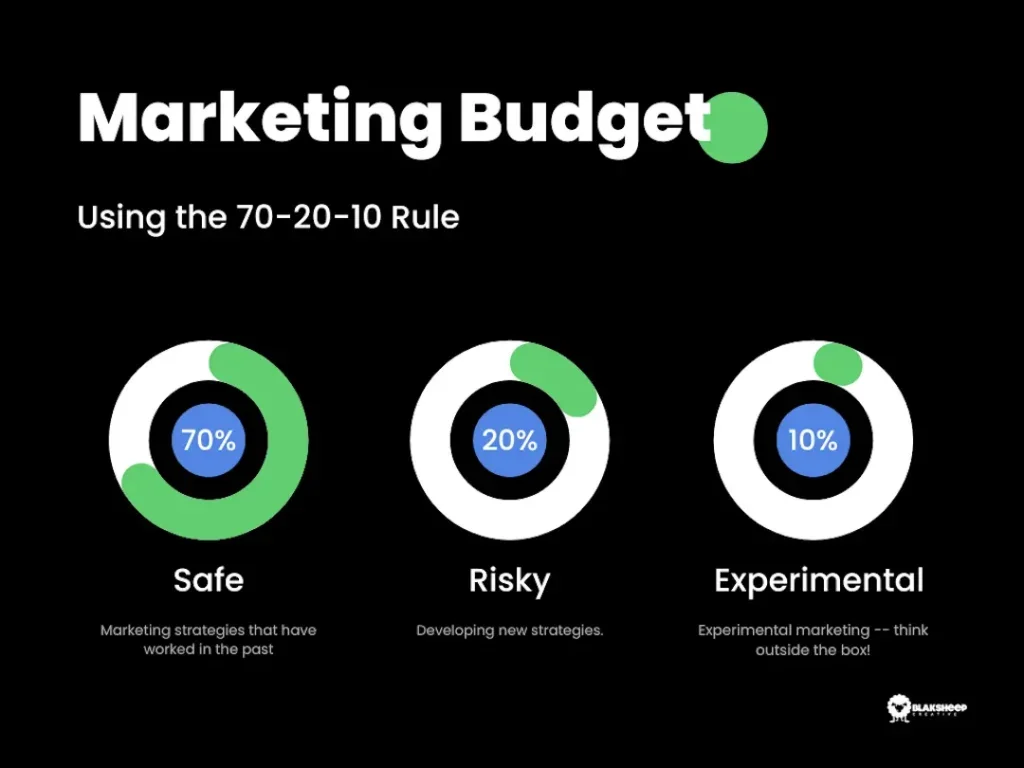
While broad reach can be important for awareness campaigns, highly targeted ads on specific platforms may yield better results for conversion-focused objectives. For optimal budgeting, consider implementing a 70-20-10 rule:
70% of your budget to channels and tactics that have proven successful
20% to promising new opportunities or emerging platforms
10% for experimental approaches or cutting-edge ad types
Source: Blaksheep Creative
Remember that budget allocation isn't a set-it-and-forget-it task. Be prepared to adjust your distribution based on real-time performance data as your campaign progresses.
Step 4: Crafting a Cohesive Messaging Strategy
A cohesive messaging strategy is the glue that holds your multi-channel marketing campaign together. It ensures that your brand speaks with one voice across all platforms.
Start by developing a core message or value proposition that encapsulates the essence of your campaign. Then, ensure brand consistency by creating a comprehensive style guide that outlines your visual identity, tone of voice, and key messaging points.
Aligning ad content with landing pages and website experience is another critical aspect of a cohesive strategy. are some examples of supporting content for each stage of the funnel:
Awareness: Educational blog posts, infographics, and social media content
Consideration: Case studies, product comparisons, and webinars
Conversion: Free trials, demos, and limited-time offer
Step 5: Integrating Various Ad Types
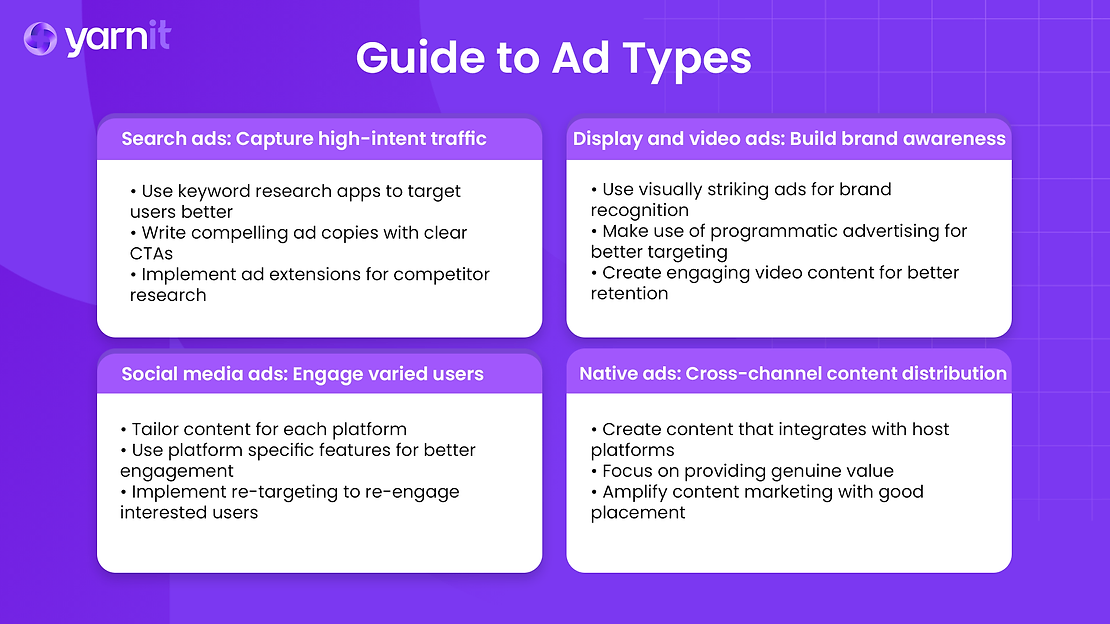
A robust multi-channel marketing campaign uses a diverse mix of ad types to create a comprehensive and effective strategy. Let's explore how to integrate various ad formats into your campaign:
Where to Use Search Ads:
Search ads excel at capturing High-Intent Traffic. Make the most out of them by:
Utilizing keyword research apps like Yarnit's Keyword Insights to target users actively searching for your products or services
Crafting compelling ad copy that aligns with search intent and includes clear calls-to-action
Implementing ad extensions like Moz to provide additional information and increase click-through rates
How to Use Display and Video Ads
Display ads are great for building brand awareness. Use this to your advantage by:
Using visually striking display ads to capture attention and build brand recognition
Leveraging programmatic advertising for precise targeting and efficient budget allocation
Creating engaging video content that tells your brand story and showcases product benefits
Running Social Media Ads for Multi-channel Marketing
Social platforms are great at engagement and community building. Amplify your strategy by:
Tailoring content to each platform's unique format and audience expectations
Utilizing platform-specific features like Instagram Stories or Twitter Polls to boost engagement
Implementing retargeting strategies to re-engage users who have interacted with your brand
Making the most out of Native Ads:
Native ads are great at distributing your content across the web. Follow best practices by:
Creating valuable, informative content that seamlessly integrates with the host platform
Focusing on providing genuine value to the reader rather than overt promotion
Using native ads to amplify your content marketing efforts and reach new audiences
To drive better outcomes, it is also important to use retargeting strategies across platforms. Implement pixel tracking on your website to build custom audiences for retargeting. Also, create tailored ad sequences that guide users through the conversion funnel. To cap it off, use dynamic retargeting to showcase specific products or services users have shown interest in.
Step 6: Cross-Platform Attribution Modeling
In the complex landscape of multi-channel marketing, understanding how each touchpoint contributes to conversions is crucial. Cross-platform attribution modeling allows marketers to assign value to different interactions along the customer journey, providing insights into the effectiveness of various channels and tactics. Here is a step-by-step guide to implement cross-platform attribution:
Map the Customer's Path to Conversion
Utilize tools like Google Analytics to track user interactions across channels
Implement UTM parameters to identify traffic sources and campaign specifics
Consider the impact of both online and offline touchpoints on the conversion process
Choose an Attribution Model
Last-click attribution: Assigns all credit to the final touchpoint before conversion
First-click attribution: Gives full credit to the initial interaction
Linear attribution: Distributes credit equally across all touchpoints
Time decay: Assigns more credit to touchpoints closer to the conversion
Position-based: Emphasizes the first and last interactions, with some credit to middle touchpoints
Data-driven attribution: Uses machine learning to determine the impact of each touchpoint
Assign Value to Different Touchpoints
Analyze the role of each channel in moving customers through the funnel
Consider both assisted conversions and direct conversions
Factor in the cost and effort associated with each touchpoint
Implement Attribution Tools
Utilize built-in attribution features in platforms like Google Analytics 360 or Adobe Analytics
Consider third-party attribution solutions for more advanced modeling capabilities
Continuously Refine Your Model
Regularly review and adjust your attribution model based on new data and insights
Test different models to find the one that best reflects your customer journey
Step 7: Campaign Management and Optimization
Effective campaign management and continuous optimization are key to maximizing the performance of your multi-channel marketing efforts. This step involves using tools, conducting tests, and making data-driven adjustments to enhance campaign effectiveness.
Tools for Managing Multi-Platform Campaigns
Marketing automation platforms (e.g., HubSpot, Marketo) for streamlined workflow management
Social media management tools (e.g., Hootsuite, Sprout Social) for coordinated social campaigns
Ad management platforms (e.g., Google Ads, Facebook Ads Manager) for centralized ad control
Project management software (e.g., Asana, Trello) for team coordination and task tracking
A/B Testing Across Different Ad Types
Develop a systematic approach to testing variables such as ad copy, visuals, CTAs, and landing pages
Implement split testing on each platform, ensuring statistical significance before drawing conclusions
Use platform-specific tools like Google Optimize or Facebook's built-in A/B testing features
Test not just individual elements, but also entire user journeys and conversion funnels
Optimization Strategies
1. Audience Refinement:
Analyze performance data to identify high-performing segments
Create lookalike audiences based on your best customers
Regularly update and refine your targeting criteria
2. Budget Reallocation:
Shift budget towards top-performing channels and ad types
Implement dayparting to focus spending during peak engagement times
Use automated bidding strategies to optimize for specific goals (e.g., ROAS, CPA)
3. Creative Optimization:
Refresh ad creatives regularly to combat ad fatigue
Personalize ad content based on user behavior and preferences
Leverage dynamic creative optimization (DCO) for automated ad customization
4. Landing Page Optimization:
Ensure message match between ads and landing pages
Optimize page load speed and mobile responsiveness
Implement conversion rate optimization (CRO) techniques like clear CTAs and trust signals
By implementing robust campaign management practices and embracing a culture of continuous optimization, you can significantly enhance the effectiveness of your multi-channel marketing efforts, driving better results and ROI over time.
The Power of an Integrated Approach
As we've explored throughout this comprehensive guide, launching a successful multi-channel marketing campaign is a complex yet rewarding endeavor. The power of an integrated approach lies in its ability to create a cohesive brand experience across multiple touchpoints, maximizing reach and impact while providing valuable insights into customer behavior.
The key to multi-channel success is not just being present on multiple platforms, but creating a seamless, consistent experience that guides customers through their journey with your brand. As you implement these strategies, remain flexible and data-driven, always ready to adapt to new insights and emerging opportunities.
If you're looking for an AI companion to guide you through launching a campaign on multiple platforms at the same time, look no further. Yarnit is your all-in-one solution for launching a campaign across multiple platforms. From identifying the best keywords with the Keyword Insights app, ideating campaign strategy in Content Ideas, to writing compliant and high-performing ad copy with our ad use-cases, to creating brand-aligned ad creatives in Canvas, you can do it all on Yarnit. What's more, our Brand Brain ensures that all your content is written in your brand's voice.
Check out Yarnit today to launch your next campaign without the content concerns.
See exactly why your Product Detail Page isn't converting
Thank you! Your submission has been received!
Oops! Something went wrong while submitting the form.