


%20(1).png)
In 2026, SEO success demands more than keyword optimization, your strategy must account for AI Overviews, LLM optimization, voice search nuances, zero-click answers, and Google's evolving focus on helpfulness, expertise, trust, and authentic user experience. Managing these interconnected ranking signals manually stretches resources thin and slows response times. That's exactly where AI-powered SEO agents come in—automating multi-layered workflows so your team can maintain competitive visibility while focusing on strategic growth.
That’s exactly where AI-powered SEO agents come in — they go far beyond basic keyword tools or content rewriters. These intelligent systems plan, execute and keep improving entire SEO workflows with almost no constant supervision, so you can stop drowning in manual tasks and start focusing on strategy, brand voice and growth. And the shift is already massive: 86% of SEO professionals have integrated AI into their daily work, proving that the gap between teams who use agents and those who don’t is widening fast.
Let’s break down what AI-powered SEO agents really are, how they actually work, and the use cases that deliver the biggest wins right now.
What Are AI-Powered SEO Agents?
Think of AI-powered SEO agents as smart assistants that go way beyond basic keyword tools. They're automation systems that handle the tedious parts of SEO—keyword research, content audits, competitor tracking, technical fixes—but they also make decisions and learn from what works.
Here's the difference: traditional SEO tools give you data and leave you to figure out what to do with it. AI-powered SEO agents analyze that data, spot patterns, and then take action. They understand context, recognise user intent, find gaps in your content, and build optimization strategies automatically.
Instead of spending your afternoon manually sorting through hundreds of keywords and checking what competitors are doing, you tell the agent your goal, and it handles the research, analysis, and planning. You review the strategy, add your creative touch, and let it execute.
The real power? These agents get smarter over time. They track what's working, adjust their approach, and improve their recommendations based on actual performance data.
How AI-Powered SEO Agents Think and Operate
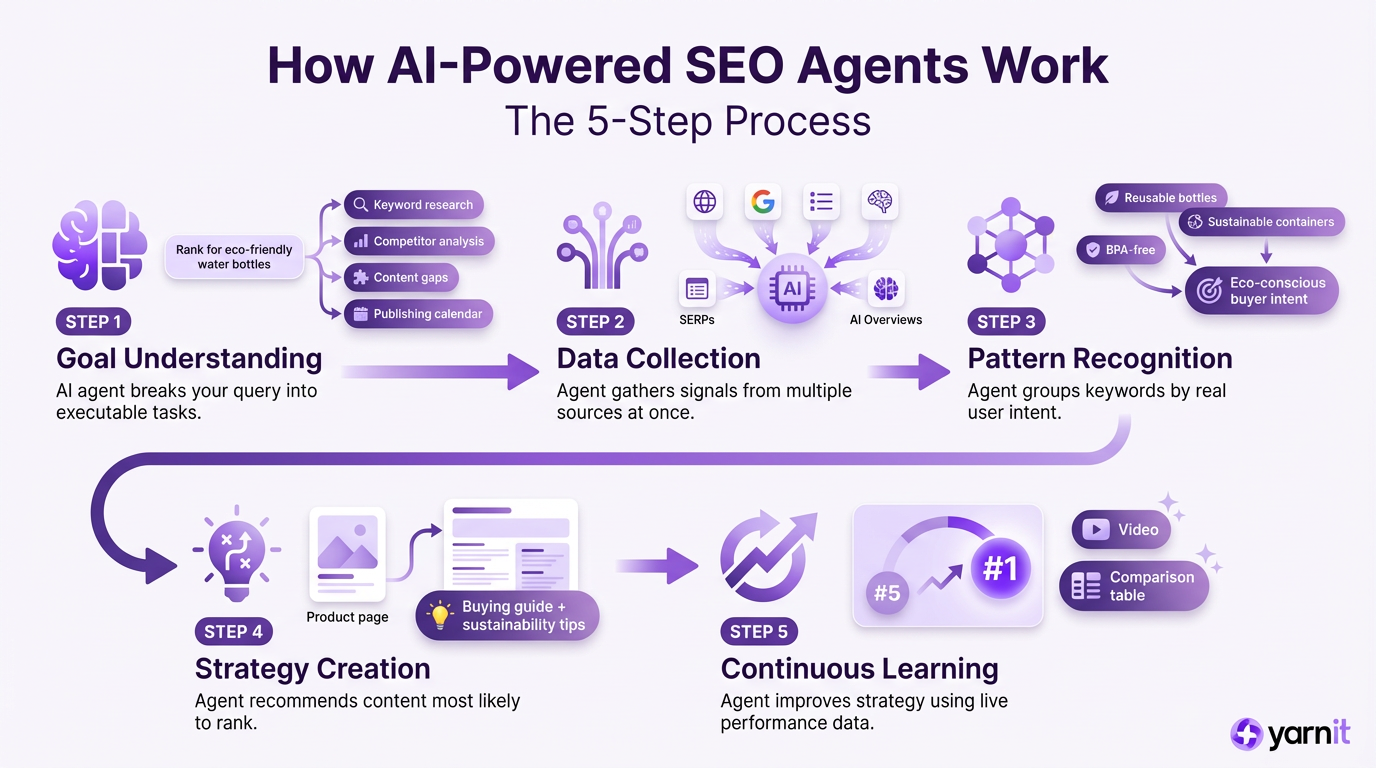
Say you're launching a Black Friday campaign for skincare products aimed at budget-conscious millennials interested in natural ingredients. You give your AI-powered SEO agent this direction: "Create a Black Friday campaign targeting budget-conscious millennials interested in natural skincare." Here's what happens:
First, It Figures Out Your Goal
The agent breaks your big objective into specific tasks that it can actually execute. "Create a Black Friday campaign" becomes a list of concrete steps:
- Find 50 high-intent keywords around natural skincare and Black Friday deals
- Identify which keywords match different stages of the buyer journey
- Map out content gaps competitors haven't filled
- Build a content calendar optimized for pre-Black Friday search behavior
Next, It Gathers the Right Signals
The agent starts collecting information from multiple sources. It's scraping competitor websites to see what keywords they're targeting, pulling data from your Google Search Console to understand current performance, analyzing search engine results pages to spot featured snippet opportunities, and checking AI overview results to see how natural skincare content appears in AI-generated answers.
For your Black Friday skincare campaign, you might discover that "affordable natural face serums" gets decent search volume but has weak competition, or that questions like "which natural skincare products actually work?" show up frequently in AI overviews.
Then It Connects Related Ideas
This is where semantic clustering happens. The agent groups related keywords by meaning and intent, not just exact matches. It might cluster "budget-friendly natural moisturiser," "affordable organic face cream," and "cheap clean beauty products" together because they represent the same search intent.
It also maps keywords to the buyer journey. Someone searching "what are natural skincare ingredients" is researching, while "best Black Friday deals on natural moisturizer" signals they're ready to buy.
It Chooses What to Do and Why
Using machine learning, the agent spots patterns and builds strategy. For your campaign, you might decide that long-form educational content ("complete guide to natural skincare for sensitive skin") will rank better than simple product pages for top-funnel keywords.
It might also be noticed that competitors aren't optimizing for AI search visibility, giving you an opportunity to structure content in ways that show up in ChatGPT and Google's AI overviews.
It Keeps Learning and Improving
After the campaign launches, the agent monitors performance. If a particular content angle isn't getting traction, it suggests adjustments. If one keyword cluster is driving unexpected conversions, it recommends doubling down with more content in that area.
This feedback loop is what separates AI agents from static tools. They adapt based on real results, not just initial assumptions.
Where AI-Powered SEO Agents Add Real Value
Keyword Research That Goes Beyond the Basics
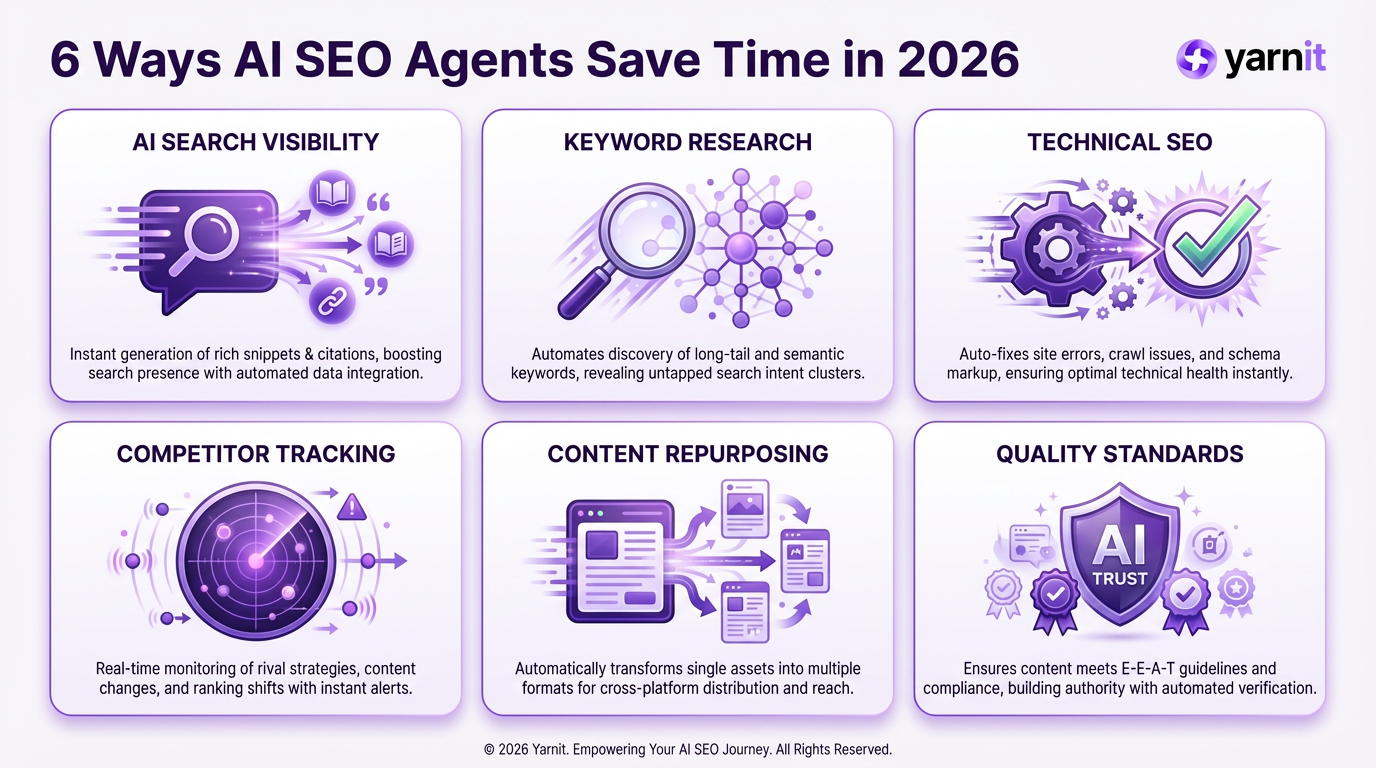
AI-powered SEO agents scan SERPs, analyze search intent, cluster keywords by topic and buyer journey, identify content gaps, and predict high-potential terms—including for AI search platforms like Google AI Overviews or ChatGPT.
Surfer AI, for example, analyzes top-ranking SERPs for your target keyword, automatically clusters related terms into topical maps, identifies content gaps based on what high-ranking pages cover, and suggests high-potential keyword opportunities to build around. This saves hours of manual SERP research and planning.
Content Creation and Smart Optimization
AI-powered SEO agents can generate complete articles from simple prompts, optimize existing posts for better keyword placement and readability, and ensure everything meets E-E-A-T standards (that's Experience, Expertise, Authoritativeness, and Trustworthiness—Google's quality guidelines).
They also rephrase content specifically for AI visibility, verify facts against trusted sources, and maintain your brand voice across all content. Yarnit, for example, helps turn one comprehensive blog post into multiple formats: social media posts, email newsletter sections, video scripts—while keeping SEO value and message consistency intact.
Technical Fixes Without the Headaches
Technical SEO audits used to mean hours of crawling through site reports. AI agents do this automatically: they scan your entire site, flag issues like slow loading times, missing structured data, broken links, and messy internal linking—then either suggest fixes or apply them directly.
They optimise meta descriptions, add descriptive text to images, and ensure your site structure is clear to both search engines and actual users. Tools like Alli AI can make on-page edits automatically across hundreds or thousands of pages (meta titles, descriptions, alt text, internal links) without needing developer help.
If you want to know more about technical SEO, read our guide: Technical SEO for AEO & GEO: Preparing Your Website for AI Crawlers.
Generative Engine Optimization (GEO) / Answer Engine Optimization (AEO)
AI powered SEO agents rewrite and structure content specifically to increase the chances of appearing in ChatGPT responses, Perplexity answers, Gemini summaries or Google AI Overviews — by adding clear entities, FAQ sections, step-by-step explanations, citation-friendly formatting and authoritative signals. Otterly AI tracks brand mentions and visibility across AI engines like ChatGPT, Perplexity, Gemini and Google AI Overviews, then provides actionable insights on frequency, sentiment, citations and prompt-level recommendations to improve how your content gets surfaced.
Competitor Analysis and Strategy Adaptation
Agents watch your main competitors 24/7 — tracking their rankings, new content, backlink gains, AI visibility and SERP features — then instantly recommend counter-strategies such as gap-filling articles, link-building ideas or quick on-page updates. NightOwl sends real-time alerts when a competitor jumps ahead and provides ready-to-use action plans to help you respond fast.
Content Repurposing
Content repurposing is one of the most practical applications of AI-powered SEO agents. They transform comprehensive blog posts into short social media posts, email newsletter sections, and video scripts—all while maintaining keyword consistency and brand voice.
Yarnit's content repurposing capabilities demonstrate this well: you create one solid piece of content, and the platform helps you turn it into a multi-channel campaign without losing SEO value or diluting your message.
Best Practices When Using AI-Powered SEO Agents
AI-powered SEO agents are extremely capable, but they can occasionally hallucinate facts, miss subtle brand nuances or push optimisation too far. Protect yourself by always running a quick manual site audit first and feeding the real gaps and priorities to the agent. Upload clear brand guidelines, tone examples and specific campaign rules into every prompt. Always review outputs for factual accuracy, natural tone and solid E-E-A-T signals (real author bios, credible sources, proof of experience). Start with a small test — one keyword cluster or single page — measure actual traffic/ranking impact, then scale confidently. This human-in-the-loop approach is what the top 58.5% of organisations are using to get maximum value without the risks.
Conclusion
AI-powered SEO agents are changing how marketers approach search optimization. They automate complex, time-consuming tasks, provide intelligent insights at scale, and enable teams to focus on strategic decision-making rather than manual execution.
These agents handle keyword research, content optimization, technical audits, and competitor analysis—but they work best when guided by human expertise and strategic vision.
SEO success in 2026 combines human creativity with AI efficiency. Tools that integrate intelligent agents into comprehensive marketing platforms, like Yarnit's approach to turning strategies into ready-to-launch campaigns, empower marketers across industries to optimize campaigns and scale marketing efforts with quality, consistency, and speed.
Pick one repetitive SEO task that's eating up your time. Hand it to an AI agent and measure the results. The time you get back might change how you approach your entire workflow.


