


Three years ago, a shopper looking for a new skincare moisturiser would open Google, type in a few keywords, scroll through brand websites, maybe land on a Reddit thread or two, and eventually make a call. The store that had the best SEO, the most convincing product page, and the sharpest price usually showed up.
That same shopper today is opening ChatGPT or Perplexity and type: "What's the best moisturiser for combination skin under ₹1,500?" And within seconds, they have a shortlist with reasons. They didn't visit a single product page. They didn't scroll through search results. An AI did all of that for them, and handed them a recommendation.
This shift from shoppers actively searching to AI actively researching on their behalf is already well underway. Referral traffic from AI assistants to retail websites grew 1,200% between 2024 and 2025. Most store owners don't realise this is already happening. There's no notification when an AI assistant evaluates your product against a competitor's. There's no separate analytics dashboard for it. AI assistants are already a discovery channel, whether you've optimised for them or not.
This is the first layer of what the industry calls agentic commerce. AI being used to actively research, evaluate, and shortlist products on a shopper's behalf. And it's only going to go further. The next step, which is already in early deployment by retailers like Amazon and Saks, is AI that also goes ahead and buys it, handling the cart, the payment, the delivery preference, all of it.
Most people haven't heard the term agentic commerce yet. But the shift it describes is already affecting your store. This guide is going to explain exactly what it is, how it works, and what you need to do so your products show up favourably when AI is doing the evaluating.
What Is Agentic Commerce, Really?
According to Deloitte's 2025 agentic commerce report, by 2030, analysts project that 25% of global e-commerce sales will be enabled by AI agents and 55% of digital consumers will begin product research using large language model platforms.
The word agentic comes from agency, the ability to act independently toward a goal. So when we say AI is becoming agentic, we mean it's going from "answer my question" to "go handle this for me."
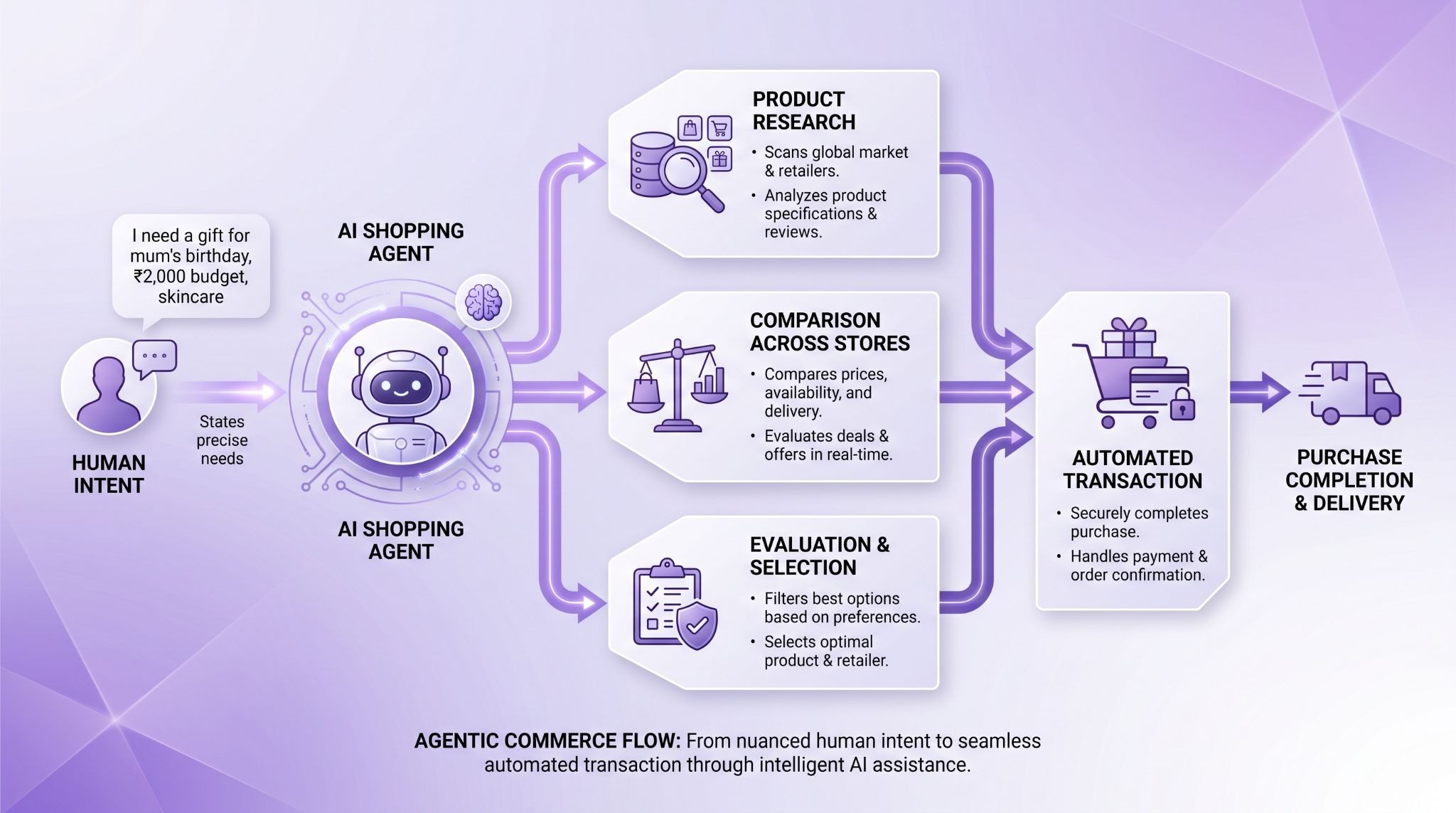
Agentic commerce is what happens when that capacity for independent action gets applied to shopping. Instead of a shopper going to your store, searching for a product, comparing options, and checking out, their AI agent does it on their behalf. The human states an intent ("I need a gift for my mum's birthday, something around ₹2,000, she likes skincare") and the agent handles everything from there. They research, compare options across stores, evaluate against user preferences (budget, style, delivery time, reviews), and complete transactions with minimal human input.
From Chatbots to AI Agents: What Actually Changed?
Fair question. There's a lot of AI noise in ecommerce right now, and it can feel like the same thing getting rebranded every six months. But the difference between a chatbot and an AI agent is actually pretty meaningful. Let's walk through it.
The chatbot era
You almost certainly have one of these, or have used one. Pop-up widget on your website, answers questions like "where's my order" or "what's your return policy." It works off a script, a fixed set of if-then rules. If a customer types something close enough to what the bot was trained on, it responds. If they deviate even slightly, it says something useless like "Sorry, I didn't understand that."
Think of a chatbot like a phone tree. Press 1 for orders, press 2 for returns. Useful for what it does. Hopeless the moment you go off-script.
The generative AI era
This is ChatGPT territory. These systems can hold real conversations, understand nuance, and generate genuinely helpful responses. But they're still reactive. They respond to you. They don't go and do things. You ask, they answer. Ask them to actually place an order or check livestock levels, and they'll tell you they can't do that.
The agentic era
This is where we're headed now. Agentic AI systems can connect to your store's catalog, check real-time inventory, compare across retailers, run a transaction through a payment gateway, and confirm the order. All autonomously, all in sequence, without a human clicking through each step.
Here's an example to make this stick:
A chatbot is like a travel brochure, it gives you information when you ask for it. A generative AI copilot is like a knowledgeable travel consultant who answers your questions brilliantly. An AI agent is like a full-service travel agent who takes your brief ("beach holiday in March, under ₹1.5 lakhs, no red-eye flights"), goes away, books everything, sends you the itinerary, and follows up if anything changes. You didn't have to manage any step of the process.
The key shift: agents can handle multi-step, multi-system tasks without handholding. According to IBM, modern agentic AI differs from previous retail AI in three critical ways: autonomy (it acts without constant input), reasoning (it adapts to changing conditions like stock depletion or price shifts), and interoperability (it integrates across multiple systems via open APIs).
Agentic AI vs. Agentic Commerce
You'll often see these terms used interchangeably, so let's untangle them quickly.
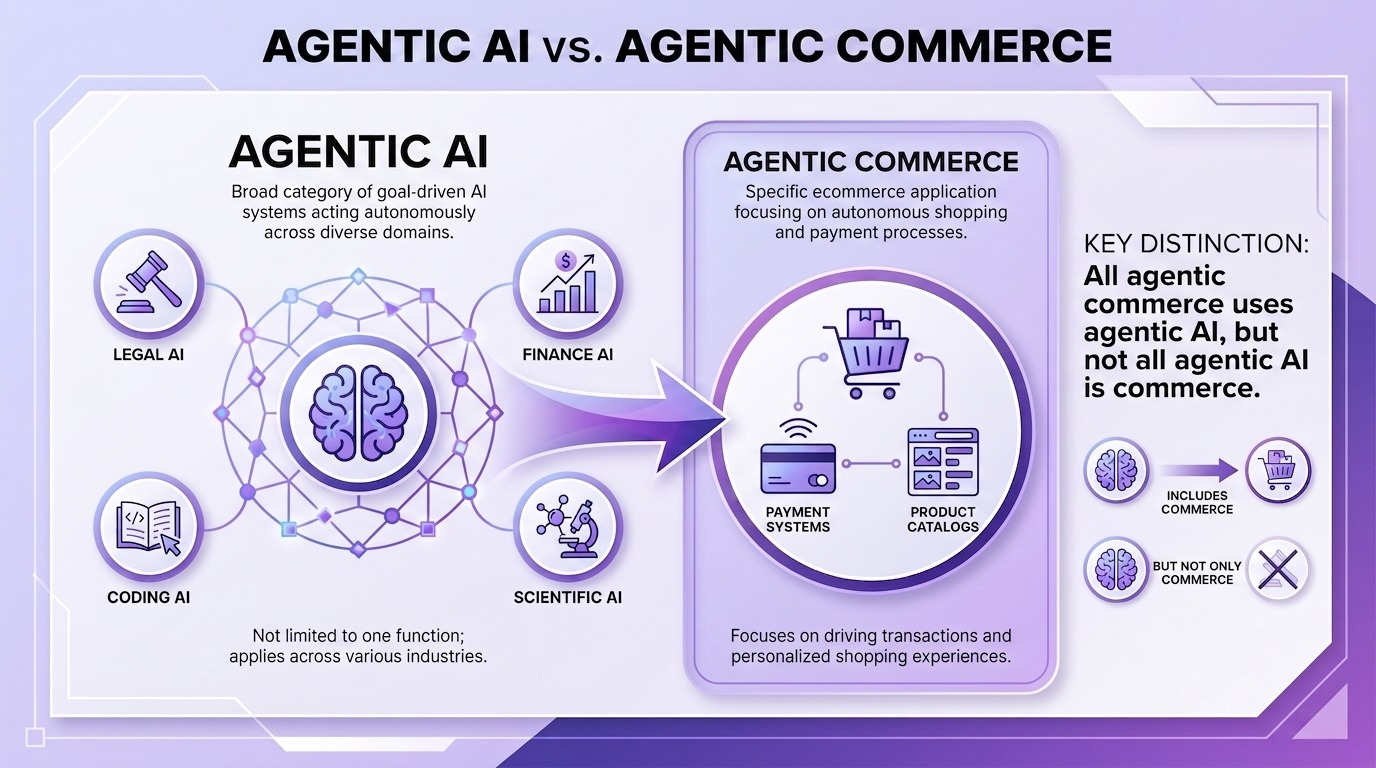
Agentic AI is the broad category. It refers to any AI system capable of independently pursuing goals, making decisions, and taking actions across complex, multi-step workflows in any domain. Legal research, code writing, financial analysis, all of these can use agentic AI.
Agentic commerce is a specific application of agentic AI focused on shopping, payments, and commerce. The agent's "domain" is the ecommerce world, product catalogs, inventory systems, payment gateways, order management systems, and customer preferences.
Think of it this way: all agentic commerce uses agentic AI, but not all agentic AI is commerce. A legal research agent and a shopping agent are both "agentic" but they operate in completely different contexts and integrate with completely different systems.
How Does an Agentic Commerce Agent Actually Work?
Let's get under the hood. When someone tells their AI assistant "I need a new pair of running shoes for a half marathon, budget ₹6,000, delivered by Thursday" what actually happens?
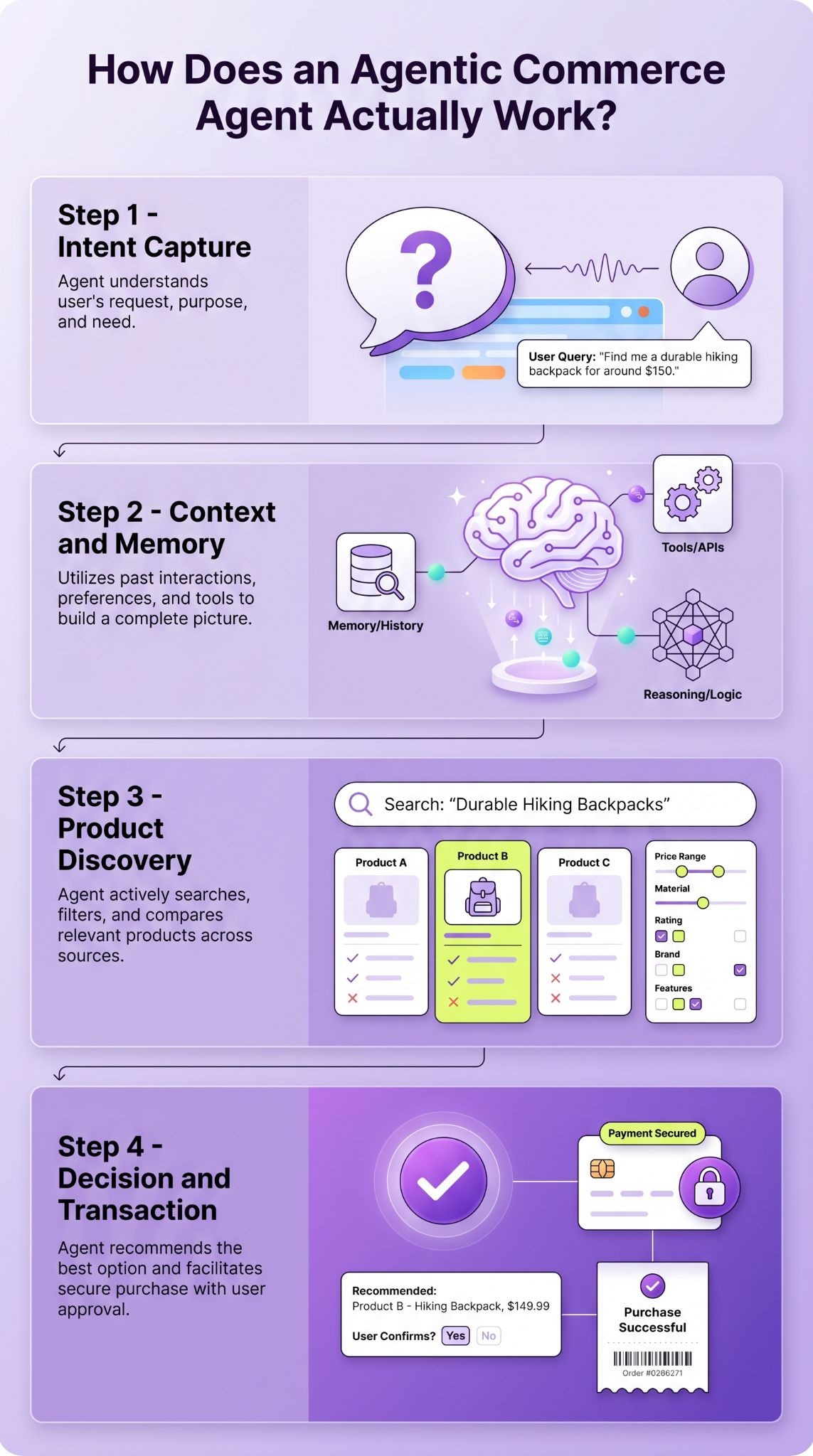
Step 1: Intent Capture and Clarification
The agent interprets the goal behind the request. If the request is vague, it asks follow-up questions: What's your usual shoe size? Do you prefer cushioned or minimal soles? Do you have a brand preference?
This is different from a search bar, which just takes keywords. The agent is trying to understand the outcome the user wants.
Step 2: Context and Memory
Here's where agentic systems start to feel genuinely intelligent. According to Mastercard, AI agents use three key components to make decisions:
• Memory: Newer agents can remember your preferences, sizes, and past purchases so they don't start from zero every time.
• Tools: Agents have access to APIs and external databases, your store's catalog, real-time inventory, pricing engines, and payment gateways.
• Reasoning: The agent can break a complex request into structured, actionable steps search, filter, compare, evaluate, transact rather than offering a single static response.
The memory layer is particularly significant for store owners. An agent that has shopped your store before builds a behavioral profile. It learns that this particular shopper always sizes up in jackets, prefers sustainable brands when prices are comparable, and tends to complete purchases between 9–11 pm.
Step 3: Product Discovery and Comparison
The agent searches across catalogs, potentially across multiple retailers simultaneously, reads structured product data, checks real-time availability, compares specs against user preferences, and filters out anything irrelevant.
This is a crucial point for store owners: AI agents don't browse your website the way humans do. They don't see your homepage hero banner. They don't respond to your "Limited Time Offer!" pop-up. According to Mirakl's breakdown of agentic commerce, agents "make decisions based on structured, machine-readable data that can be processed through APIs and payment systems." If your product data isn't structured and machine-readable, agents can't evaluate it, and your products effectively don't exist in their world.
Step 4: Decision and Transaction
Once the agent has narrowed down the options, it selects the best match and executes the purchase securely, within pre-approved guardrails the user has set (maximum spend, preferred payment method, delivery requirements).
On the payments infrastructure side, 2025 saw a major leap forward. Visa launched Intelligent Commerce, Mastercard introduced Agent Pay, and PayPal released its Agentic Toolkit all designed to allow AI agents to authenticate and transact securely using cryptographic tokens, without exposing actual card details. The security bottleneck that once blocked agentic commerce at checkout has largely been solved.
How Shoppers Can Use AI Agents
Here are the three main ways shoppers are leveraging AI agents in commerce right now:
1. Conversational Product Discovery
Instead of typing "blue linen kurta" into a search bar and wading through 4,000 results, shoppers describe the situation they are in: "A formal kurta for a daytime wedding in Chennai in June, lightweight fabric, not too bright, under ₹3,000."
The agent understands the occasion, the climate context, the price constraint, and the aesthetic preference and surfaces only what's actually relevant. This is a fundamentally different discovery experience from anything that existed before.
2. Hyper-Personalised Recommendations
Traditional recommendation engines work on broad cohorts: "people who bought X also bought Y." Agentic systems go further. Delight AI's platform, for example, analyses real-time behaviour alongside stored customer data to tailor interactions to a "segment of one", meaning every recommendation is specific to that individual's history, context, and intent at that moment, not a demographic average.
3. Post-Purchase and Order Management
Agentic AI proactively tracks delivery status, flag delays, initiate returns, and even reorder consumables when it predicts you're running low, all without the customer needing to log into a portal and click through support menus.
A good example is Amazon, which uses a multi-agent system with a manager agent (Amazon Q) that orchestrates specialised sub-agents across supply chain, inventory, and fulfilment. Using this system, Amazon increased same-day deliveries by 30% in 2025 while reducing cost-to-serve for the third consecutive year.
How to Get Your Ecommerce Store Ready for Agentic Commerce
That's not a distant threat. It's already happening. So what do you actually do about it?
1. Make Your Product Data Machine-Readable
This is the single most important thing you can do. AI agents read structured data, not pretty product pages. Implement Schema.org markup (in JSON-LD format) on all your product pages. This tells machines exactly what an item is in terms of price, brand, color, dimensions, material, availability, return policy, and more.
As Google Cloud advises, structured product data "creates your intelligent digital shelf", it helps agents match your products to shopper intent. Think of it this way: you're not writing product descriptions for Google anymore. You're writing them for an AI that will decide, in a fraction of a second, whether your product makes the shortlist or not.
Practically, this means replacing vague descriptions like "luxuriously soft bedding" with specific, factual attributes: "100% organic cotton, pre-shrunk, 200 thread count, available in queen and king, ships in 2 days."
2. Build or Enable API Access to Your Inventory and Catalog
AI agents query your data directly. This means you need APIs that expose your product catalog, real-time stock levels, pricing, and fulfillment options in a consistent, machine-readable format.
If you're on Shopify, BigCommerce, or WooCommerce, the good news is that these platforms already offer API infrastructure. BigCommerce specifically notes that merchants on their platform have an advantage through open architecture that integrates with emerging AI tools. Your job is to ensure your product data is clean, consistent, and complete because an agent is only as good as the data it can access.
3. Optimise for AI Engine Optimisation (AEO)
Traditional SEO optimises your content for human readers and search engine crawlers. AEO optimises your content for AI systems that are deciding what to recommend to a user.
This means adding FAQ sections to product pages (in FAQ schema format), creating comparison content, writing clear use-case descriptions, and making your brand's value proposition factual and specific.
4. Explore OpenAI's Agentic Commerce Protocol (ACP)
In 2025, OpenAI launched the Agentic Commerce Protocol (ACP), an open standard that acts as a connective layer between merchants and ChatGPT users. It enables ChatGPT to ingest structured catalog data, understand merchant inventory, and surface relevant products in conversation. If your store integrates with ACP, your products become directly discoverable by ChatGPT's shopping features.
This is the new equivalent of getting indexed by Google, except it's for AI-powered shopping flows.
One Tool Worth Knowing: Yarnit's AI Discoverability Engine
If step one is making your product data structured and machine-readable, the honest challenge is: doing that at scale is genuinely tedious. Going product by product, manually rewriting descriptions into attribute-rich copy and adding schema markup, is a real time investment, especially if your catalog runs into the hundreds.
That's the problem Yarnit's AI Discoverability Engine is built to solve. It includes an AI Feed Generator that takes your existing product catalog and generates structured product feeds in the format AI shopping agents actually read the attributes that matter to them: material, dimensions, use cases, availability, pricing, compatibility, return terms. All structured, standardised and machine-readable.
In practice, this means your products stop being human-readable pages that agents can't parse and become structured data that AI agents can evaluate, compare, and confidently recommend. You're making yourself visible to every AI assistant a potential customer hands their shopping to.
Think of it as doing the foundational AI-readiness work that most store owners know they need to do but keep pushing down the list, without it becoming a months-long internal project. You get a catalog that speaks the language AI agents are listening for, and you get there without rebuilding your entire tech stack.
If you're serious about showing up in AI-led shopping flows, structured product data is where it starts. Yarnit's AI Feed Generator is built to get you there.


