



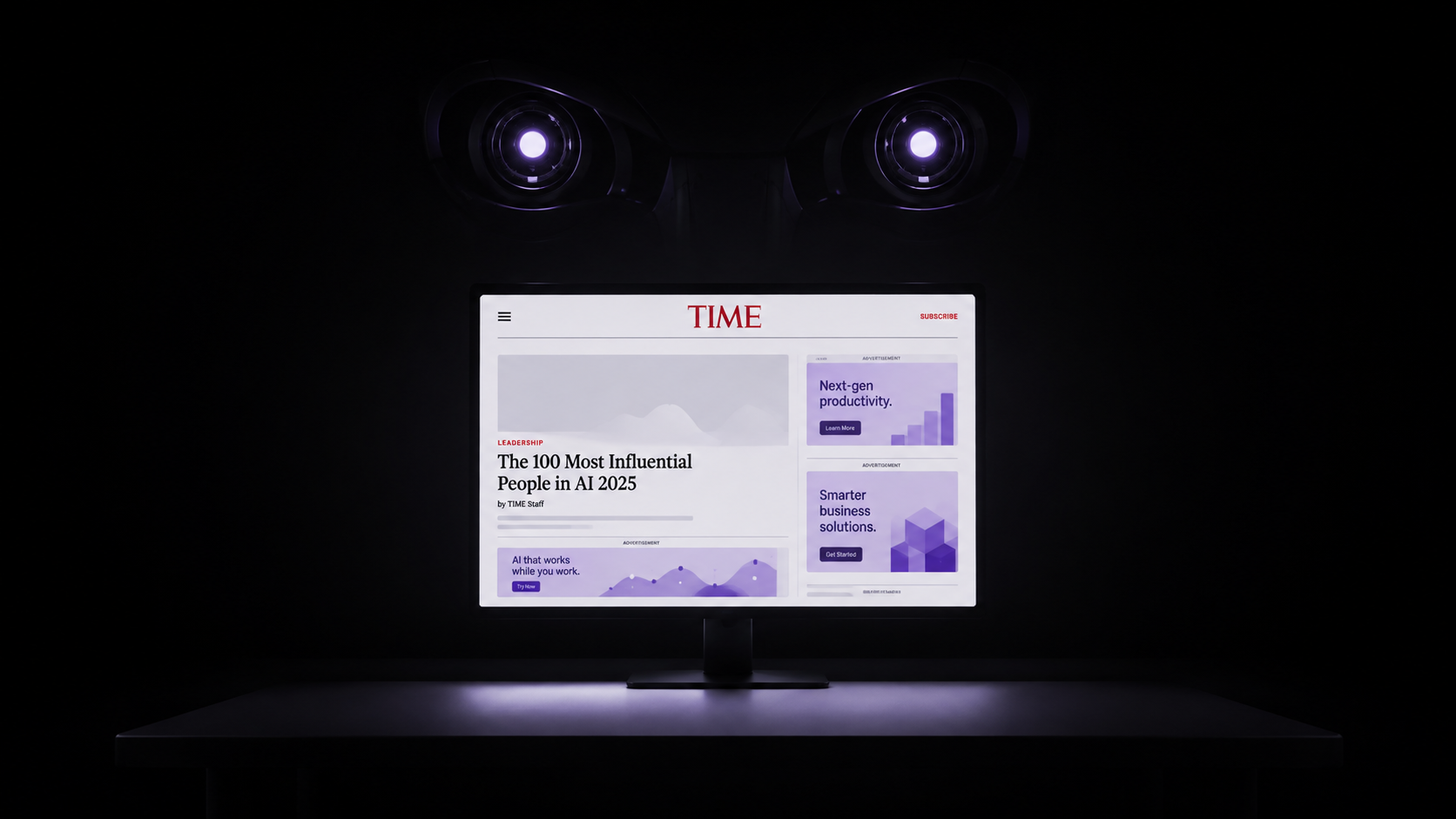
In July, TIME started running ads that no human being will ever see.
I should say up front that this is a real product with real buyers, because it reads like satire.
Here's the setup: TIME converted its webpages into markdown: plain text versions, stripped of design and images, sitting in parallel to the pages you and I read. Machines find them far easier to swallow.
Then it started selling ad slots inside those files. The ads are formatted as FAQs carrying a brand's messaging, labelled as sponsored content, one per page, sold at a premium.
TIME's COO Mark Howard says the site sees more bot traffic than human traffic on most days, and Cloudflare's data puts automated requests somewhere around 57% of web traffic.
Meanwhile, the human side keeps shrinking. AI chatbots send back a fraction of the referral traffic search used to, and plenty of publishers have watched most of their audience evaporate inside a year.
When over half your audience is machines and the other half is heading for the door, you go looking for a way to charge the machines. Any of us would.
My question, however, is narrower. Is the thing being sold actually there?
You can't sell impressions to something without eyes
"When you influence ChatGPT, you're influencing potentially all of ChatGPT."
That's Jonah Goodhart, CEO of Mobian, the adtech firm behind TIME's format, breaking down the pitch. Great line.
Notice what it promises: influence at the level of the model itself. Permanent. Systemic. Worth a premium.
Now here's what the mechanics deliver.
The AI crawlers picking up those markdown pages are mostly fetching them to answer one question, for one user, in one session. Retrieval, in other words. Nothing gets written into the model's memory. Ask the same question tomorrow and the answer might get built from a completely different set of sources.
So what a brand buys is a per-query placement priced like a permanent one, and nobody can measure it either way. No impression count. No click. No reach figure. No AI lab has said whether their systems even recognise these blocks as ads.
However, if AI labs decide this looks like cloaking, the pages get devalued, exactly the way Google devalued cloaked pages fifteen years ago. In fact, Perplexity has already taken a stance against this, saying that it’s “deceptive”.
Credit where it's due, though. Being first at something unmeasured is how most channels start. Somebody has to sell the thing before anyone can price it, and TIME is asking a question worth asking.
Bot traffic has value. Nobody's arguing that. The market just looks like it's answering with licensing instead of advertising. The key learning here for marketers? Machines aren't an audience. They're a pipeline to one: a high-intent, super-targeted form of human traffic.
OpenAI built a network. Everyone else added a format.
That's the speculative side of performance marketing, but there’s a more solid, dependable type of AI ads as well: ads inside chatbots, AI overviews, and more channels.
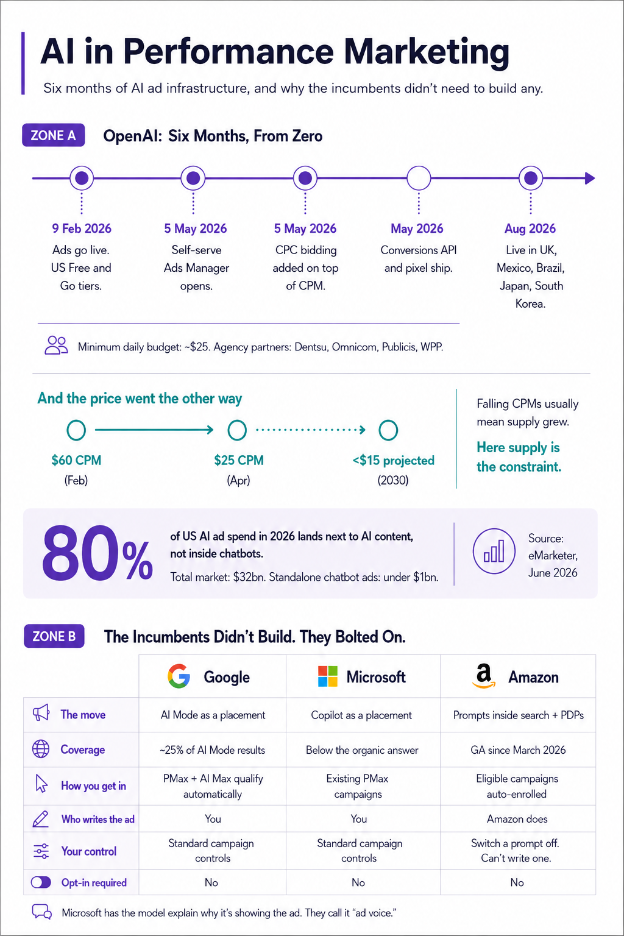
ChatGPT ads went live on 9 February 2026 for US Free and Go users. By 5 May, OpenAI had opened a self-serve Ads Manager, added CPC bidding on top of CPM, and shipped a conversions API and pixel. By August it was running in the UK, Mexico, Brazil, Japan and South Korea. Minimum daily budget sits around $25. Dentsu, Omnicom, Publicis and WPP all signed on as agency partners.
That's a lot of platform in six months and it runs straight into a wall that execution can't fix.
The ads sit beneath the answer, not inside it.
This move caps the available inventory permanently. A search results page carries four ads up top, more in shopping, more down the side, all of it scrolling past someone who came to scan a list anyway.
A chat answer, on the other hand, gives users one block of prose and one slot underneath. Push the density any higher and the conversation starts to feel bought.
US AI ad spending is set to climb from $32bn in 2026 to $68bn by 2030. But more than 80% of that sits next to AI content, mostly ordinary search ads beside Google's AI Overviews. Ads inside standalone chatbots come to under $1bn this year. Roughly 3% of the total.
ChatGPT ads launched at a $60 CPM. By April they were around $25, and are expected to fall to under $15 by 2030. Falling CPMs usually mean supply expanded, except supply here is the bottleneck, so the fall is coming from the demand side.
Now watch what the incumbents did, because they played it completely differently.
Google made AI a placement rather than a product. Ads appear in roughly a quarter of AI Mode results, and Performance Max and AI Max campaigns qualify automatically. No new campaign. No opt-in.
Microsoft ran the same play with Copilot. A PMax placement below the answer, matched against your whole conversation rather than your last message, with the model narrating why it's showing you the ad. They call it "ad voice."
Amazon went furthest. Sponsored Products and Sponsored Brands prompts hit general availability in March. Amazon writes the prompt copy itself, pulling from your detail pages, Brand Store and reviews, auto-enrols eligible campaigns, and bills clicks at your normal CPC. You can switch a prompt off. You can't write one.
Three companies with existing auctions, existing advertisers and existing budgets bolted AI on as a format. One company is building the whole network from scratch. OpenAI has the better raw material here, and I'd argue the intent quality inside a ChatGPT conversation beats almost anything else on the market.
Which brings me to the part most teams haven't clocked. You are probably already running AI ads. PMax live on Google, Microsoft or Amazon? Then you're in these surfaces right now. Nobody sent a memo. Amazon is writing ad copy in your brand's voice while you read this, and your only lever is switching individual prompts off.
Go look. Worth an afternoon.
The map hasn't been drawn yet
Fair warning, this last stretch runs on more guesswork than reporting. But there's a rhyme here I keep coming back to, and it goes about twenty years deep.
Paid search gave marketers a way to buy traffic. It also gave us the map.
Overture's keyword tool, then Google's keyword planner, produced something nobody had ever had. A query-level view of demand. Volume, competition, cost. Every organic strategy of the next two decades ran on that data. Keyword research, content clusters, topical authority, the whole discipline.
All of it built on numbers the ad system generated. Organic borrowed its map from paid.
Right now, AI search has no map.
Nobody can tell you how many people ask ChatGPT for a sunscreen that won't pill under makeup. No prompt volume. No prompt planner. The entire GEO industry runs on simulated prompt sets, where you write fifty questions you think buyers ask, loop them, and count your mentions.
So does the ad auction eventually fix this, the way AdWords did in 2003?
The case for yes. An auction can't function without telling bidders what they're bidding on. The moment OpenAI reports impressions by context, clicks and CPCs at any real granularity, marketers will reverse-engineer demand from it. We always have. And the plumbing is already going in: conversions API, pixel, CPC bidding, measurement partnerships.
The case for no, which is where I land. OpenAI's entire pitch rests on conversations staying private and advertisers seeing aggregate data only. A prompt volume tool blows a hole in that. Its ad targeting already sidesteps keywords, asking advertisers for "context hints" described as broad thematic guidance rather than exact matches.
Look at Google, who spent fifteen years quietly removing query visibility. Performance Max is opaque by design. The companies dominating AI ad spend have shown zero appetite for rebuilding the 2005 keyword planner inside a Gemini answer.
The map still gets drawn, but the difference is nobody hands it to you.
Less exciting than a prompt planner, and more annoying. The people who got good at keyword research in 2006 had the same tools as everybody else. They started earlier and built the habit while the rest of the market waited around for certainty.
Your raw material sits in the business already, mostly unexamined. What people type into your site search. The question your sales calls keep circling back to. The phrasing customers reach for in support tickets. That "how did you hear about us" field nobody reads.
Read more: The Best Content Ideas are Hidden in Your CRM
Put those in one place and you have a demand map. It won't look like a dashboard, because nobody is going to build you the dashboard.
Where that leaves you
A quick recap on where performance marketing x AI is today:
Treat bot traffic as plumbing. TIME's experiment tells you more about the squeeze publishers are in than about a channel opening up. Licensing looks like the version that sticks: pay-per-use, where content earns when it shows up in an answer. That's the thread I'd follow.
Don't rush the buy. Get ready for it. ChatGPT ads are early. Thin inventory, softening CPMs, measurement still under construction. There's no prize for being first. The prize goes to whoever has their house in order, meaning clean, structured, machine-readable information about what you sell and why it's any good, because every one of these surfaces is reading exactly that, paid and organic alike.
If PMax is running, you're in AI placements on three platforms today, and you should know what they're doing before you plan anything new.
Start building your query map. Nobody is handing you prompt volume. Collect the questions yourself, from the sources you already own, and write them down somewhere consistent. It will feel deeply unglamorous for about two quarters.
Everyone's watching the ad units, because ad units are visible and launch dates make headlines. Meanwhile TIME is selling a placement nobody can measure, OpenAI is selling inventory that barely exists, and the thing genuinely up for grabs is far less photogenic. So prepare meaningfully for the rise of the first new channel we’ve seen in almost a decade, but don’t rush into it.


