



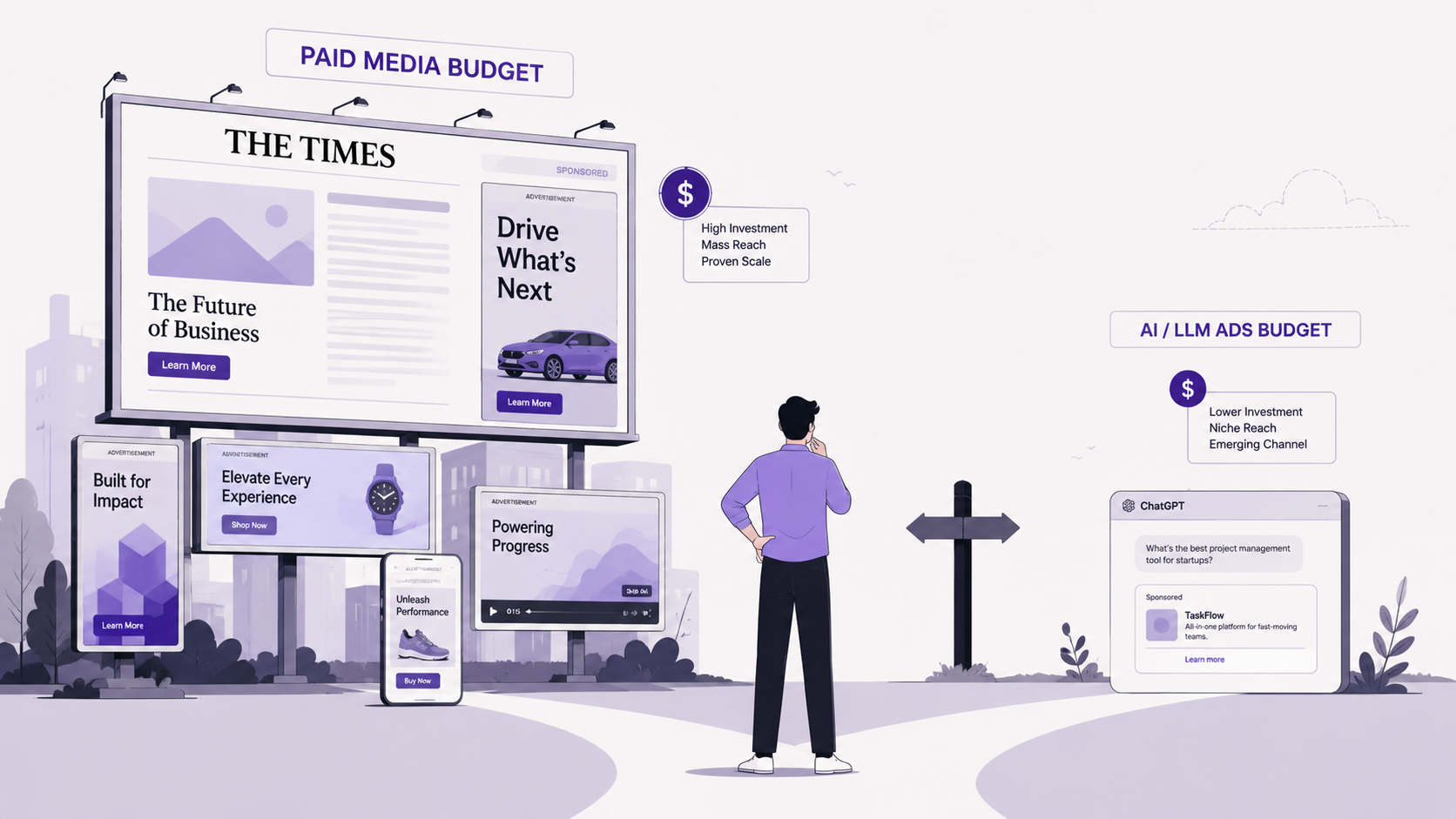
Ads arrived in AI this year, and with them a word that is about to cause a lot of expensive confusion.
"Paid."
We have argued before that paid media buys you AI visibility. A press placement, a G2 badge, a founder interview on a podcast with a transcript: money spent, citations earned, and the effect keeps running long after the invoice clears. That still holds.
What does not hold is the assumption that a ChatGPT ads budget does the same thing. It does not. Not partly, not eventually. The two run on separate machinery, and a marketer who treats them as one line item is going to fund the wrong one and wonder why the recommendation never showed up.
Here is the distinction, and then what to do about each.
Getting Cited on AI Engines
An AI assistant answering "best project management tool for a 20-person agency" is assembling a consensus from sources it already trusts. Your brand either appears in that web or it does not.
Three things move it, all of which we have covered in more detail elsewhere.
Third-party trust beats owned content. The overwhelming majority of brand mentions in AI answers originate on pages you do not control. Review platforms, forums, news, analyst write-ups. Your homepage is a witness testifying on its own behalf, which is exactly as persuasive as it sounds. More on that here.
Comparison and decision content gets cited; thought leadership does not. Models pull from the material that resolves a choice. Alternatives pages, pricing explainers, structured comparisons, case studies with actual numbers in them. The BOFU argument in full.
Your prompt list comes from your customers, not a tool. Nobody sells reliable prompt volume, and the vendors claiming to are sampling a fraction of a percent of actual usage. The questions your sales calls keep circling back to are better raw material and they cost nothing. We wrote a whole piece on mining that.
Notice what none of these have in common with an ad auction. There is no bid. There is no placement to buy. Money helps, but only by producing artefacts that other people publish about you.
Which brings us to the other lever, where money buys something quite specific and quite limited.
Running Ads on AI Platforms
ChatGPT started selling ads in February. Google built two formats into AI Mode. Amazon put sponsored placements inside Rufus. Perplexity looked at the category and walked away.
The structural rule across every platform running ads today: the ad sits below or beside the generated answer, and ad dollars do not alter what the answer says. You can win the slot and lose the recommendation in the same response, on the same query, on the same screen.
Worth knowing how small the chatbot piece actually is. eMarketer puts US AI ad spending at around $32 billion in 2026, with more than 80% of it appearing next to AI content rather than inside chatbots. Standalone chatbot advertising comes to under a billion. For most teams the AI ad budget already exists, filed under paid search, running quietly for years.
Two things to do about that, and neither of them is opening a ChatGPT ads account this week.
Audit what you are already running
On September 1, Google starts auto-upgrading Search campaigns using automatically created assets or the campaign-level broad match setting into AI Max. There is no opt-out. The email confirming the date went out on August 5, signed by nobody in particular.
At Google Marketing Live in May, Vidhya Srinivasan confirmed that eligibility for the new AI search ad formats runs through AI Max for Search or Performance Max with text customization. So the on-ramp to AI placements is the campaign type you are being moved into regardless.
If you migrate on your own schedule you choose your settings. If you wait, you inherit Google's defaults on campaigns you spent three years structuring. Pick one.
Get your website ready, for a reason that has nothing to do with SEO
This is the part most teams have not clocked.
AI Max ships with text customization and final URL expansion enabled. Which means Google generates your ad headlines from your landing pages, and picks which page to send the click to. In AI Mode, Gemini writes fresh creative per query rather than serving something you uploaded. Amazon writes Rufus prompt copy from your own pages, and you can switch a prompt off but you cannot write one.
Your website stopped being the destination. It became the creative brief.
For a B2B brand that means your solutions pages, pricing page, case studies and docs are now feedstock for ad copy you will not see before it runs. Same for the organic lever, incidentally, which is the tidy part of all this: both machines read the same pages.
They are also reading them worse than you think. Adobe ran a machine-readability check across US retail sites and found homepages averaging 75% and returns pages 82%, while the pages that actually sell scored 66%. Your returns policy is more legible to a machine than your product page, which is worth reading twice.
Five checks, none of which need a vendor:
1. Open robots.txt. GPTBot, ClaudeBot, PerplexityBot, Google-Extended. Somebody blocked one of them in 2024 during a panic. Find out who.
2. Load a key page with JavaScript disabled. If the pricing, the product name or the value proposition vanishes, so does your ad copy and your citation.
3. Read your first paragraph as a stranger. One unambiguous line saying what you sell and who it is for. Models lift this. So does Google's headline generator.
4. Check that your comparison and pricing content exists as text. Not in a PDF, not in a carousel, not baked into an image.
5. Confirm Organization, FAQ and Article schema are actually firing. Cheap, mechanical, and the thing most often silently broken after a redesign.
Where that leaves you
Two levers, two budgets, and only one of them compounds.
Money spent on mentions keeps working after the campaign ends, because the artefact stays published and stays citable. Money spent on ad placements stops the day the flight does, same as it always has, with the added indignity that the answer above your ad may be recommending a competitor.
Fund the first properly. Test the second at a size you can afford to learn from. And go read your own website the way a machine does, because two different systems are doing exactly that right now and neither of them is going to send you the draft for approval.


